
A high concentration slurry pump for tailings disposal is usually the right choice when the tailings stream is dense, abrasive, and difficult to keep moving. In most mineral processing applications, the practical answer is not simply “a larger slurry pump.” The suitable pump is typically a heavy-duty centrifugal slurry pump designed for high solids loading, fitted with wear-resistant wetted parts, and selected around the real slurry behavior rather than water-based flow assumptions.
That distinction matters. A pump that performs well with dilute slurry can lose capacity, draw excessive power, wear rapidly, or experience unstable flow when solids concentration rises. Tailings disposal systems often operate continuously and may include long pipelines, elevation changes, bends, valves, and variable feed conditions. The pump must therefore provide enough head to move the slurry through the entire system while maintaining an operating point that does not create unnecessary wear or blockage risk.
The suitable pump is usually a heavy-duty centrifugal slurry pump
For most high-concentration tailings applications, a horizontal heavy-duty centrifugal slurry pump is the preferred starting point. It is widely used because it can handle abrasive solids, offers practical access for maintenance, and can be configured with different impeller designs, liners, sealing arrangements, and drive systems.
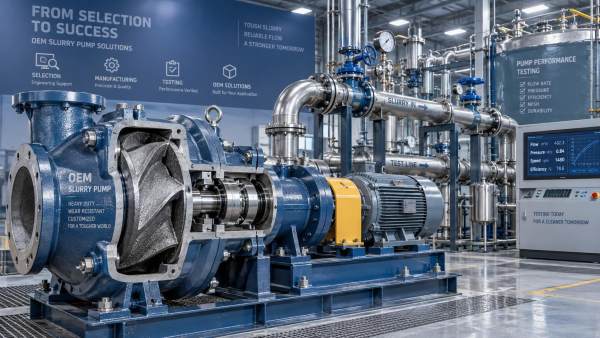
However, “centrifugal slurry pump” is only the broad category. A high-density tailings line needs a pump built for severe-duty service, not a standard water pump adapted with harder materials. The pump casing, impeller, throatbush, liners, shaft seal, bearings, and drive must all be suited to the combination of solids concentration, particle size, abrasiveness, and discharge pressure.
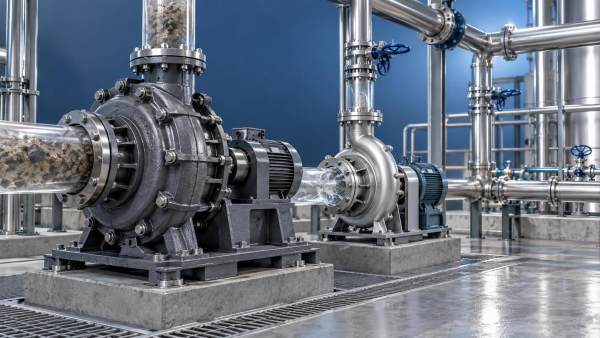
For very long transfer distances, high lift requirements, or especially dense slurry, a single pump may not be sufficient. The system may require pumps in series, a booster station, or a positive displacement pump in selected duties. The correct arrangement depends on the pipeline resistance and how the slurry behaves at the required flow rate.
Do not select from flow and head alone
Flow rate and total dynamic head are essential pump selection inputs, but they do not tell the full story for tailings disposal. A common error is to calculate a duty point as though the fluid were water, then choose a pump with the nearest water performance curve. Dense tailings change both the hydraulic losses in the pipeline and the pump’s effective performance.
As solids concentration increases, the slurry becomes heavier and may become more resistant to flow. Coarser particles can settle if velocity is too low. Fine, high-density slurries can behave more like a thick paste, especially when the solids content fluctuates or the material contains clay. These effects influence the head required, pump efficiency, power demand, and minimum operating velocity.
A reliable selection should account for the full slurry duty:
- Required throughput, including normal, minimum, and peak conditions.
- Solids concentration by weight and, where relevant, by volume.
- Particle size distribution, especially the largest particles and the proportion of coarse material.
- Specific gravity and hardness of the solids.
- Slurry chemistry, including corrosion potential and pH conditions.
- Pipeline diameter, length, elevation profile, bends, valves, and discharge point.
- Expected variation in feed density during plant operation.
- Available suction conditions and the risk of air entrainment or poor sump design.
These inputs should be considered together. A tailings stream with moderate concentration but sharp, hard particles may require stronger wear protection than a denser slurry made up mainly of fine, rounded particles. Similarly, a pump handling a short discharge line may face a different challenge from one transporting the same slurry across a long pipeline with significant elevation.
High concentration changes the pump duty in several ways
Dense slurry affects a centrifugal pump in more than one direction. It increases the energy needed to move material through the line, but it can also reduce the pump’s delivered flow and head compared with clean-water performance. The pump may need a larger impeller, a higher speed, a larger frame, or a different pump size than a water calculation would suggest.
Wear also becomes more important. Abrasive particles strike the impeller and casing surfaces at high velocity, particularly around the impeller eye, vane leading edges, throat area, and discharge zone. As the internal clearance grows through wear, pump efficiency declines and recirculation can increase. The result is often higher energy use and reduced capacity before a visible failure occurs.
For this reason, selecting a pump only for its initial duty point can be shortsighted. The pump should have enough practical adjustment range to remain workable as liners wear, slurry density shifts, or downstream resistance changes. That does not mean oversizing without limit. A severely oversized pump can run too far from its efficient operating range, create excess turbulence, and make flow control more difficult.
Wetted material selection is a service-life decision
The wet-end materials of a tailings pump deserve the same attention as pump size. For abrasive tailings, high-chrome white iron is commonly used for impellers, liners, and other wetted components because it resists sliding and impact abrasion well in many mineral processing duties. It is often a practical choice where particle erosion is the primary problem.
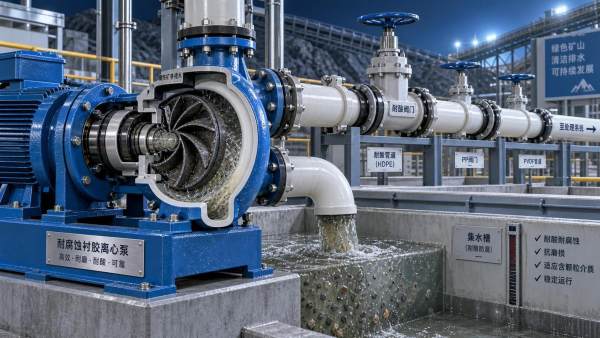
Elastomer-lined pumps can be suitable for certain fine-particle slurries, particularly where particles are not excessively sharp or large. Rubber and similar elastomers can absorb particle impact and may perform well under the right conditions. They are less suitable where sharp, coarse, or high-energy particles can cut or tear the lining.
Corrosion complicates the choice. A material that provides excellent abrasion resistance may not provide sufficient chemical resistance in an acidic or otherwise aggressive slurry. In that situation, the decision may involve corrosion-resistant alloys, elastomers, or a material combination selected for both wear and chemical exposure. There is no universal “best” material because particle shape, chemistry, temperature, and operating speed all matter.
Impeller design and passage size affect blockage and wear
Impeller geometry determines how the pump transfers energy to the slurry and how readily solids pass through it. A closed impeller can provide strong hydraulic performance in many slurry duties, but the clearances and passage dimensions must suit the expected particle size. If the passages are too narrow, oversized particles, tramp material, or accumulated debris can cause obstruction or accelerated wear.
In a tailings system with coarse solids, the pump should have adequate particle passage and a configuration that does not force material through unnecessarily tight internal paths. This is not a reason to select the largest possible passage in every case. Wider passages can reduce blockage risk, but hydraulic efficiency and wear behavior still need to be balanced.
Impeller diameter is also a practical operating variable. Many slurry pumps allow trimming or changing the impeller diameter within the pump’s design range. This can help match the pump to the actual system duty. When site conditions change, an impeller change may be more appropriate than continuously throttling a pump that is producing too much head.
The pipeline is part of the pump selection
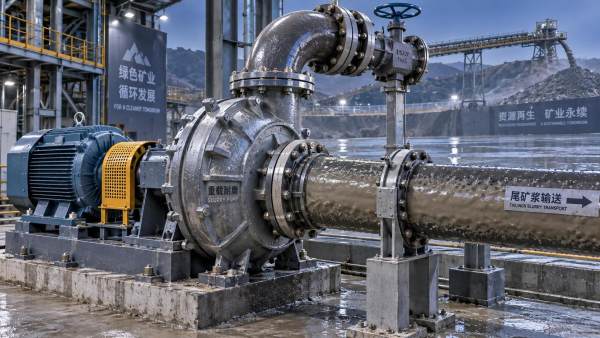
A tailings pump cannot be selected in isolation from the pipeline. In high-concentration service, pipeline velocity is particularly important. If velocity falls too low, solids can settle in low points, horizontal runs, dead legs, or areas downstream of partially closed valves. Restarting a settled line can be far more difficult than preventing deposition in the first place.
At the same time, excessive velocity increases friction losses and can accelerate wear in pipes, bends, valves, and pump components. The goal is a stable transport velocity that keeps solids suspended without imposing unnecessary energy demand and erosion. The right value depends on particle size, density, concentration, and pipeline geometry; it should not be copied from an unrelated installation.
Long lines often create a selection challenge because the required head may be high even when the flow rate is moderate. In these cases, one larger pump is not automatically the best solution. Multiple pumps in series can divide the pressure duty, improve control, and reduce the load placed on a single casing and seal arrangement. Booster pumps also make sense when the pipeline route creates pressure limitations or when an intermediate location is needed for operational control.
Sealing is not a minor detail in tailings service
The seal arrangement must suit the actual site conditions. Tailings pumps may use packed gland seals, expeller-assisted seals, or mechanical seals, depending on pump design and operating requirements. Each option has different needs for flush water, pressure control, dry-running tolerance, and maintenance.
Packed glands remain common in demanding slurry duties because they are serviceable and can tolerate conditions that would quickly damage a poorly applied mechanical seal. Their drawback is that they usually require controlled sealing water and regular adjustment. Where dilution must be minimized or seal water is limited, an expeller or mechanical seal arrangement may be considered, but the system must be designed around that choice.
A seal cannot compensate for poor suction conditions. Air entering the pump, vortexing in the sump, intermittent feed, or inadequate submergence can cause vibration, unstable performance, and seal damage. A well-selected pump still needs a properly designed feed tank or sump.
When a positive displacement pump may be the better option
A centrifugal slurry pump is not the ideal answer for every high-concentration tailings stream. If the material has very high yield stress, behaves like paste, or cannot be transported reliably at normal centrifugal pump operating conditions, a positive displacement pump may be more suitable. These pumps can generate high pressure at relatively low flow and are often considered when handling thickened tailings, paste tailings, or difficult dewatered material.
The trade-off is that positive displacement systems bring different requirements for pressure protection, pulsation management, pipework design, and maintenance. They are not simply interchangeable with centrifugal pumps. Their suitability depends on whether the slurry can still be treated as a pumpable suspension or has moved into a more paste-like transport regime.
For tailings that remain flowable but are abrasive and dense, the heavy-duty centrifugal slurry pump remains the more common and practical choice. For material that becomes highly viscous or develops a strong yield stress, the selection process should begin with slurry rheology rather than conventional slurry pump curves.
Common selection mistakes that increase operating cost
One frequent mistake is specifying the pump from nominal tonnage alone. Tonnes per hour matter, but they do not reveal solids concentration, particle size, pipeline losses, or chemical conditions. Two streams with the same dry solids rate can place very different demands on a pump.
Another error is selecting for the clean, normal operating condition while ignoring start-up, upset conditions, and density fluctuations. Tailings systems can experience changes in feed rate or water balance. A pump with no margin for those conditions may repeatedly operate near an unstable or inefficient region.
It is also risky to focus only on purchase cost. A lower-cost pump that requires frequent wet-end replacement, excessive seal water, or repeated unplanned shutdowns can be more expensive over its service life than a properly specified severe-duty unit. Wear part availability, maintenance access, bearing arrangement, and the time required to change liners or an impeller should be considered before purchase.
What to confirm before requesting a pump quotation
A useful pump enquiry should give suppliers enough information to evaluate the duty accurately. Provide the slurry flow rate, solids concentration range, solids specific gravity, particle size information, and any known chemistry concerns. Include the pipeline profile, pipe diameter and material, total length, static lift, fittings, valves, and discharge conditions.
It is equally useful to state whether the pump will operate continuously, intermittently, or in a standby arrangement. Explain whether the system must start against a full line, whether flushing is available, and whether seal water can be supplied. These operational details often determine the practical seal, drive, and control arrangement.
The right question is not simply, “Which pump handles high-concentration tailings?” It is, “Which pump configuration can keep this specific slurry moving through this specific pipeline with acceptable wear, power demand, and maintenance effort?” For most conventional dense tailings duties, that leads to a heavy-duty centrifugal slurry pump with correctly selected hydraulics, abrasion-resistant wetted parts, a suitable seal system, and a pipeline design that maintains stable transport conditions.
 Sep 22, 2026How Does an OEM Slurry Pump Custom Order Process Work?Delin OEM slurry pump custom order process: learn how duty analysis, material selection, seal options, testing, and commissioning create reliable pumps for demanding slurry applications.
- Sep 23, 2026Which Pump Is Suitable for High-Concentration Tailings Disposal?High concentration slurry pump for tailings disposal: learn how to select a heavy-duty centrifugal pump with wear-resistant materials, reliable sealing, and pipeline-matched performance.
- Sep 22, 2026How to Choose a Corrosion-Resistant Pump for Acid Mine DrainageCorrosion resistant pump for acid mine drainage: learn how to match materials, seals, hydraulics, and solids handling for longer service life.
- Sep 23, 2026Wear-Resistant vs. Standard Slurry Pumps: Which Lasts Longer?Wear resistant slurry pump vs standard pump lifespan: compare materials, wear factors, maintenance, and total cost to choose the longer-lasting solution.
Get a Quote
Please leave your information and email address, and we will contact you as soon as possible.