
Why Is My Slurry Pump's Rubber Liner Peeling?
A peeling rubber liner can reduce slurry pump performance, expose metal components to wear, and turn a planned maintenance stop into an urgent repair. Sharp particles are an obvious suspect, but they are not the only possible cause. Poor bonding, chemical attack, excessive temperature, improper installation, and flow conditions can all leave rubber lifting away from the surface beneath it.
The important distinction is between rubber that has been cut or torn by the slurry and rubber that has separated at an interface. Both may look like peeling when the pump is opened, yet they call for different corrective actions. A careful inspection of the damaged area, the slurry, and recent operating history is usually more useful than replacing the liner and hoping the problem disappears.
Start by identifying what is actually peeling
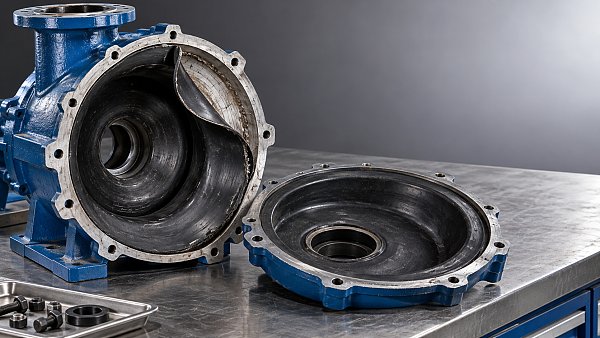
Slurry pumps use different liner constructions. Some have replaceable, molded rubber components that fit inside a metal casing; others use rubber bonded to a metal backing. A replaceable liner may move, deform, or tear at an edge without any adhesive bond failing. By contrast, a bonded lining can separate at the rubber-to-metal interface.
Before deciding on a cause, locate the failure as precisely as possible:
- Rubber lifting from metal: Examine the exposed metal and the underside of the rubber for signs of bond failure, corrosion, contamination, or chemical attack.
- A flap torn from the working surface: Look for cuts, gouges, impact damage, or an edge that may have been caught by the flow.
- Damage around joints or fasteners: Check fit, compression, alignment, and whether a liner edge was exposed to the slurry.
- Damage concentrated near an inlet, cutwater, or high-velocity area: Consider local flow, particle impact, and recirculation as well as liner material selection.
Photograph the damage before removing loose material. Record its position relative to the pump inlet, outlet, impeller, and direction of rotation. Once a torn section is removed, the evidence that explains how it started may go with it.
Can sharp particles cause a rubber liner to peel?
Yes. Sharp particles can cut into rubber rather than simply abrade its surface. A protruding fragment, coarse piece of ore, or other angular solid may make a small incision; repeated impacts can then enlarge it. If slurry gets beneath the damaged edge, the flow and further particle impacts may lift a flap of rubber.
That does not mean every peeling liner is proof that the slurry is too sharp for rubber. Rubber often performs well in suitable abrasive slurry applications, but its behavior depends on the particle size, shape and hardness, impact angle, velocity, temperature, and selected rubber compound. Large, highly angular particles or severe impact conditions may make another liner material more appropriate.
Signs that particle damage may be involved
Look for directional scratches, deep cuts, gouges, or missing chunks around the peeled area. The damaged surface may face the incoming flow, and the wear may be concentrated where particles strike or change direction. Compare the debris with the normal feed: a change in upstream crushing, screening, or process conditions can alter what reaches the pump.
Also check for foreign objects. A single metal fragment or other hard object can initiate a tear that later looks like a liner defect. If possible, retain representative slurry and debris samples for review. A visual impression alone may miss an occasional oversize particle that does disproportionate damage.
When the problem is at the bond line
For a bonded rubber lining, separation between the rubber and its metal substrate points the investigation toward the bond itself or conditions that weakened it. Inadequate surface preparation, contamination, incorrect adhesive application, or unsuitable curing during manufacture or repair can all contribute. Moisture or chemicals reaching an exposed edge may also undermine a bond over time.
The appearance of the two surfaces can provide clues. A relatively clean area of metal with rubber detached over a broad region may suggest separation at or near the interface. Rubber residue left on the metal, or rubber torn within its thickness, can indicate a different failure path. These observations are not conclusive on their own: corrosion, operating damage, and previous repairs can change the appearance.
If the bond is suspected, document the extent of separation and consult the liner supplier or a qualified rubber-lining specialist before grinding or scraping the surfaces. They may need to inspect the original interface and review manufacturing or repair records. Rebonding without establishing why the original bond failed can put the same pump back on the same failure timeline.
Chemicals, heat, and the condition of the rubber
A liner may start out securely fitted or bonded and still lose strength in service. Rubber compounds differ in their resistance to chemicals and temperature; a liner suitable for an abrasive water-based slurry may not be suitable for a process containing oils, solvents, or other aggressive substances.
Check for changes in the rubber as well as peeling. Swelling, softening, tackiness, hardening, cracking, or an unusual change in flexibility may point toward chemical or thermal exposure. These symptoms are not exclusive to one cause, so compare them with operating records and the compatibility information for the actual compound.
Pay attention to what happens outside normal operation. Cleaning solutions, temporary process chemicals, temperature excursions, and periods when slurry sits in a stopped pump can expose the liner to conditions that are absent from the usual operating description. When asking a supplier about compatibility, provide the complete fluid composition where known, solids characteristics, operating temperature, and any cleaning or upset conditions—not just the name of the main slurry.
Operating conditions that can accelerate liner failure
Even a suitable liner can be damaged by conditions that concentrate stress on a small area. The following factors are worth checking against the location and timing of the failure.
- High local velocity or turbulence: Flow restrictions, worn components, or operation away from the intended duty can increase localized erosion and expose edges to repeated impacts.
- Recirculation and cavitation: Low-flow operation or inadequate suction conditions can produce unstable flow and surface damage. Noise and vibration may be clues, but they do not prove cavitation without further assessment.
- Dry running or overheating: Loss of liquid can create heat and damage rubber components. Check whether the pump has experienced loss of prime, blocked suction, or operation without adequate fluid.
- Vibration or mechanical contact: Excessive vibration, incorrect clearances, or contact between rotating and stationary parts may damage the liner. Investigate the underlying mechanical cause rather than treating the rubber in isolation.
- Pressure and flow fluctuations: Repeated transients can stress a loose edge or already weakened area. Review operating trends and any changes in valves, controls, or upstream equipment.
A single inspection rarely identifies every contributing factor. A sharp particle may make the initial cut, for example, while turbulent flow enlarges it. Similarly, chemical softening can make rubber more vulnerable to mechanical tearing. The most reliable diagnosis connects the physical evidence with the pump’s actual duty.
How to inspect a peeling slurry pump liner safely
Do not reach into a pump or loosen its casing while it is connected to an uncontrolled system. Follow site lockout and isolation procedures, stop the pump, isolate all relevant energy and process sources, relieve pressure, and drain the casing safely. Slurry may be hot, corrosive, or otherwise hazardous, so use the site’s required protective equipment and handling procedures.
- Preserve the evidence. Photograph the liner in place, including surrounding wear, joints, and nearby pump components. Note whether loose rubber is still attached at one end.
- Map the damage. Record its location, approximate size, depth, and relationship to the flow path. Check whether damage is isolated or appears at several similar positions.
- Inspect the exposed surfaces. Look for cuts, embedded particles, corrosion, rubber residue on metal, swelling, and signs that a molded liner has shifted.
- Check adjacent components. Examine the impeller, casing, throatbush or equivalent wear parts, and joints for abnormal wear or contact. Follow the pump manufacturer’s inspection guidance.
- Review operating history. Compare the failure with changes in solids size, concentration, flow, temperature, chemicals, maintenance, and any unusual noise or vibration.
- Compare with the previous liner. Repeated damage in the same position can be more informative than a single failure, especially if the operating duty or installation method has remained unchanged.
If the liner has failed soon after installation, retain relevant part identification and installation records. If it has worn gradually over a long service period, compare the damage with the normal wear pattern for that pump and duty. Premature peeling and end-of-life wear should not automatically be treated as the same problem.
Repair or replace the liner?
The answer depends on the liner design, the extent of damage, and the consequence of another failure. A small, localized defect may sometimes be repairable with a system approved for the rubber compound and operating conditions. A large loose flap, extensive bond separation, exposed metal with substantial wear, or damage near a critical sealing area is generally a reason to evaluate replacement rather than a simple patch.
Do not assume that adhesive alone will make a lifted liner reliable. The area beneath the rubber may be contaminated, corroded, or damaged beyond what is visible. Surface preparation, repair materials, curing conditions, and inspection all matter. For a replaceable molded liner, a field-applied patch may also interfere with fit or create another exposed edge.
Use the pump and liner manufacturers’ guidance to assess the repair. Before returning the unit to service, inspect related wear parts, fit the liner correctly, and confirm clearances and assembly requirements for the specific pump. A new liner installed against a worn or damaged mating surface may fail for reasons unrelated to the rubber itself.
Prevent the next liner from peeling
Start with the cause that the evidence supports. If angular or oversize solids are cutting the liner, review upstream screening and whether the current rubber compound and liner design suit the particle characteristics. Where impact or cutting is severe, compare rubber with other available wear materials in consultation with the pump supplier; harder is not automatically better for every slurry or flow condition.
If separation occurred at a bonded interface, review the lining specification, preparation, handling, storage, and exposure history. If the liner shifted or tore at a joint, focus on fit, assembly, mating surfaces, and any exposed edges. Where chemicals or heat are implicated, verify the compound against the full range of normal and abnormal service conditions.
Finally, establish a practical inspection baseline. Record liner condition and operating hours at planned shutdowns, note changes in feed and process chemistry, and keep photographs in the maintenance history. That makes it easier to distinguish gradual wear from a new failure mechanism—and gives the next inspection a much better starting point than a peeled piece of rubber on the workshop floor.
Related Information
 Nov 08, 2026
Why Is My Slurry Pump's Rubber Liner Peeling?
Can sharp particles make your slurry pump's rubber liner peel? Discover the warning signs, other common causes, and practical ways to prevent repeat failures.- Nov 08, 2026
Do High-Chrome Pump Parts Resist Coarse, Sharp Particles?
Will high chrome pump parts resist wear from coarse, sharp particles? Discover when they perform best and how to choose the right alloy for your slurry. - Nov 07, 2026
What Factors Affect FGD Pump Lifecycle Cost?
FGD pump lifecycle cost goes beyond purchase price. Explore how energy, slurry wear, maintenance, spares, and downtime affect your total investment. - Nov 07, 2026
Froth Pump vs. Standard Slurry Pump: What's the Difference?
Froth pump vs standard slurry pump: compare air handling, performance, and selection factors to choose the right pump for your application.

{item.title}
Get a Quote
Please leave your information and email address, and we will contact you as soon as possible.