
A slurry pump custom order should begin with the slurry, not with a catalog model. Flow rate and head matter, but they do not tell the whole story. A pump that looks suitable on paper can wear out quickly, consume excess power, or suffer repeated seal failures if the solids are more abrasive, coarser, hotter, or less stable than expected.
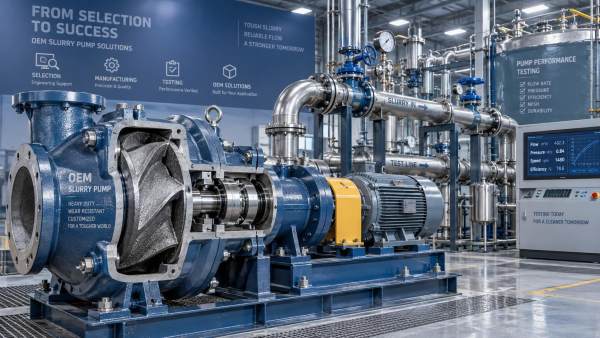
The Delin OEM slurry pump custom order process is best understood as an engineering workflow: the buyer supplies operating information, the manufacturer converts that information into a hydraulic and mechanical configuration, both sides confirm the specification, and the pump is manufactured and tested against the agreed requirements. The goal is not simply to modify a standard pump. It is to select an impeller, casing, wet-end material, seal arrangement, drive arrangement, and accessories that work together under the actual duty conditions.
This matters in mining, mineral processing, dredging, coal washing, metallurgy, sand handling, power-plant ash transport, and industrial wastewater applications. In each case, the liquid may be only part of the challenge. Particle size, solids concentration, mineral hardness, corrosiveness, temperature, and piping layout can all change what “the right pump” means.
Start with the duty conditions, not a part number
An OEM manufacturer normally begins by reviewing the pump duty. Buyers sometimes send only the existing pump model or a photo of the nameplate. That can be useful as a reference, especially when replacement dimensions must match an installed base, but it is not enough to define a custom slurry pump.
The first discussion should establish what the pump must move and where it must move it. The required flow rate, total dynamic head, operating hours, and pipeline arrangement shape the hydraulic selection. The slurry itself determines how durable and maintainable the selected configuration needs to be.
A practical inquiry should include as much of the following information as possible:
- Required flow rate, including normal and maximum operating conditions.
- Required discharge pressure or total dynamic head.
- Slurry type and the process stage where the pump will operate.
- Solids concentration by weight or volume, when available.
- Particle size distribution, especially the largest expected particles.
- Particle shape and abrasiveness; sharp mineral particles behave very differently from rounded sand.
- Liquid density, slurry density, pH, temperature, and any corrosive chemicals.
- Suction conditions, including sump level, feed pressure, pipe length, and available suction head.
- Discharge pipe size, route, elevation changes, valves, bends, and downstream equipment.
- Preferred motor power supply, drive method, installation orientation, and site limitations.
- Whether the order is for a new system, an upgrade, or a replacement that must fit existing connections.
Not every project has complete laboratory data. In that situation, it is better to state what is unknown than to present a rough estimate as a fixed condition. For example, “particle size may increase during upset conditions” is useful design information. It tells the supplier that a narrow-passage configuration may create a blockage risk.
Application analysis turns process data into a pump selection
Once the operating information is available, the OEM evaluates the hydraulic duty. The central question is whether the proposed pump will operate in a stable part of its performance curve at the required flow and head. A pump selected too far from its preferred operating region can experience vibration, recirculation, poor efficiency, and accelerated wear. A large pump with an undersized impeller may appear flexible, but it is not automatically a better solution if the duty remains far from its efficient operating range.
For slurry service, the analysis also considers the effect of solids on pump performance. Slurry usually requires more power than clean water at the same nominal flow and head. It may also reduce achievable head and alter the way the pump fills and handles particles. This is why a water-only calculation can lead to an undersized motor or an unsuitable impeller.
The supplier may recommend changes outside the pump itself. A suction line that is too small, too long, poorly supported, or full of unnecessary fittings can starve an otherwise correct pump. A discharge line with frequent sharp bends may add more resistance than expected. If the pump is replacing a failed unit, the failure history should be part of the review. Repeated bearing damage, seal leakage, cavitation marks, or uneven liner wear may point to a system issue rather than a defective pump design.
Hydraulic design and wear design are related, but they are not the same decision
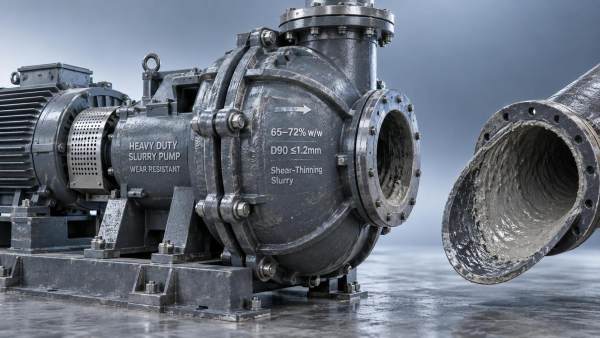
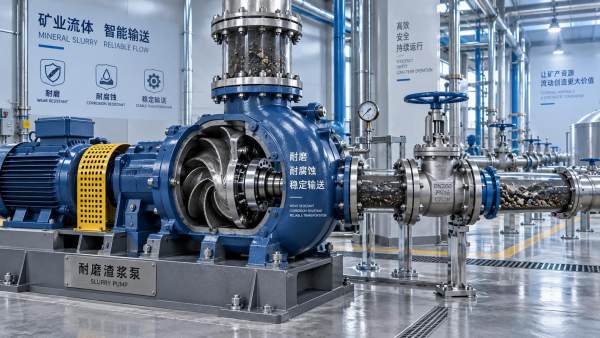
Custom slurry pump work often involves adjusting the impeller, casing, throatbush, liner arrangement, and internal clearances. These parts determine how the slurry moves through the wet end and where wear will occur. Buyers commonly focus on material grade first, but hydraulic geometry is equally important. The most wear-resistant alloy cannot fully compensate for a passage that is too tight for the solids being handled.
Coarse, high-solids slurry generally benefits from larger flow passages and a design that is less sensitive to blockage. Fine, highly abrasive slurry may call for a different balance between hydraulic efficiency and replaceable wear parts. A high-head duty can require a different impeller arrangement from a lower-head transfer application, even when the slurry is similar.
Wear clearance also needs a realistic maintenance plan. As wet-end components wear, clearances increase and pump performance can decline. Some pump designs allow adjustment to restore the relationship between the impeller and wear components. That feature is valuable only if site personnel can inspect and adjust the pump at appropriate intervals. If maintenance access is difficult, the buyer should raise that issue during the specification stage rather than treating it as an afterthought.
Select materials according to the wear mechanism
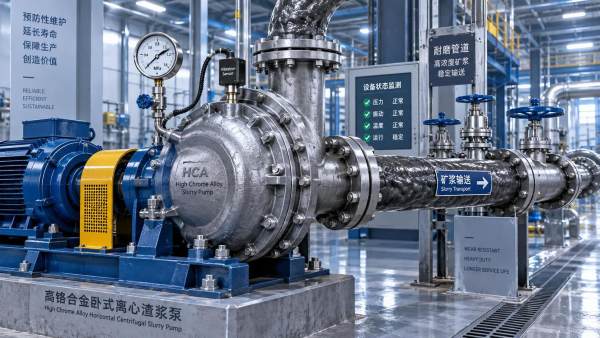
Material selection is not a simple choice between “hard” and “corrosion-resistant.” High-chrome white iron is commonly used where abrasive wear dominates. Elastomer-lined wet ends can be effective with fine particles and some corrosive or abrasive slurries, but they are not suited to every particle size, temperature, or chemical environment. Metal options with improved corrosion resistance may be needed where acidity, alkalinity, chlorides, or process reagents make standard abrasion-resistant materials unsuitable.
The correct choice depends on which mechanism is dominant:
There is no universally superior wet-end material. A configuration that lasts well in tailings service may be unsuitable for acidic process liquor, while a corrosion-focused choice may wear too quickly in a dense, sharp-grit slurry. The manufacturer needs the process conditions to make a defensible recommendation.
Mechanical configuration is where installation details become important
After the hydraulic and wet-end approach is agreed, the custom order moves into mechanical configuration. This stage determines whether the pump can be installed, maintained, and operated safely within the available space and utility conditions.
The buyer and OEM should confirm the pump orientation, inlet and outlet flange positions, baseplate dimensions, shaft direction, coupling arrangement, motor mounting, and lifting requirements. A replacement pump may need to match existing centerline heights and pipe locations. In a new installation, it may be better to optimize the layout rather than force the pump to imitate an older machine.
Seal selection deserves direct discussion. Depending on the duty, a slurry pump may use packing, an expeller-assisted arrangement, a mechanical seal, or another sealing configuration. The appropriate option depends on factors such as suction pressure, discharge pressure, availability of flush water, leakage tolerance, slurry characteristics, and maintenance capability.
Packing can be practical where controlled leakage is acceptable and regular adjustment is realistic. A mechanical seal can be appropriate where leakage control is more critical, but it must be selected for the actual slurry and support conditions. A seal plan that depends on clean flush water is a poor fit for a site that cannot provide a stable, clean supply. The best seal is the one that can operate reliably within the plant’s real constraints.
Drive selection also affects ownership cost. Direct coupling, belt drive, and variable-speed control each have a place. A fixed-speed motor may suit a stable duty. A variable-speed drive can help when throughput changes materially, but it does not solve a bad hydraulic selection. It should be evaluated along with the motor, control system, operating range, and the pump’s permissible speed.
What happens before manufacturing begins
A professional custom order should not proceed to production based on an informal description alone. Before manufacturing, the OEM usually issues a technical proposal or approved drawing package that captures the agreed scope. This may include the pump model or hydraulic size, performance duty, wet-end materials, seal type, drive details, dimensions, connection sizes, and any requested accessories or spare parts.
This review is the buyer’s best opportunity to identify mismatches. Check the stated duty against the process requirement, not just the previous pump’s nameplate. Confirm whether the quoted motor has adequate capacity for the specified slurry duty. Review flange standards, pipe directions, base dimensions, voltage, and any site-specific requirements. If the equipment must integrate with existing instrumentation, control logic, or guards, that should appear in the scope before fabrication.
One frequent mistake is treating an approved general arrangement drawing as proof that every operating condition has been considered. A drawing confirms physical configuration; it does not replace a careful review of slurry properties, suction conditions, and operating range. Both hydraulic information and installation information need to be aligned.
Manufacturing, inspection, and testing
Once the specification is approved, manufacturing begins. For a slurry pump, this typically includes producing or sourcing the casing and wet-end components, machining critical surfaces, assembling the bearing frame and shaft components, fitting the seal arrangement, mounting the drive components, and completing final assembly.
Custom work may involve changes to materials, impeller diameter, inlet arrangement, shaft seal, baseplate, or drive package. Those changes should remain traceable to the approved technical scope. If the OEM identifies a manufacturing constraint that requires a design adjustment, it should be resolved through a documented revision rather than an unrecorded substitution.
Inspection and testing should match the contract scope and the importance of the application. Typical checks can include dimensional inspection, assembly verification, rotation checks, leak checks where applicable, and performance testing when specified. Buyers should be clear about what documentation they need at delivery. A basic transfer pump order and a critical process pump for continuous production may require very different levels of documentation, witness testing, packaging, and spare-parts support.
Testing also has boundaries. Factory testing can confirm defined aspects of the assembled equipment under test conditions, but it cannot reproduce every variable of a plant’s slurry circuit. Field commissioning remains necessary to verify suction behavior, system resistance, operating speed, vibration, seal support, and actual process flow.
Delivery is not the end of the custom order process
The final stages include preservation, packing, shipment, installation, and commissioning. For equipment that will sit before installation, storage requirements matter. Moisture, dust, outdoor exposure, and long periods without shaft rotation can affect bearings, seals, and corrosion protection. The delivery package should identify lifting points, installation orientation, lubrication requirements, recommended start-up checks, and the spare parts supplied.
At commissioning, verify rotation direction before allowing the pump to run normally. Confirm that the suction line is flooded or primed as required, that isolation and discharge valves are in the intended positions, and that seal or flush arrangements are operating. Then compare actual pressure, flow behavior, current draw, vibration, and leakage with the expected duty. A gradual performance decline after commissioning often points to wear or process changes; an immediate mismatch more often indicates a system, speed, rotation, piping, or specification problem.
It is also useful to establish a baseline inspection routine early. Track wear-part condition, bearing temperature, seal behavior, vibration, and operating point. This does not require an elaborate program for every pump, but it helps distinguish normal wear from a developing failure. The first replacement interval provides practical information for future spare-parts planning and later custom orders.
Questions worth resolving before placing the order
Before issuing a purchase order, the buyer should be able to answer a few practical questions clearly: Is the stated duty based on the real pipeline and slurry, or on a previous pump selection? What is the largest particle the pump may see during abnormal operation? Which wear mechanism is expected to dominate? Can the site support the proposed seal arrangement? Must the pump fit existing connections, or can the layout be improved? Which spares would create the longest production delay if they were unavailable?
Those answers make the OEM process faster and more reliable because they prevent late changes after fabrication has started. A custom slurry pump order succeeds when the pump design reflects the process, the installation, and the maintenance reality together. The result is not merely a pump that fits the pipework, but a configuration that has a reasonable chance of delivering the required duty and wear life in the conditions it will actually face.
 Sep 22, 2026How Does an OEM Slurry Pump Custom Order Process Work?Delin OEM slurry pump custom order process: learn how duty analysis, material selection, seal options, testing, and commissioning create reliable pumps for demanding slurry applications.
- Sep 20, 2026Corrosion Resistant Pumps: A Complete Selection Guide for Chemical, Mining, and Power Generation ApplicationsLearn how to select corrosion resistant pumps for chemical processing, mining, and power generation. Compare stainless steel, duplex, high-chromium alloy, rubber-lined materials, key specifications, and sealing options for corrosive and abrasive slurry service.
- Sep 15, 2026When custom slurry pumps make sense for unusual duty conditionsCustom Slurry Pumps deliver reliable performance in abrasive, corrosive, high-temperature, and variable-duty applications. Learn when customization reduces downtime and lifecycle costs.
- Sep 14, 2026How slurry pumping solutions can lower unplanned downtimeSlurry Pumping Solutions help manufacturers cut unplanned downtime through smarter pump selection, condition monitoring, wear control, and lifecycle-focused maintenance strategies.
Get a Quote
Please leave your information and email address, and we will contact you as soon as possible.