
Are High-Chrome Alloy Slurry Pumps Worth the Higher Price?
Are High-Chrome Alloy Slurry Pumps Worth the Higher Price?
In abrasive slurry service, the cheapest pump is often only cheap on the purchase order. Once a pump is handling hard mineral particles, coarse tailings, mill discharge, ash, or dense process slurry, wear becomes the cost driver. Impeller passages open up, liners lose profile, clearances increase, efficiency slips, and a planned maintenance task can turn into an unplanned shutdown.
So, are high chrome alloy slurry pumps worth the higher price? Often, yes—but not automatically. Their value depends on what is actually wearing the pump, how severe the duty is, how expensive downtime is, and whether the pump has been selected and operated correctly. A high-chrome wet end can be a very sensible investment in a mineral processing circuit. It can also be an unnecessary expense in a mildly abrasive, corrosive, or highly variable application where another material or pump arrangement would be a better fit.
The useful way to judge the decision is not “high-chrome versus low-cost pump.” It is “what will this duty cost over the period between shutdowns?” That includes replacement parts, labor, production interruption, power use, inventory, and the practical difficulty of keeping the system running.
Why High-Chrome Alloys Cost More
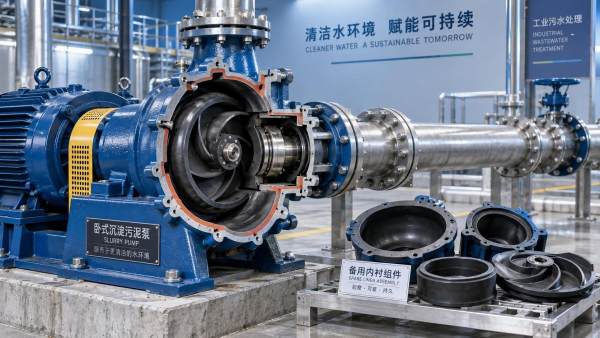
High-chrome white iron is widely used for slurry pump wet-end components such as impellers, casings, throatbushes, frame plates, and replaceable liners. The material is selected primarily for its resistance to abrasive wear. Its hard microstructure makes it well suited to slurries carrying sharp, hard particles, particularly where erosion and particle impact are the dominant failure mechanisms.
That material advantage comes with higher manufacturing and quality-control demands. Casting geometry matters. Heat treatment matters. Machining hard wear parts takes more effort. A component also has to be dimensionally consistent enough to maintain proper internal clearances. If it is not, the pump may lose performance long before the wear material itself is exhausted.
The higher price is therefore not just a label attached to “alloy.” It should reflect the quality of the wet-end design, casting control, fit-up, and the supplier’s ability to provide replacement parts that remain interchangeable over time. That last point is easy to overlook until a site needs an impeller during a short maintenance window.
Where the Extra Wear Resistance Usually Pays Back
High-chrome slurry pumps tend to make the strongest economic case in duties where abrasive wear is predictable and relentless. Typical examples include cyclone feed, mill discharge, flotation tailings, thickener underflow, sand recovery, coal washery circuits, and certain ash-handling systems. These are not necessarily the most visually dramatic services. A steady-duty pump running every day on moderately abrasive slurry can consume more parts over a year than a pump exposed to occasional severe events.
The important distinction is between abrasion and corrosion. If particles are hard and the slurry chemistry is reasonably compatible with high-chrome iron, the material can offer long service life. Where the slurry is strongly acidic, chemically aggressive, or contains conditions that promote corrosion, the answer becomes less straightforward. Corrosion can undermine a hard alloy’s wear performance, and elastomer-lined or corrosion-resistant metal options may deserve a closer look.
Particle size also changes the picture. Fine, sharp particles may create a polishing or erosive wear pattern. Larger particles can cause impact damage and passage blockage. A pump handling coarse solids needs more than hard material; it needs a hydraulic passage design appropriate for the maximum expected particle size. Installing a high-chrome impeller in a pump with an unsuitable passage is not a durable solution. It is simply an expensive component waiting to be damaged.
A practical comparison: purchase price versus operating cost
A high-chrome pump does not have to last twice as long as a lower-cost alternative to be worthwhile. If an unplanned changeout stops a milling or classification circuit, the avoided interruption may matter more than the price difference between two liner sets. On the other hand, if the pump has a true installed standby, can be changed without affecting output, and runs a relatively forgiving slurry, the financial argument for premium materials is weaker.
The Mistake of Treating “Chrome Content” as the Whole Specification
Buyers sometimes focus on a single material description and assume that it guarantees equivalent wear life. In practice, “high chrome” is not a complete pump specification. The chemistry range, casting quality, heat treatment, component thickness, hydraulic geometry, and assembly tolerances all influence field performance. Two parts described with similar material language may not behave identically in service.
Pump speed is another major variable. Running too fast may meet the required flow initially, but it can accelerate wear and increase vibration risk. Running too slowly can invite settling in pipes or poor solids transport. The best selection is generally one that meets the system duty near an efficient and stable operating region, with enough margin for foreseeable variation but not so much excess head that the pump must be throttled aggressively.
This is why a proper duty review should include more than flow and head. Solids concentration, density, particle size distribution, particle hardness, slurry temperature, pH, suction conditions, expected operating hours, and the presence of tramp material all affect the decision. In many real plants, these values are estimates rather than fixed facts. That is normal. What matters is being honest about uncertainty and selecting a design with reasonable tolerance for it.
When High-Chrome May Not Be the Best Choice
High-chrome alloy is hard, but hardness is not the only property that matters. It can be less forgiving of severe impact than some alternative materials. For a duty with large, irregular solids, frequent oversize material, or shock loading, the pump’s passage size and impact resistance deserve particular attention. A liner material that survives fine abrasive erosion very well may not be the ideal answer to repeated large-particle strikes.
Rubber or elastomer-lined configurations can be highly effective in selected fine-particle applications, especially where slurry chemistry and temperature are suitable. They are not simply a budget option. In the right duty, they can provide excellent wear performance. In the wrong duty—high temperature, coarse solids, sharp tramp, or unsuitable chemical exposure—they can fail quickly.
For corrosive chemical slurries, the material conversation may move toward stainless alloys, duplex grades, nickel alloys, specialty polymers, or other corrosion-focused solutions. The correct choice should be based on the combined effect of corrosion, abrasion, temperature, and solids. A material that looks good on a corrosion chart may still wear too fast when hard particles are introduced.
How to Assess Value Before You Buy
The most useful pre-purchase exercise is to review the current pump’s failure history. Not just how often it fails, but how it fails. Are impellers thinning at the leading edge? Are liners wearing around the cutwater? Is the throatbush repeatedly damaged? Are bearings or seals failing before wet-end components? Is the pump being operated well away from its intended duty? Wear patterns often reveal more than a generic material recommendation.
Ask the supplier or engineering team to work from the full duty rather than a nominal model-for-model replacement. A direct dimensional replacement may be necessary for plant layout reasons, but it should not prevent a review of speed, impeller diameter, liner style, seal arrangement, and drive capacity. A slightly better-matched pump can be more valuable than a more expensive alloy upgrade installed into the same flawed operating condition.
It is also sensible to separate critical pumps from non-critical ones. A cyclone-feed pump supporting a production bottleneck should be evaluated differently from a washdown sump pump with a simple standby. For critical service, spare wet-end availability and interchangeability can be as important as nominal wear resistance. There is little comfort in a long-life component if replacement parts have uncertain lead times.
Questions worth asking during pump selection
- What are the expected solids concentration, particle size range, and particle hardness?
- Is wear mainly abrasive, corrosive, impact-related, or a combination of all three?
- What does the system curve look like, and where will the pump operate most of the time?
- How much production or process capacity is lost if this pump is removed from service?
- Can the pump be maintained safely and quickly with the lifting tools and access available on site?
- Which wet-end parts should be held in stock, and are they reliably interchangeable with future replacements?
Maintenance Still Determines a Large Part of Pump Life
Premium wear materials do not eliminate the need for routine attention. They make the most difference when the pump is kept within its intended operating envelope. Clearance adjustment, seal-water management where applicable, vibration checks, bearing lubrication practices, and inspection of suction conditions all matter. A pump that cavitates, runs dry, recirculates excessively, or ingests unexpected oversize will consume even high-quality components faster than expected.
One practical habit is to record component condition at every planned inspection. Simple notes and photographs of impeller, liner, and throatbush wear can help establish a site-specific replacement pattern. That information is more useful than a generic service-life promise because it reflects the actual ore, process water, operating hours, and maintenance practices at that plant.
If wear life suddenly changes, do not assume the material quality has changed. Check process conditions first. A variation in grind size, solids density, cyclone operation, dilution water, pipe blockage, or pump speed can alter wear dramatically. The pump is often the first component to show that the upstream process has shifted.
The Bottom Line
High-chrome alloy slurry pumps are usually worth the higher price when abrasive wear is the main threat, the pump operates continuously or in a critical circuit, and the cost of maintenance interruption is meaningful. Their strongest benefit is not that they are indestructible. It is that a correctly selected high-chrome wet end can make wear more manageable, maintenance more predictable, and total operating cost easier to control.
But material alone does not rescue poor selection. Before paying a premium, confirm the slurry characteristics, operating point, particle size, corrosion exposure, and maintenance constraints. If those fundamentals point to abrasive service, high chrome is often a sound lifecycle-cost decision. If they do not, spending more on the wrong alloy can be just as wasteful as buying the cheapest pump available.
Related Information
 Oct 04, 2026
When custom slurry pumps make sense for nonstandard process duty
Custom Slurry Pumps reduce wear, blockage, downtime, and lifecycle costs in demanding nonstandard process duties. Learn when tailored pump engineering delivers measurable value.- Oct 03, 2026
Selecting pumps for flue gas desulfurization systems with gypsum slurry
Flue Gas Desulfurization Systems pump selection guide: optimize gypsum slurry handling with wear-resistant materials, reliable sealing, and lower lifecycle costs. - Oct 02, 2026
How abrasive slurry handling reduces premature impeller wear
Abrasive Slurry Handling reduces premature impeller wear through optimized velocity, material selection, suction control, and inspection strategies. Discover practical maintenance tips. - Oct 01, 2026
How mining slurry pumps affect downtime in high-wear circuits
Mining Slurry Pumps can make or break uptime in high-wear circuits. Learn how smarter selection, wear materials, and maintenance reduce failures and lifecycle costs.

Get a Quote
Please leave your information and email address, and we will contact you as soon as possible.