
When custom slurry pumps make sense for nonstandard process duty
When a process falls outside normal equipment limits, project leaders need more than a pump that meets a catalog flow point on paper.
Custom Slurry Pumps make sense when standard designs create unacceptable risks involving wear, blockage, unstable operation, downtime, safety exposure, or expensive future modifications.
The central question is not whether customization is technically possible. It is whether a tailored pump will reduce total project risk and lifecycle cost.
For project managers, that decision should be based on process evidence, operating variability, maintenance consequences, supplier capability, and the cost of getting the duty wrong.
Start With the Decision: Is Standard Equipment Truly Adequate?
A standard slurry pump is often the correct answer when the slurry properties, flow range, pressure requirements, materials, and installation conditions resemble proven applications.
Customization becomes justified when the selected standard model requires repeated compromises, such as oversized drives, unsuitable materials, extreme impeller trimming, or frequent operating restrictions.
Those compromises can appear manageable during procurement, yet they commonly transfer cost and uncertainty into commissioning, maintenance, and production operations.
Project teams should first distinguish between a difficult duty and an undefined duty. A difficult duty may need customization; an undefined duty needs better data.
Buying a custom design without credible process information can create the same uncertainty as selecting a generic pump from a catalog.
The decision should therefore begin with a structured comparison: standard configuration, modified standard configuration, and fully engineered custom slurry pump solution.
Compare each option against reliability targets, expected wear life, energy demand, maintenance windows, delivery schedule, installation constraints, and operational flexibility.
Customization is most valuable when it resolves a specific constraint that materially affects project economics, rather than simply adding features that appear technically impressive.
Process Conditions That Commonly Justify Custom Slurry Pumps
Highly abrasive solids are one of the clearest reasons to consider Custom Slurry Pumps, especially where particle hardness, angularity, or concentration accelerates wet-end wear.
Abrasive service is not defined by solids percentage alone. Particle size distribution, mineral composition, velocity, impact angle, and recirculation patterns all influence wear.
For example, a slurry containing coarse, sharp particles may require different impeller geometry and liner materials than a finer slurry with similar density.
High-density mixtures also deserve careful attention because they increase hydraulic losses, shaft loading, power demand, and the likelihood of settling during low-flow operation.
If density varies across operating campaigns, the pump must remain stable at both the expected condition and credible upset conditions.
Unusual flow requirements are another trigger. Some duties demand a narrow operating range, while others require broad turndown without repeated starts and stops.
A standard pump may achieve the design flow but operate too close to shutoff, runout, or its best efficiency point during normal process variation.
Custom hydraulic selection can align the pump curve more closely with actual operating demand, reducing recirculation, vibration, heat generation, and premature component damage.
Nonstandard pressure requirements also matter. Long pipelines, elevated discharge points, high-pressure vessels, cyclone feed systems, and multiple isolation components can create complex system resistance.
Where system head changes frequently, a pump design should account for the full operating envelope rather than only the nominal duty point.
Special material requirements may justify customization when slurry chemistry, chlorides, acidity, temperature, or oxidation risks exceed the capability of common elastomer or metal selections.
Material selection is especially important because a chemically compatible material can still fail early if it lacks the required abrasion resistance or mechanical strength.
Why Pump Duty Data Must Be More Detailed Than a Flow and Head Number
Projects frequently specify slurry pumps using only flow rate, total dynamic head, solids content, and motor voltage. That information is rarely sufficient for critical applications.
A reliable specification should include minimum, normal, and maximum flow; solids density; liquid density; particle sizing; temperature; viscosity; pH; and anticipated contaminants.
It should also define whether solids are friable, corrosive, magnetic, fibrous, sticky, or prone to segregation during storage and transport.
Project leaders should request a system curve whenever possible. This reveals how the operating point shifts as valves, piping conditions, tank levels, and downstream equipment change.
Without a system curve, pump selection may be based on an assumed static condition that does not represent real operating behavior.
Net positive suction head information is equally important. Low suction margins can produce cavitation, unstable flow, noise, vibration, and rapid loss of hydraulic performance.
For slurry service, suction design should consider not only available head but also solids settling, air entrainment, inlet geometry, and startup conditions.
Transient events deserve explicit review. Power interruption, blocked discharge, valve closure, dry running, flush cycles, and emergency shutdowns can define actual equipment requirements.
A pump that performs well during steady operation may still fail the project if it cannot tolerate foreseeable startup and upset scenarios.
Evaluate Lifecycle Cost Instead of Purchase Price Alone
Custom slurry pump proposals often carry a higher initial price. That difference should be evaluated against the cost of unplanned maintenance, lost production, spares consumption, and retrofit work.
For a critical process line, one unexpected shutdown can outweigh the apparent savings gained by selecting the lowest-priced standard pump package.
Lifecycle cost analysis should include capital cost, electrical consumption, wear parts, labor, planned outages, inventory holding, transport, and production losses from availability constraints.
Energy deserves attention because slurry pumping can be a major operating expense. Even modest efficiency improvement may create meaningful savings over continuous service.
However, efficiency should not be considered in isolation. A highly efficient hydraulic design that wears quickly or blocks easily can produce poor lifecycle results.
Wear life affects more than replacement cost. Short maintenance intervals require crews, access equipment, permits, downtime coordination, and spare-part availability.
For remote facilities, the logistical burden can be substantial. Shipping heavy components or waiting for specialty parts may turn a routine repair into a prolonged outage.
A custom design can be economically attractive when it extends service intervals, standardizes consumable components, or makes high-wear items easier to replace safely.
Project managers should ask suppliers to state assumptions behind lifecycle estimates. Transparent assumptions are more useful than broad claims about superior reliability.
Engineering Choices That Should Be Reviewed Before Approval
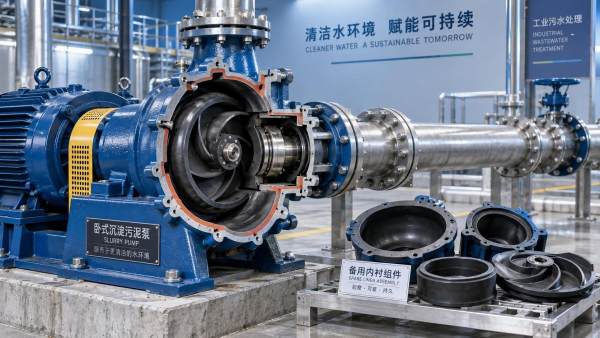
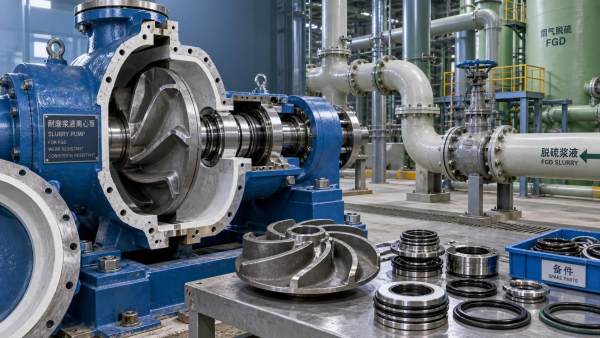
Hydraulic geometry is the first major review area. Impeller diameter, vane profile, passage size, casing shape, and speed determine efficiency, solids handling, and wear behavior.
Larger internal passages may reduce blockage risk, but they can also alter hydraulic efficiency and particle velocity. The correct balance depends on the slurry.
Operating speed influences wear, vibration, and power demand. Lower speed can improve wear life, while higher speed may reduce pump size or improve head capability.
The selected wet-end materials should be matched to the dominant failure mechanism. Abrasion, corrosion, erosion-corrosion, impact damage, and temperature effects require different approaches.
High-chrome alloys are often effective for abrasive duty, while elastomer liners may suit certain fine-particle or corrosive services. Neither choice is universally correct.
Seal selection should reflect leakage tolerance, suction stability, pressure, shaft movement, slurry characteristics, and plant maintenance capability.
Expeller seals, gland packing, mechanical seals, and water-flush arrangements each create different operating obligations. The lowest-maintenance option may require the most stable process conditions.
Bearing arrangement and shaft stiffness should not be treated as minor details. Deflection and vibration can shorten seal life, damage liners, and increase maintenance frequency.
Drive configuration also matters. Direct drive, belt drive, variable-frequency drive, and gearbox arrangements affect controllability, available speed range, maintenance, and installed footprint.
For demanding projects, request a clear description of which elements are customized and why. This helps distinguish meaningful engineering from superficial configuration changes.
How to Manage Delivery, Spares, and Commissioning Risk
Customization can introduce schedule risk when engineered components, castings, special materials, or nonstandard seals have long procurement lead times.
That risk should be managed early through supplier manufacturing plans, documented approval points, realistic lead-time commitments, and contingency planning for critical components.
Project managers should identify components that are truly unique. A custom pump with common bearings and standard motors is easier to support than a fully proprietary package.
Spare-parts strategy should be established before commissioning. Recommended inventory should reflect duty criticality, expected wear rate, supplier lead time, and site access limitations.
It is useful to separate commissioning spares from operational spares. Early operation may reveal installation issues or process variability that consume parts unexpectedly.
Acceptance testing should match the application risk. Depending on the duty, this may include hydrostatic testing, performance verification, material certification, vibration checks, or inspection records.
For complex systems, factory testing can reduce uncertainty before site installation. It cannot reproduce every slurry condition, but it can confirm core mechanical and hydraulic requirements.
Commissioning plans should include baseline measurements for flow, pressure, motor load, vibration, bearing temperature, seal-water use, and wear component condition.
Those baseline records make it easier to identify declining performance before a failure becomes disruptive. They also validate whether the selected design matches actual process conditions.
Where a Configured Standard Pump May Be the Better Choice
Not every unusual duty requires a fully custom pump. Many applications can be handled effectively with a configurable platform and carefully selected options.
This approach is often appropriate when the process is broadly conventional but requires a different liner, seal, drive speed, impeller size, or mounting arrangement.
For example, the Type DM(R) Slurry Pump may be evaluated as part of a broader selection process where a proven slurry pump platform fits the duty envelope.
A configured standard solution can offer shorter lead times, easier spares support, lower engineering cost, and more reference installations than a ground-up design.
The key is to confirm that modifications do not force the pump into an unsuitable operating region or create a maintenance burden that offsets initial savings.
Ask whether the proposed configuration has comparable operating references. Similar slurry chemistry, particle profile, head range, and service hours are more meaningful than general industry references.
Standardization also has value across a site. Using compatible equipment can simplify training, spares holdings, maintenance procedures, and long-term asset management.
Questions Project Leaders Should Ask Pump Suppliers
Begin by asking which process assumptions drive the recommended design. A credible supplier should identify the data that most affects pump sizing, materials, speed, and sealing.
Ask how the pump will perform at minimum, normal, and maximum conditions. The answer should address efficiency, absorbed power, operating margin, and expected wear implications.
Request clarity about the expected operating point relative to the best efficiency point. Continuous operation far from that region may increase vibration and hydraulic instability.
Ask which components are likely to wear first, how they are inspected, and how long replacement normally takes with site resources.
Determine whether specialty tools, lifting equipment, flush water, or trained technicians are required. Maintainability should be assessed before equipment reaches the site.
Ask for material rationale, not merely material names. The supplier should explain how the proposed combination handles abrasion, corrosion, temperature, and mechanical loading.
Review the warranty boundaries carefully. Clarify whether process variation, dry running, insufficient seal water, or solids changes affect coverage.
Finally, ask what operational data should be monitored after startup. The best suppliers help establish practical limits that protect the pump and support predictable maintenance.
Build a Clear Business Case for Customization
A strong business case connects engineering decisions to project outcomes. It explains which duty constraint exists, why standard equipment is insufficient, and what risk customization removes.
Quantify the consequences of failure where possible. Include production loss, repair labor, safety exposure, environmental risk, schedule impact, and costs associated with emergency replacement.
Then compare those consequences with the incremental cost and delivery implications of the customized solution. This creates a decision framework that executives can evaluate.
Avoid unsupported statements that a custom pump will simply last longer. Use expected service intervals, documented references, design features, and stated process assumptions.
Where process uncertainty remains high, consider phased validation. Pilot testing, conservative design margins, or modular configurations may reduce risk without overcommitting capital.
The objective is not to specify the most elaborate machine. It is to select equipment that gives the project an acceptable combination of availability, cost, and controllability.
Conclusion: Customize for Measurable Risk Reduction
Custom Slurry Pumps are justified when process conditions create risks that a standard design cannot address economically through normal configuration options.
The strongest cases involve abrasive or variable slurries, unusual hydraulic demands, restrictive installation conditions, special material requirements, or costly consequences of downtime.
Project leaders should base the decision on complete duty data, lifecycle cost, maintainability, supplier engineering evidence, and a realistic understanding of operational variability.
When customization directly improves reliability, serviceability, and process control, it is not an unnecessary premium. It is a practical investment in project performance.
Related Information
 Oct 04, 2026
When custom slurry pumps make sense for nonstandard process duty
Custom Slurry Pumps reduce wear, blockage, downtime, and lifecycle costs in demanding nonstandard process duties. Learn when tailored pump engineering delivers measurable value.- Oct 03, 2026
Selecting pumps for flue gas desulfurization systems with gypsum slurry
Flue Gas Desulfurization Systems pump selection guide: optimize gypsum slurry handling with wear-resistant materials, reliable sealing, and lower lifecycle costs. - Oct 02, 2026
How abrasive slurry handling reduces premature impeller wear
Abrasive Slurry Handling reduces premature impeller wear through optimized velocity, material selection, suction control, and inspection strategies. Discover practical maintenance tips. - Oct 01, 2026
How mining slurry pumps affect downtime in high-wear circuits
Mining Slurry Pumps can make or break uptime in high-wear circuits. Learn how smarter selection, wear materials, and maintenance reduce failures and lifecycle costs.


Get a Quote
Please leave your information and email address, and we will contact you as soon as possible.