
Is Delin a Slurry Pump Manufacturer Worth Considering for Export?
Delin may be worth considering as a slurry pump supplier for export if its proposed equipment matches the duty, the commercial terms cover the full scope of supply, and support is practical in the destination market. The decision should rest on a specific pump proposal rather than a catalog listing: a pump that appears suitable by size or price can still be costly if it wears quickly, needs unavailable spare parts, or cannot operate reliably within the existing system.
For an international purchase, ask Delin to respond to the same technical specification you would give any competing supplier. Then compare the complete offer: the selected pump and materials, performance at the required duty, documentation, delivery responsibilities, and the arrangements for commissioning and replacement parts.
Start with the slurry and the operating duty
A slurry pump moves liquid containing suspended solids, but that description covers very different applications. Fine mineral tailings, coarse sand, mill discharge, and corrosive process slurry can place different demands on the pump. A suitable selection depends on what is being pumped and how the installation operates, not simply on pipe diameter or the volume of the tank.
Provide the intended flow rate and total dynamic head, along with the range over which the pump will operate. Total dynamic head includes the static lift and the pressure losses the pump must overcome through the piping and equipment. If the slurry settles readily, the required flow range also needs to account for keeping solids moving in the pipeline. An oversized pump is not automatically safer: operation far from its intended range can increase wear, vibration, and energy use.
The supplier also needs a useful description of the solids. Include the expected concentration, particle size range, particle shape where known, and whether the material is abrasive or tends to settle. State whether concentration is expressed by weight or by volume; the two are not interchangeable. Temperature, pH, and any corrosive chemicals matter because wear and corrosion can act together.
For example, a pump handling relatively fine tailings may call for different wear materials and operating speeds from one moving coarse, sharp particles. If the feed changes between normal operation and upset conditions, provide both. A proposal based only on average conditions may not address the periods that cause the most damage.
What a useful pump proposal should show
Ask for the selected pump’s performance curve and the proposed operating point. The curve should make it possible to see how flow, head, efficiency, and power change across the operating range. The supplier should explain how the properties of the slurry have been considered, since performance information for clean water alone does not describe every slurry duty.
Look beyond the rated point. If the process will run at reduced flow for long periods, ask how the pump is expected to behave there. If the pipeline may be extended or the solids concentration may rise, ask whether the selection has room for those changes. A pump that works at one carefully defined point may be less suitable for a process that routinely moves away from it.
The proposal should also identify the motor rating, speed, drive arrangement, and expected power requirement at relevant operating conditions. The motor must suit the electrical supply at the destination and have sufficient capacity for the duty, including conditions that can increase load. A variable-speed drive can help adjust output when the process demands it, but the operating range still has to respect the pump’s hydraulic and mechanical limits.
Suction conditions deserve particular attention. The pump needs adequate pressure at its inlet to avoid cavitation, which can cause noise, vibration, reduced performance, and component damage. Share the suction tank level, pipe layout, liquid temperature, and any restrictions or fittings. Where solids can settle, the suction arrangement should also support a steady flow into the pump. A suitable pump cannot compensate for a poorly designed inlet.
Match wear materials and seals to the service
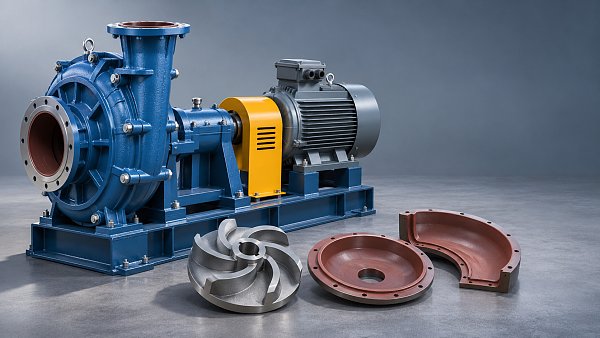
Slurry pump life is strongly affected by the relationship between the pumped material, the wetted components, and operating speed. When reviewing a Delin proposal, ask which material is offered for the impeller, casing or liners, and other parts in contact with the slurry. Request the reasons for those choices in relation to abrasion, particle size, corrosion, and temperature.
Hard metal components are commonly considered for abrasive duties, while elastomer linings can be useful in some services involving finer particles and suitable chemicals. Neither is a universal choice. Coarse or sharp solids, chemical attack, and temperature can change the result. The most wear-resistant material on paper may not be the best commercial choice if it is difficult to obtain, expensive to replace, or unsuitable for the actual solids.
Sealing deserves the same attention. Depending on the pump design and process, options may include packed glands, mechanical seals, or other sealing arrangements. Packing can require gland water and routine adjustment; a mechanical seal may need a compatible flush or support arrangement and careful protection from unsuitable operating conditions. Ask what utilities are required, their acceptable quality and pressure, and what happens if the supply is interrupted.
Also establish how maintenance will be carried out. Space around the pump, lifting equipment, liner replacement, and access to the seal can affect downtime. A drawing showing maintenance clearances is more useful than overall dimensions alone when the pump must fit into an existing plant.
Assess manufacturing scope and the exact supply package
The word “manufacturer” does not by itself explain which parts of an order a supplier will make, source, assemble, or test. For a Delin slurry pump quotation, request a clear scope covering the pump, motor, baseplate, coupling or belt drive, guards, instrumentation, and any control equipment. If the order includes components from other suppliers, the proposal should identify them and explain who is responsible for coordinating the complete assembly.
For a replacement pump, dimensional fit can be as important as hydraulic fit. Ask for an arrangement drawing with flange locations, mounting dimensions, shaft orientation, and service clearances. If a pump is described as interchangeable with an existing unit, specify the exact parts or dimensions that must match. Similar model descriptions do not establish that a complete pump or its internal parts will fit.
Discuss inspection before placing the order. Depending on the project, the agreed plan may include dimensional checks, material identification, pressure testing of relevant components, or a performance test. State which results must be documented, whether the buyer or an independent inspector may witness particular checks, and what acceptance criteria apply. A test is most useful when the parties agree on its scope and conditions in advance.
Export readiness includes the journey and the paperwork
A competitive pump price can change substantially once packing, freight, insurance, import charges, site delivery, and handling are included. Compare offers using the same delivery point and scope. The agreed trade term should establish which party arranges and pays for each stage of transport and where the risk transfers; it does not replace a detailed discussion of unloading, customs clearance, or local delivery.
Heavy pump assemblies may need robust packing, corrosion protection, and clear lifting instructions. Ask whether the pump and motor will ship assembled or separately, the expected package dimensions and weights, and any storage or preservation requirements if installation is delayed. These details affect freight planning and the equipment needed at the receiving site.
Documentation should be part of the purchase order, not an assumption. Depending on the destination and project, the package may need commercial documents, a packing list, drawings, material records, test reports, operating instructions, and documents required for customs or local acceptance. Agree on the language, number of copies, electronic format, and delivery schedule. Where local electrical or machinery requirements apply, identify the equipment and evidence the project needs before the order is finalized.
Plan for spare parts before the pump ships
For an imported slurry pump, the first replacement impeller or liner may matter more than a small difference in initial price. Wear rates depend on the duty, so a supplier should avoid promising a service life without an agreed basis. Instead, ask for a parts breakdown, recommended initial spares, individual part prices, and an explanation of which components are expected to wear or require routine replacement.
Consider the cost of a stoppage when deciding what to hold on site. A plant with a standby pump and an accessible local distributor may accept a different inventory from a remote operation with one critical pump. Lead times for spare parts should include transport and import processing, not just production time. Establish how parts will be identified later, especially if materials, seals, or dimensions differ from a standard configuration.
After-sales support should also have a defined route. Ask who handles technical questions, how quickly a response is expected, whether remote commissioning assistance is included, and what arrangements exist if site attendance is needed. The warranty should state its duration, coverage, exclusions, and claim procedure. In particular, agree how a disputed failure will be assessed and who pays for shipping, inspection, and replacement work.
When does Delin make sense for the shortlist?
Delin is a reasonable candidate when its proposal addresses the actual slurry duty, identifies the materials and support equipment, and gives clear answers on export delivery and ongoing parts supply. The case is stronger when the supplier can provide the drawings and inspection records the project needs within the purchasing schedule.
Proceed cautiously if the offer is based only on a pump size, leaves the seal-water requirements unresolved, or relies on vague claims of interchangeability. A lower purchase price may still be attractive, but only after allowing for modifications, spare parts, freight, and the consequences of downtime. For a time-sensitive installation, limited access to replacement parts or technical support can outweigh the initial saving.
The most useful next step is to prepare one duty sheet and send it with the same scope of supply to each shortlisted supplier. Compare the returned operating points, material selections, drawings, exclusions, delivery terms, and support commitments side by side. That gives the decision a practical basis and exposes differences while they can still be resolved in the order.
Related Information
 Nov 17, 2026
Is Delin a Slurry Pump Manufacturer Worth Considering for Export?
Is Delin a slurry pump manufacturer worth considering for export? Compare pump selection, shipping terms, spare parts and support before you buy.- Nov 17, 2026
How Good Are Delin's High-Chrome Alloy Pumps?
Explore Hebei Delin Machinery high chrome alloy pump quality, from wear resistance to testing and maintenance, and find out what to verify before you buy. - Nov 16, 2026
How Much Do Delin Cement Slurry Pumps Cost?
Hebei Delin Machinery Co. cement slurry pump costs depend on duty and configuration. Explore key price factors and learn how to request a reliable quote. - Nov 16, 2026
Is Delin a Reliable Metallurgical Slurry Pump Supplier?
Comparing Ltd. cement slurry pump prices? Discover how to assess Delin’s pump selection, durability, spare parts, and support before you buy.

{item.title}
Get a Quote
Please leave your information and email address, and we will contact you as soon as possible.