
Selecting pumps for flue gas desulfurization systems with gypsum slurry
Selecting Pumps for Flue Gas Desulfurization Systems with Gypsum Slurry
Selecting the right pumps for Flue Gas Desulfurization Systems is critical when handling abrasive gypsum slurry, where reliability, wear resistance, and lifecycle cost directly affect project performance.
For project managers and engineering leaders, pump selection must balance slurry characteristics, flow requirements, materials of construction, and maintenance access throughout the plant operating life.
This guide explains the technical and commercial factors that should drive pump specifications for efficient, dependable gypsum slurry handling in modern FGD installations.
Start with the Project Risks That Matter Most
The core search intent behind pump selection for Flue Gas Desulfurization Systems is practical: identify equipment that will meet duty requirements without creating excessive downtime or maintenance costs.
Project leaders are rarely looking for a generic pump definition. They need a defensible basis for selecting equipment under abrasive, corrosive, and highly variable operating conditions.
Gypsum slurry pumping failures can delay commissioning, reduce sulfur dioxide removal performance, increase spare-parts consumption, and create unplanned shutdowns that affect broader plant availability.
The best selection process therefore begins by identifying the consequences of failure at each pumping location, rather than treating every slurry service as identical.
Critical services often include absorber bleed pumps, gypsum discharge pumps, hydrocyclone feed pumps, underflow pumps, and dewatering transfer pumps serving filtration equipment.
Each duty has different flow stability, pressure, solids concentration, particle-size distribution, and standby requirements. These differences should be captured before suppliers propose pump models.
For project managers, the central question is not simply which pump has the lowest purchase price. It is which configuration offers predictable performance during its planned service interval.
That assessment should include expected wear life, repair duration, spare-parts availability, energy consumption, sealing reliability, and the operational impact of a pump outage.
A technically suitable pump can still become a poor project decision when it requires difficult maintenance access, specialized lifting equipment, or frequent wet-end replacement.
Define the Gypsum Slurry Before Selecting the Pump
Accurate slurry data is the foundation of pump selection. A pump designed for clean water will not provide reliable guidance for gypsum slurry service.
Specifications should identify solids concentration by weight, slurry density, maximum particle size, particle hardness, particle shape, temperature, pH range, and expected chemical composition.
In many Flue Gas Desulfurization Systems, gypsum crystals are not uniformly sized. Fine particles may coexist with larger crystals that accelerate localized wear in impellers and liners.
Solids concentration often changes between normal operation, startup, upset conditions, and dewatering cycles. Designers should select against credible maximum conditions, not only nominal laboratory values.
Density affects both hydraulic power and mechanical loading. As density rises, the pump requires more input power to deliver the same volumetric flow and head.
Particle hardness strongly influences wet-end material selection. Abrasion-resistant high-chrome alloys may be appropriate for some duties, while rubber-lined designs suit other chemical and particle conditions.
Corrosion must be evaluated alongside erosion. Chloride content, acidic excursions, oxidation conditions, and chemical additives may limit the suitability of otherwise wear-resistant metallic materials.
Project teams should request operating data from similar plants whenever possible. Actual slurry behavior in comparable FGD applications is usually more valuable than generic material assumptions.
When slurry information remains uncertain, the specification should state assumptions clearly and require suppliers to identify how those assumptions affect guarantee conditions and wear-life estimates.
Match Hydraulic Duty to Real Operating Conditions
Hydraulic sizing should be based on the complete system curve, including static lift, pipeline friction, valves, fittings, cyclones, filters, and anticipated fouling allowances.
A frequent project mistake is selecting a pump precisely at the expected duty point. This leaves inadequate margin when slurry density or pipeline resistance increases.
At the same time, excessive design margin can force a pump to operate far from its best efficiency point, increasing vibration, recirculation, and component wear.
For most slurry services, the preferred operating point should remain close to the pump’s best efficiency region across the likely range of operating scenarios.
Engineering teams should review minimum, normal, maximum, startup, and upset flow cases. A single nominal flow value rarely represents the true duty profile.
Variable-speed drives can improve flexibility when flow requirements change materially. However, the pump curve, motor rating, minimum speed, and control philosophy must be coordinated carefully.
Net positive suction head available must be checked under unfavorable conditions, including low tank level, elevated temperature, high-density slurry, and potential suction-line restrictions.
Inadequate suction conditions may produce cavitation, vibration, noise, loss of capacity, and rapid impeller damage. These risks are especially costly in abrasive slurry applications.
Where practical, use flooded suction arrangements, short suction piping, smooth transitions, and sufficiently sized lines to reduce losses and improve stable pump operation.
Select Wet-End Materials for Wear Life, Not Initial Cost
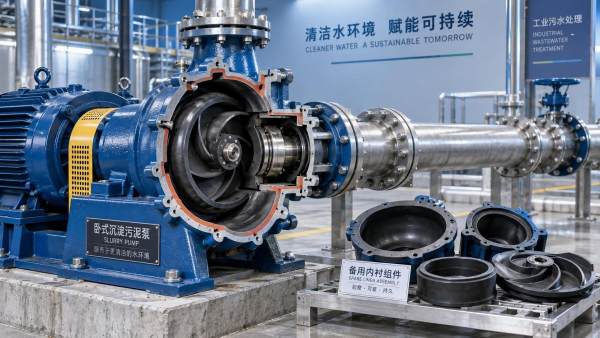
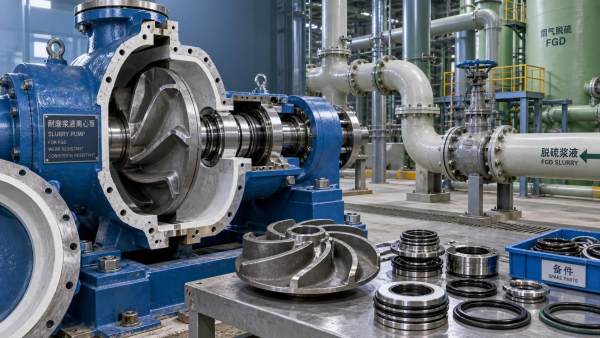
The wet end is usually the primary wear zone in gypsum slurry pumps. Its material selection determines replacement frequency, hydraulic efficiency retention, and maintenance expenditure.
High-chrome white iron is commonly used for abrasive slurry service because it provides strong resistance to erosion under many gypsum handling conditions.
Elastomer linings can offer advantages where particle size is relatively fine, impact loads are lower, and chemical conditions support the selected rubber compound.
Neither material family is universally superior. The right choice depends on slurry chemistry, solids size, pressure, temperature, pump speed, and required service interval.
Project specifications should require suppliers to identify materials for impellers, liners, throatbushes, casing components, shafts, sleeves, and fasteners rather than offering vague wear-resistant claims.
Wear-life estimates should be tied to stated slurry conditions. A supplier’s expected life figure is less meaningful when operating concentration and particle characteristics are unspecified.
Consider whether the design allows adjustment of impeller clearance. Controlled clearance restoration can extend useful operating life and delay major wet-end replacement.
However, maintenance teams need safe access and clear procedures for these adjustments. A theoretically maintainable design adds little value if adjustment requires extensive disassembly.
Include corrosion allowances where chloride-rich liquor or chemical fluctuations are possible. Material degradation can alter clearances and reduce structural reliability before visible wear appears severe.
Choose Sealing and Valve Arrangements as a System
Seal selection should reflect the consequences of leakage, the availability of flush water, slurry pressure, environmental requirements, and maintenance capabilities at the site.
Expeller-based dynamic seals may reduce dilution needs in selected applications, while mechanical seals can provide controlled containment where operating conditions justify their complexity.
Packed gland seals remain practical in many slurry duties, but they require reliable seal-water quality, flow monitoring, and maintenance discipline to prevent accelerated sleeve wear.
Seal water is not free. It affects water balance, wastewater treatment loading, operating cost, and potential process disruption when supply quality or pressure becomes inadequate.
Isolation valves must also tolerate slurry service. Standard valves can seize, leak, or erode rapidly when exposed to abrasive gypsum solids and settling conditions.
For pump isolation and maintenance shutdowns, a 2.Leak-free High Wear-resistant Knife Gate Valve(Enhanced Type) can support a more dependable slurry handling arrangement where its pressure and material ratings match the duty.
Valve placement should permit safe isolation, drainage, flushing, and inspection. Avoid layouts that trap slurry in dead legs or require personnel to work beneath suspended equipment.
Project managers should review the pump, seal, valve, flushing, and drain arrangement together. A reliable pump cannot compensate for a poorly designed surrounding system.
Design for Maintenance Access and Faster Recovery
Maintenance accessibility is often undervalued during procurement, even though it has a direct effect on outage duration, labor cost, and plant availability.
Specify whether the pump must permit back-pull maintenance, liner replacement, impeller adjustment, or seal servicing without removing major pipework or disturbing adjacent equipment.
Provide sufficient clearance for lifting devices, casing removal, motor handling, and safe personnel movement. Congested layouts turn routine maintenance into a major shutdown event.
Heavy slurry pump components require a defined lifting plan. Beam capacities, lifting points, crane coverage, and component weights should be confirmed during detailed engineering.
Standardizing pump sizes where duty conditions permit can reduce spare inventory, simplify technician training, and improve recovery time after unexpected equipment failure.
However, standardization should not force an unsuitable pump into a critical service. Hydraulic and material suitability must remain the first selection criteria.
For each pump category, establish recommended capital spares, operating spares, and wear-part stocking levels based on lead time and expected consumption.
Long-lead wet-end components can create disproportionate availability risk. Procurement planning should consider supplier manufacturing capacity, logistics routes, and regional service support.
Ask suppliers for typical replacement durations and tools required. These details help project teams compare maintainability beyond broad statements about simple design.
Evaluate Total Cost of Ownership, Not Only Bid Price
Lowest-cost bids can become expensive when lower wear life, inefficient operation, frequent seal failures, or limited spare availability drive recurring operating costs.
A lifecycle comparison should include purchase price, installation requirements, motor energy, expected wet-end replacements, labor, seal-water use, inventory, and production losses from downtime.
Energy should be evaluated at actual operating conditions, not only at the quoted best efficiency point. Off-design operation can create material annual power penalties.
Wear parts should be compared by expected hours, replacement cost, and replacement duration. A cheaper liner has limited value if it requires frequent outages.
Availability analysis is particularly useful for high-consequence services. It quantifies whether duty-standby configuration, installed spares, or upgraded materials reduce overall project risk.
For critical pumps, evaluate whether a full standby unit is justified. In lower-risk services, rapid replacement capability may provide a more economical solution.
Contract documents should define performance guarantees, test requirements, documentation deliverables, warranty terms, and responsibilities when field slurry conditions differ from declared data.
Clear acceptance criteria reduce disputes during commissioning. They also give project managers a structured basis for comparing technically different supplier proposals.
Build a Procurement Specification Suppliers Can Actually Price
A strong specification prevents ambiguity and makes bid comparisons more meaningful. It should define process data, duty points, design cases, materials, sealing, instrumentation, and testing requirements.
Require pump curves showing efficiency, power, NPSH required, minimum continuous stable flow, and operating ranges for the proposed impeller diameter and speed.
Suppliers should state the recommended operating point relative to best efficiency point and identify any expected restrictions associated with low-flow or high-flow operation.
Specify motor service factor, enclosure, voltage, hazardous-area classification where applicable, drive type, coupling guard requirements, and vibration monitoring needs for critical services.
Documentation should include general arrangement drawings, foundation loads, nozzle loads, weights, maintenance clearances, recommended spares, materials lists, and installation instructions.
Factory testing may include hydrostatic testing, mechanical run testing, and hydraulic performance testing. The required test standard should be stated before purchase order release.
For especially demanding duties, request references from comparable gypsum slurry installations. Confirm operating hours, maintenance intervals, seal arrangement, and actual wear-part experience.
Do not rely only on nominal capacity and head when comparing bids. Review the proposed equipment against every stated process condition and maintenance requirement.
Use Commissioning Data to Protect Long-Term Performance
Pump selection does not end when equipment arrives on site. Installation quality and commissioning discipline strongly influence the expected service life of slurry pumps.
Verify piping alignment, suction cleanliness, foundation condition, rotation direction, lubrication, seal-water supply, valve positions, and instrumentation calibration before initial operation.
During commissioning, record flow, discharge pressure, motor current, vibration, bearing temperature, seal condition, and slurry density at several operating points.
These baseline records help maintenance teams detect progressive wear, blockage, changing system resistance, and deviations from the original design assumptions.
Trend hydraulic performance over time. A gradual loss of head or efficiency may indicate impeller wear, liner deterioration, internal recirculation, or changing slurry properties.
Planned inspections should be based on actual operating evidence, not only fixed calendar intervals. Condition-based maintenance can reduce unnecessary shutdowns while avoiding catastrophic wear-through.
After the first operating campaign, update the spare-parts strategy using real consumption data. This creates a stronger basis for future projects and plant expansions.
Conclusion: Make Pump Selection a Lifecycle Decision
Reliable pumps for Flue Gas Desulfurization Systems are selected by understanding gypsum slurry behavior, matching hydraulic duty carefully, and choosing materials that resist actual wear mechanisms.
For project managers, the most useful decision framework combines process risk, maintenance access, energy use, standby philosophy, supplier capability, and long-term replacement costs.
The right pump is not necessarily the most expensive or the most heavily specified option. It is the solution that delivers stable duty with manageable lifecycle risk.
When specifications are based on credible slurry data and verified operating scenarios, project teams can reduce commissioning uncertainty, improve plant availability, and control total ownership cost.
Related Information
 Oct 03, 2026
Selecting pumps for flue gas desulfurization systems with gypsum slurry
Flue Gas Desulfurization Systems pump selection guide: optimize gypsum slurry handling with wear-resistant materials, reliable sealing, and lower lifecycle costs.- Oct 02, 2026
How abrasive slurry handling reduces premature impeller wear
Abrasive Slurry Handling reduces premature impeller wear through optimized velocity, material selection, suction control, and inspection strategies. Discover practical maintenance tips. - Oct 01, 2026
How mining slurry pumps affect downtime in high-wear circuits
Mining Slurry Pumps can make or break uptime in high-wear circuits. Learn how smarter selection, wear materials, and maintenance reduce failures and lifecycle costs. - Sep 30, 2026
Selecting coal washing pumps for fine coal recovery circuits
Coal Washing Pumps for fine coal recovery: learn how to select reliable slurry pumps for stable pressure, longer wear life, efficient dewatering, and lower downtime.

Get a Quote
Please leave your information and email address, and we will contact you as soon as possible.