
Acid mine drainage demands a pump selection process built around the actual liquid, not a generic acid rating. Water from mine workings, waste rock, tailings areas, or collection channels can combine low pH, dissolved iron and other metals, chloride or sulfate ions, suspended grit, and changing flow conditions. A pump that withstands a clean laboratory acid may fail early when solids wear through a lining, deposits lock a seal face, or intermittent operation allows corrosive liquid to remain in the casing.
Start by defining the fluid at the pump suction under normal, low-flow, and upset conditions. The most useful information includes pH range, temperature, dissolved metal content, sulfate and chloride concentration, suspended-solids concentration, particle size and hardness, density, viscosity, gas content, and the expected variation over time. A single sample is rarely enough when runoff, groundwater, process water, and neutralization streams can mix. The pump material must tolerate the most damaging credible condition, while the hydraulic design must handle the flow range without operating too far from its efficient region.
Characterize the liquid before selecting materials
pH alone does not define corrosion severity. Two streams with the same pH can behave very differently because dissolved oxidizing salts, chlorides, temperature, and aeration alter the corrosion mechanism. Ferric iron can increase oxidizing conditions. Chloride contamination can challenge alloys that perform well in sulfate-rich service. A hot, oxygenated liquid is often more aggressive than a cool, stagnant one of similar acidity.
Solids deserve equal attention. Fine precipitates can erode narrow passages and settle in seal chambers. Coarser quartz-bearing particles cause abrasive wear at impeller vanes, throat areas, volute cutwaters, and wear liners. If the liquid contains both acid and abrasive solids, choosing a highly corrosion-resistant but soft material may create a short wear life. Conversely, a hard abrasion-resistant metal may be unsuitable if the chemistry attacks it rapidly.
Record where the sample was taken. Fluid chemistry at a collection sump may differ from chemistry at the pump inlet after residence time, agitation, dilution, or chemical addition. When lime or another neutralizing reagent is injected upstream, local zones of higher pH and newly formed precipitates can occur before the bulk liquid is fully mixed. Those local conditions affect clogging, scaling, seal performance, and material selection.
Match the wetted materials to the real failure mechanism
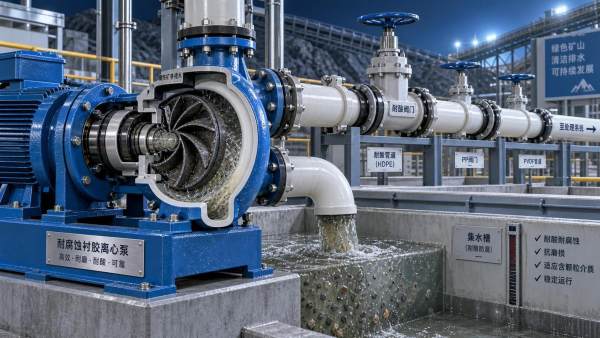
A corrosion-resistant pump for acid mine drainage commonly uses polymer, elastomer-lined, alloy, or composite wetted components. The correct choice follows the combination of chemistry, temperature, solids, pressure, and mechanical loading. The casing, impeller, liners, shaft sleeve, fasteners exposed to vapors, seal hardware, and any suction strainer should be assessed as a system. A suitable casing material does not compensate for an incompatible sleeve or seal component.
Elastomer selection is especially important in lined pumps. A lining that resists dilute sulfuric acid may not be the right choice where hydrocarbon contamination, elevated temperature, oxidizing compounds, or sharp abrasive particles are present. The same review applies to O-rings, gaskets, valve seats, and flexible connectors. These smaller components are frequently overlooked because they are not treated as primary pump materials, yet their failure can cause leakage or air ingress that disrupts pump operation.
For metal pumps, ask whether corrosion will be uniform, localized, galvanic, or erosion-assisted. Uniform thinning can be managed through material allowance and inspection planning. Localized attack at crevices, threaded joints, under deposits, or stagnant pockets is harder to predict and can create a leak before visible general wear appears. Joining dissimilar metals without considering the electrolyte and exposed area ratio can also concentrate attack on the less resistant component.
Choose a pump design that fits solids and hydraulic duty
Centrifugal pumps are common for continuous drainage because they provide steady flow and can be configured with different impeller geometries and liner systems. Their suitability depends on where the duty point falls on the pump curve. Running far to the left of the best efficiency region creates recirculation, heat, vibration, and uneven loading. Far-right operation can overload the motor, reduce suction margin, and accelerate erosion at high velocity. Acid-resistant materials do not correct an unstable hydraulic operating point.
For slurry-bearing drainage, a recessed, open, or semi-open impeller may pass solids better than a closed impeller, but this can reduce hydraulic efficiency or change wear behavior. Clearance between the impeller and liner must be considered as a service item. As abrasion opens that clearance, head and efficiency decline. A design that permits adjustment or replacement of wear components without replacing the complete pump can simplify maintenance, provided adjustment does not compromise lining integrity or create rubbing contact.
Vertical sump pumps are useful where the source is a pit, basin, or collection trench and a flooded suction is desired. They avoid some external suction-line problems, but the immersed wet end must withstand solids settling, fluctuating liquid level, and vapors above the sump. Long shafts require attention to deflection, bearing arrangement, and the ability to inspect or replace wet-end parts. A dry-installed horizontal pump gives easier access to the drive and seal, but it needs a suction arrangement that prevents air pockets, vortexing, and excessive suction losses.
Positive displacement equipment may suit low-flow, high-pressure, or highly variable-viscosity duties, yet abrasive solids and chemically aggressive leakage paths require close examination. For most acid mine drainage transfer duties, selecting the right centrifugal configuration is often more practical than forcing a positive displacement design into a solids-bearing stream.
Do not treat the mechanical seal as an afterthought
Seal selection is often where a sound materials decision fails. Acidic slurry can damage seal faces through abrasion, crystallization, dry running, or solids packing into the seal area. A single mechanical seal may be acceptable for relatively clean drainage with reliable suction conditions. Where solids are present, a seal chamber arrangement that improves circulation and keeps abrasive material away from the faces is usually more important than choosing a nominally harder face material alone.
External flush plans require a compatible, reliable source of clean liquid and a destination for the resulting contaminated discharge. The flush pressure and flow must remain adequate when the pump is running. An intermittent or poorly controlled flush can create a false sense of protection while allowing solids to enter during start-up or low-flow periods. If clean flush water is unavailable, consider seal-less, magnetic-drive, vertical cantilever, or packed arrangements only after evaluating pressure, temperature, solids content, and allowable leakage. Seal-less designs remove one leak path but introduce other material, containment, and dry-running constraints.
Seal faces, secondary seals, springs, and gland hardware must all be compatible with the fluid and any cleaning chemicals used during maintenance. A chemically resistant face pairing cannot overcome swelling of an incompatible elastomer secondary seal. Similarly, corrosion on exposed springs or hardware can prevent the seal from responding to shaft movement.
Calculate the system, not only the discharge head
The required total dynamic head includes static lift, discharge pressure, friction in piping, losses through valves and fittings, and variation caused by fouling or scale. Acid mine drainage systems often change over time as precipitates collect in lines, strainers, and valves. A pump selected for a clean-pipe calculation may lose capacity after deposits increase friction. Building reasonable fouling allowance into the system review is more useful than selecting a larger pump without examining the curve.
Net positive suction head available must be calculated using the lowest expected liquid level, highest liquid temperature, worst suction-line condition, and vapor pressure. Long suction lifts are especially problematic with corrosive slurry because even a small air leak can reduce flow, cause noise and vibration, and damage wetted components through cavitation. Suction piping should be short where possible, continuously rising toward a horizontal pump, and free of high points that trap air. The pipe diameter should limit velocity without becoming so large that solids settle during low-flow operation.
Variable speed control can accommodate seasonal flow changes, but the acceptable speed range must be checked against minimum continuous stable flow, motor cooling, seal support, and the risk of settling in pipes. Slowing a pump reduces energy demand only when the resulting velocity still carries solids and the pump remains within a stable operating range.
Review construction details that affect service life
Construction quality matters most at interfaces. Lined casings need sound bonding, controlled thickness, and protected flange faces. Machined metal surfaces should avoid sharp edges that cut gaskets or concentrate stress in a liner. Shaft sleeves should be replaceable where they pass through seals or packing, because replacing a sleeve is less disruptive than replacing a corroded shaft. External fasteners, baseplates, guards, and coupling components also need a corrosion plan when the installation is exposed to acidic mist or splash.
Ask how the pump will be dismantled after months of exposure. Access to the impeller, liners, seal chamber, and drain points affects downtime more than a catalog description of corrosion resistance. A casing drain that cannot be opened because deposits harden in the passage is not useful. Lifting points, wear-part orientation, gasket replacement access, and the availability of compatible spare components should be reviewed before installation.
Instrumentation should support diagnosis rather than merely collect readings. Suction and discharge pressure indication helps distinguish a blocked suction, a worn impeller, a fouled discharge line, and a changing liquid level. Motor current can reveal a shift in density, mechanical drag, or an operating point that has moved. Leakage observation around the seal area, vibration trend monitoring, and inspection of removed liners can show whether the dominant problem is corrosion, abrasion, cavitation, or solids deposition.
Use the installation to protect the pump
A correctly selected pump can still fail prematurely when the sump design encourages vortexing or sediment accumulation. Provide enough submergence and calm liquid approach to limit air entrainment. Keep the suction inlet above the zone where dense solids settle, unless the pump is intentionally designed to handle settled slurry. Where solids must remain suspended, the basin geometry, agitation, or recirculation method should be considered separately from the pump selection.
Pipe supports must carry the weight of pipework, valves, and retained liquid rather than transferring that load into a nonmetallic casing or lined flange. Misaligned piping can distort the pump casing, overload bearings, and compromise gasket sealing. Expansion from temperature changes requires attention in long lines, particularly where plastic-lined components and metallic pipework move differently.
Commissioning should begin with confirmation of rotation, flooded or properly primed suction, open flow path, and the intended flush or barrier arrangement. Record initial suction pressure, discharge pressure, motor load, flow where measurable, and vibration. These reference conditions make later wear easier to identify. Repeatedly adjusting the pump to recover lost performance without finding the cause can hide erosion, a plugged suction, increasing system resistance, or a developing seal problem.
The durable choice is the pump whose materials, hydraulics, seal arrangement, and installation all fit the drainage stream at its worst realistic condition. Treat chemistry samples, solids analysis, pump curves, and piping conditions as one selection package. That approach avoids the common mistake of buying corrosion resistance in the casing while leaving the actual failure point in the seal, suction line, wear clearance, or support system.
 Sep 22, 2026How Does an OEM Slurry Pump Custom Order Process Work?Delin OEM slurry pump custom order process: learn how duty analysis, material selection, seal options, testing, and commissioning create reliable pumps for demanding slurry applications.
- Sep 22, 2026How to Choose a Corrosion-Resistant Pump for Acid Mine DrainageCorrosion resistant pump for acid mine drainage: learn how to match materials, seals, hydraulics, and solids handling for longer service life.
- Sep 20, 2026Corrosion Resistant Pumps: A Complete Selection Guide for Chemical, Mining, and Power Generation ApplicationsLearn how to select corrosion resistant pumps for chemical processing, mining, and power generation. Compare stainless steel, duplex, high-chromium alloy, rubber-lined materials, key specifications, and sealing options for corrosive and abrasive slurry service.
- Sep 15, 2026When custom slurry pumps make sense for unusual duty conditionsCustom Slurry Pumps deliver reliable performance in abrasive, corrosive, high-temperature, and variable-duty applications. Learn when customization reduces downtime and lifecycle costs.
Get a Quote
Please leave your information and email address, and we will contact you as soon as possible.