
Wear-Resistant vs. Standard Slurry Pumps: Which Lasts Longer?
When abrasive solids, corrosive fluids, and continuous duty challenge pumping systems, equipment lifespan becomes a critical cost factor. The real question behind a wear resistant slurry pump vs standard pump lifespan comparison is not simply which pump has the tougher nameplate. It is whether the pump’s wet-end materials, hydraulic geometry, speed, sealing arrangement, and maintenance approach match the slurry it must move.
In mining, mineral processing, metal finishing, wastewater treatment, dredging, pulp production, and many manufacturing operations, a pump can appear to run normally while its internal components are wearing at an unsustainable rate. By the time flow drops, vibration rises, or a seal begins to fail, the cost is no longer limited to replacement parts. Production interruptions, cleanup, labor, emergency freight, and lost process control may all be involved.
A wear-resistant slurry pump usually lasts longer in demanding slurry service, but that statement needs an important qualification: it lasts longer only when it is correctly selected and operated. Installing a high-alloy pump in a poorly controlled system can still produce short service intervals. Conversely, a standard centrifugal pump may give acceptable service in a low-solids, non-abrasive application where a heavy-duty slurry design would add unnecessary capital and power cost.
Why slurry changes the lifespan equation
Water-like liquids primarily challenge a pump through pressure, temperature, corrosion, cavitation risk, and mechanical loading. Slurry introduces another destructive force: solid particles strike, slide across, and recirculate through internal surfaces. The effect can be erosive, abrasive, corrosive, or a combination of all three.
Particle size matters, but it is not the only variable. A fine, sharp mineral can create substantial wear because of its hardness and concentration. Larger particles can cause impact damage, blockage, or localized erosion at the impeller eye and casing throat. A chemically aggressive liquid may attack exposed metal at the same time that solids strip away protective surface films. This is why slurry pump life cannot be predicted from solids percentage alone.
The duty point also matters. A pump operating far from its best efficiency region can experience internal recirculation, turbulence, uneven loading, and higher localized velocity. In abrasive service, those hydraulic problems accelerate material loss. A pump with an excellent wear alloy may therefore outlast a standard pump by a wide margin in one circuit, yet disappoint in another if the operating point is wrong.
What separates a wear-resistant slurry pump from a standard pump?
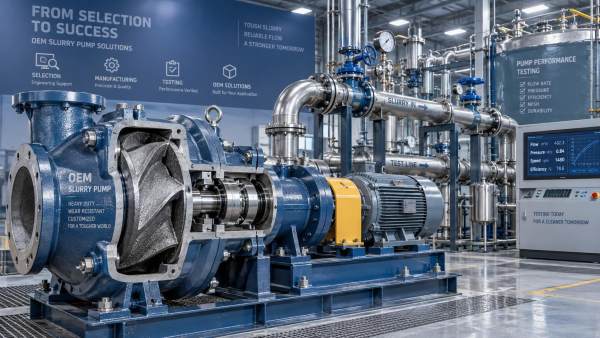
The distinction is broader than casing thickness. A purpose-built slurry pump is generally designed around the reality that its wetted components will wear and may need planned replacement. Its construction often emphasizes robust bearings, a stiff shaft, enlarged passages where solids handling requires them, replaceable wet-end components, and hydraulic profiles intended to reduce damaging flow patterns.
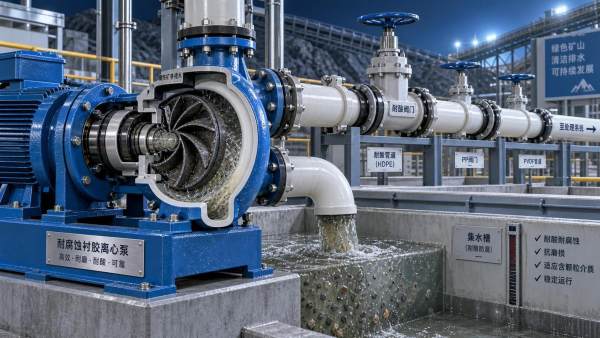
Material selection is central. Depending on the chemistry and abrasion mechanism, slurry pumps may use high-chrome white iron, elastomer linings, polyurethane, stainless alloys, duplex materials, or other specialized options. None of these is universally superior. Hard metallic materials often perform well against sharp, abrasive particles; elastomer linings can be effective with certain fine slurries and may absorb particle impact. Corrosive duty may shift the decision toward a corrosion-resistant alloy or a lined configuration. Compatibility must be evaluated against the actual process fluid, not assumed from the word “slurry.”
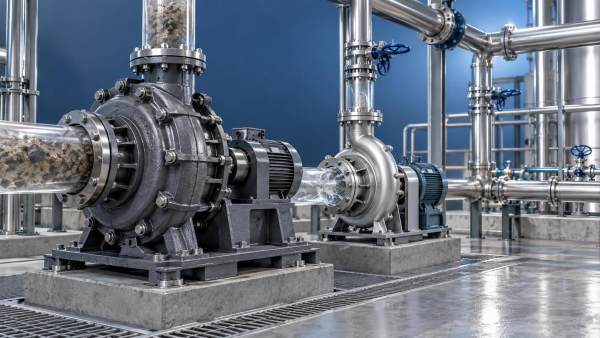
A standard process pump is commonly optimized for cleaner fluids, narrower viscosity ranges, or general transfer tasks. It may have thinner wetted sections, tighter clearances that are not intended for solids, and seals selected for relatively clean service. These features are not design flaws. They simply reflect a different operating environment. In low-abrasion applications, a standard pump can be the practical choice. In a harsh solids circuit, those same features can become early failure points.
Which components usually determine service life?
The impeller, throatbush, casing or liner, and side liners are normally the first components examined in abrasive slurry service. Their wear changes hydraulic clearances and internal flow paths. As clearances open, the pump can lose head and efficiency. Operators may respond by increasing speed or keeping the pump running longer, which can intensify wear and create a cycle of declining performance.
The seal arrangement deserves equal attention. Mechanical seals can perform reliably in slurry duty when the arrangement, flush plan, pressure conditions, and solids exposure are appropriate. Yet a seal intended for cleaner fluid can fail quickly when solids enter the seal faces or when dry-running occurs. Packed gland arrangements may be more tolerant in some heavy-duty applications, although they require deliberate adjustment and adequate flush water where applicable. The right choice is process-specific rather than ideological.
Bearings and shafts do not contact the slurry directly, but they often reveal whether the pump is hydraulically or mechanically stressed. Excessive vibration, misalignment, belt tension, pipe strain, unbalanced impeller wear, or operation away from the intended duty point can shorten bearing life. A pump may be sold as wear-resistant, but no wet-end alloy can compensate for poor installation practices.
Material choice is not a simple “harder is better” decision
Hardness is useful when abrasion dominates, but it is only one part of the selection process. A very hard material can be less suitable where large particles create repeated impact, where thermal changes are significant, or where corrosion is the primary threat. Rubber and other elastomer linings can provide excellent resistance in selected duties, especially when particle characteristics and chemical compatibility support their use. They are not automatically appropriate for coarse, sharp solids or high-temperature conditions.
The most reliable approach is to characterize the slurry before finalizing the wet end. Useful information includes solids concentration by weight or volume, particle size distribution, particle hardness and shape, liquid chemistry, pH, temperature, density, viscosity, flow rate, total dynamic head, suction conditions, and expected operating hours. If those inputs are uncertain because the process is changing, the pump selection should acknowledge that uncertainty rather than pretend it does not exist.
This is especially relevant in manufacturing plants where upstream process changes alter the feed. A different grinding media, a revised filtration stage, a new chemical additive, or more variable batch production can change slurry behavior enough to affect pump wear. The installed pump may not be defective; the duty may simply have moved beyond its original design envelope.
Operating conditions can erase the advantage of a heavy-duty design
Pump speed is one of the most influential controls on wear. Higher rotational speed generally increases particle velocity inside the pump. In abrasive duty, that can increase erosive wear sharply. Selecting a larger pump at a lower speed can sometimes offer a better lifecycle outcome than operating a smaller unit at the top of its speed range, provided the hydraulic requirements and system behavior support that choice.
Cavitation is another common source of confusion. It may sound like a gravel-like crackle, but it is not always obvious in a noisy plant. Inadequate suction conditions can cause vapor bubbles to form and collapse, damaging surfaces and generating vibration. When slurry is present, cavitation damage and solids erosion can occur together. Checking suction pipe layout, inlet restrictions, liquid level, temperature effects, and available NPSH is often more productive than repeatedly replacing impellers.
Intermittent operation creates its own problems. Solids can settle in lines or the pump casing during downtime, leading to difficult restarts, overload, blocked passages, or dry-running. Where settling is likely, the process may need flushing procedures, minimum line velocities, agitation, or operating controls that keep solids suspended. A durable pump is still vulnerable when it repeatedly starts against settled material.
How to compare total cost rather than purchase price
A standard pump can cost less to purchase, and in mild service that may be entirely rational. The problem arises when the initial price becomes the only comparison point. For abrasive pumping, a more useful calculation includes expected wear-part consumption, planned maintenance labor, unplanned shutdown exposure, energy use at the actual duty point, spare-part availability, and the consequences of a seal or casing failure.
Wear-resistant slurry pumps are often chosen because their wet-end components can be renewed without replacing the entire machine. This does not mean maintenance is inexpensive or optional. It means wear can be managed as a scheduled operating cost rather than allowed to become an emergency. Access to the correct spare parts, clear assembly procedures, and baseline inspection records can make a meaningful difference to actual pump lifespan.
When evaluating alternatives, ask what happens after the first signs of wear. Can clearance adjustments restore performance? Are liners, impellers, and seal components available within the required maintenance window? Does the plant have lifting access and room for service? Is the pump design compatible with the site’s existing motors, baseplates, controls, and piping? These practical questions often decide whether a theoretically good pump is workable in daily operation.
Warning signs that the pump selection needs review
- Flow or discharge pressure declines even though motor speed and system settings have not changed.
- Wear parts are replaced far more often than planned, especially at the impeller eye, throat area, or casing cutwater.
- Seal failures repeat despite replacing the seal with the same design.
- Vibration increases after a change in slurry source, solids size, density, or production throughput.
- The pump is regularly throttled heavily, operated at unstable flow, or run outside the originally intended duty range.
- Operators report settling, difficult starts, suction starvation, or frequent blockage in connected pipework.
These symptoms do not automatically prove that a standard pump should be replaced with a wear-resistant slurry pump. They indicate that the system should be reviewed as a whole. Sometimes the remedy is material selection; sometimes it is an impeller diameter adjustment, a lower operating speed, a redesigned suction line, improved instrumentation, or a different sealing strategy.
The practical answer: choose for the duty, then protect the duty
For sustained abrasive, solids-laden, or mixed corrosion-and-abrasion service, a properly selected wear-resistant slurry pump will generally provide a longer and more manageable service life than a standard pump. Its value lies not only in tougher materials but in a design that anticipates wear, supports maintenance, and handles the mechanical realities of slurry movement.
For clean or lightly contaminated liquids, the standard pump may remain the sensible option. Overspecifying every installation can waste capital, energy, and maintenance effort. The objective is not to buy the heaviest pump available; it is to match the pump to the fluid, solids, system curve, operating schedule, and acceptable maintenance interval.
Before making a replacement decision, document the present duty and the failure pattern. Compare worn parts, not just failed parts. Confirm whether the process conditions have changed, review actual operating flow and pressure, and identify the dominant wear mechanism. That evidence gives engineers and maintenance teams a far stronger basis for deciding whether a wear-resistant slurry pump is justified—and what configuration is most likely to last.
 Sep 22, 2026How Does an OEM Slurry Pump Custom Order Process Work?Delin OEM slurry pump custom order process: learn how duty analysis, material selection, seal options, testing, and commissioning create reliable pumps for demanding slurry applications.
- Sep 23, 2026Which Pump Is Suitable for High-Concentration Tailings Disposal?High concentration slurry pump for tailings disposal: learn how to select a heavy-duty centrifugal pump with wear-resistant materials, reliable sealing, and pipeline-matched performance.
- Sep 22, 2026How to Choose a Corrosion-Resistant Pump for Acid Mine DrainageCorrosion resistant pump for acid mine drainage: learn how to match materials, seals, hydraulics, and solids handling for longer service life.
- Sep 23, 2026Wear-Resistant vs. Standard Slurry Pumps: Which Lasts Longer?Wear resistant slurry pump vs standard pump lifespan: compare materials, wear factors, maintenance, and total cost to choose the longer-lasting solution.
Get a Quote
Please leave your information and email address, and we will contact you as soon as possible.