
How Do You Choose a Slurry Pump for Crystallizing Liquids?
Choosing a slurry pump for crystallizing liquids requires more than matching flow rate and pressure. As dissolved solids form crystals, they can increase abrasion, obstruct passages, and affect pump reliability. The right selection depends on factors such as crystal size, solids concentration, liquid temperature, and the potential for further crystallization during operation. This guide explains how to evaluate pump designs, materials, and operating conditions so you can reduce maintenance risks and maintain consistent process performance.
The practical starting point is to treat the pump as part of the crystallization process, not as an isolated piece of equipment. A pump that handles the slurry at normal temperature may struggle after a short shutdown, while a design that resists wear may break crystals that the process needs to keep intact. The best choice balances those risks against the actual operating duty.
Define the slurry at the pump, not just in the vessel
Ask what the liquid and solids will look like at the pump suction under normal operation, startup, shutdown and upset conditions. A sample taken from a well-mixed crystallizer does not necessarily represent material reaching the pump after it has passed through a cooler line or settled in a low point.
Start with the liquid composition and solubility behavior over the expected temperature range. Identify whether crystals form mainly through cooling, evaporation, concentration changes or a reaction. Also check whether pressure reduction can cause flashing or evaporation: either can change local conditions and encourage deposits, particularly near a restriction or seal.
For the solids, a single average particle size is rarely enough. The larger end of the size distribution matters for passage selection, while fine particles can influence viscosity and seal behavior. Record crystal shape, hardness, tendency to agglomerate and sensitivity to breakage. Needle-like crystals, for example, may bridge in a narrow passage even when their nominal diameter looks manageable.
Specify solids concentration on a consistent basis: weight and volume percentages are not interchangeable. Give the supplier the expected range, including the highest credible concentration during process variation. Density and viscosity should correspond to those conditions, because both affect hydraulic performance and motor loading.
If the slurry settles quickly, say so. A pump selected from laboratory properties alone may be satisfactory while running but difficult to restart after solids accumulate in the casing and suction line.
Choose a pump design around the dominant failure risk
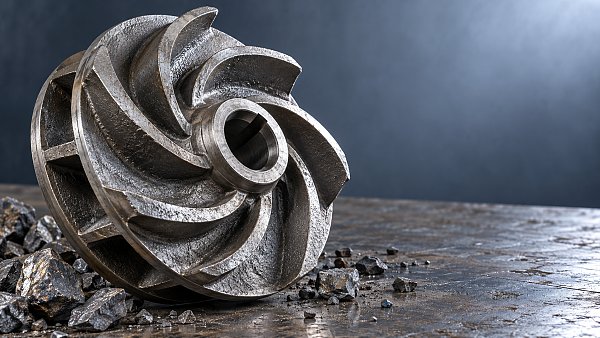
Centrifugal slurry pumps are a common choice where continuous flow, abrasive solids and relatively high throughput dominate the duty. Their open or semi-open impeller arrangements and generous passages can help with solids handling, depending on the design. Replaceable wear parts are useful when abrasion is expected, but a larger passage alone does not prevent crystals from depositing on cooler internal surfaces.
The trade-off is especially important when crystal integrity matters. Recirculation, impeller contact and high local velocities can contribute to particle breakage. A lower-speed or larger pump may be worth evaluating, but it still needs to operate within the manufacturer’s recommended range. Running a centrifugal pump far from its intended duty point can introduce its own recirculation, vibration and wear problems.
Positive displacement pumps can be suitable for some viscous slurries or duties requiring controlled flow. Their suitability depends heavily on particle size, concentration, crystal fragility and the clearances in the particular design. Some configurations tolerate solids better than others; do not assume that every progressive cavity, rotary lobe or diaphragm pump will handle every crystalline slurry equally well.
A positive displacement pump also needs appropriate overpressure protection. A blocked discharge or crystallized valve can cause pressure to rise rapidly. The relief arrangement must be compatible with the slurry and routed so that a relief event does not create another process or safety problem.
When the product is valuable because of its particle size distribution, ask for evidence relevant to crystal breakage, not just a solids-handling claim. A representative trial or a review of comparable test data is often more useful than choosing a pump solely from its published passage size.
Size for the real hydraulic duty
Provide the required flow range and total differential head, including static lift, vessel pressures and friction losses through the complete line. Include strainers, heat exchangers, control valves and any fittings that could accumulate deposits. The clean-pipe calculation is a starting point, not necessarily the operating condition after deposits develop.
Use slurry properties in the selection. Water-based pump curves do not automatically describe performance with a dense or viscous mixture, and the effect varies with the slurry and pump geometry. Ask the supplier how the proposed duty point and power requirement have been adjusted and what assumptions were used.
Check available net positive suction head against the pump’s required value, with a margin appropriate to the application. Hot liquids, elevation, suction-line losses and vapor pressure can leave little suction head available. Cavitation can damage components and make an existing crystallization problem harder to diagnose; pressure reduction may also change local temperature or concentration. These are related risks, but they are not the same failure mechanism.
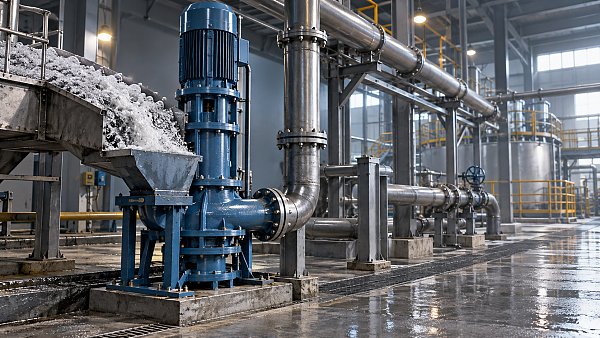
Pipe velocity requires a balance. Too little velocity can allow settling; too much can increase erosion, pressure loss and crystal breakage. There is no universal minimum velocity for every slurry. Determine an appropriate operating range using the particle and liquid properties, line layout and available test or supplier data. Pay particular attention to horizontal sections and any standby line where flow stops.
Match materials and seals to both chemistry and solids
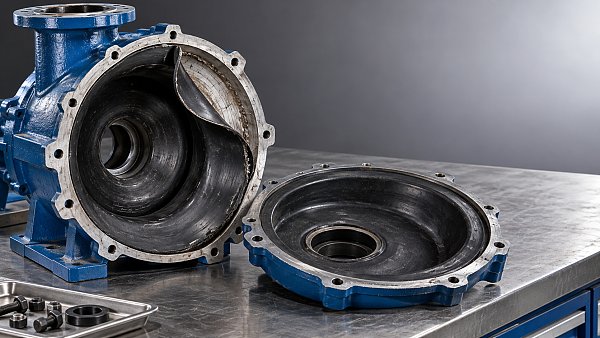
Material selection is not simply a choice of the hardest metal. The wetted surfaces must tolerate the liquid chemistry and temperature as well as abrasive wear. A material that performs well against dry abrasion may be a poor choice in a corrosive mother liquor; corrosion and erosion can also act together. Review the casing, impeller, fasteners, shaft sleeve and any exposed seal components as a system.
Hard alloys, elastomer-lined parts and other wear-resistant options each have limitations. Elastomers may suit some abrasive duties but require checks for chemical compatibility, temperature and particle characteristics. Hard components may resist certain wear mechanisms but can still be vulnerable to corrosion or impact. Ask where wear is expected and whether the affected parts can be replaced without excessive downtime.
Seal selection deserves an early discussion. Crystals can form around seal faces, springs or narrow flush passages; abrasive particles can also shorten seal life. A mechanical seal with a suitable support arrangement may be appropriate, while packed designs may be considered where controlled leakage and maintenance are acceptable. Neither is automatically the better choice.
If a flush is proposed, check its pressure, temperature, availability and compatibility with the process. A cold or chemically unsuitable flush can promote crystallization rather than prevent it. Also establish whether dilution or contamination is permitted. Where product containment is critical, agree on the allowable leakage and the response to seal failure before finalizing the arrangement.
Plan for the periods when flow stops
Many crystalline services become difficult during shutdown rather than at the design operating point. Material left in a pump can cool, settle or harden. On restart, the motor may face a packed casing, a blocked suction line or a restriction that was not present when the equipment was stopped.
Consider whether the pump and adjacent pipework need heat tracing, insulation or a jacket. The objective is not simply to keep the pump warm: it is to keep all relevant wetted areas within the process temperature range, including the seal chamber, valves and short dead legs. Confirm the heating medium and temperature limits with both the process engineer and pump supplier.
A flushing or draining procedure can be more practical than trying to hold temperature indefinitely, but it must suit the chemistry. Check whether the flush liquid dissolves the deposits, creates an unwanted reaction or changes downstream product quality. Provide access for draining and cleaning, and make sure isolated sections do not trap slurry where it can solidify.
For standby pumps, decide how the idle unit will be kept ready. Alternating duty, circulation, flushing or isolation may be appropriate, but each changes the operating procedure. A standby pump that has quietly filled with settled crystals is not much of a backup.
What to confirm before approving the selection
A useful supplier review should connect the proposed pump to specific process conditions. Request a curve showing the expected operating range, the basis for slurry corrections, the predicted power requirement and the suction-head assessment. Confirm the maximum permissible particle size and concentration for the proposed configuration, not merely for the pump family.
Then walk through a realistic abnormal sequence: loss of flow, cooling, flushing and restart. Can the casing be drained? Can the seal be accessed? What happens if the discharge line plugs? Which wear parts are stocked, and how long does replacement normally require? The answers often matter as much as the initial efficiency comparison.
Where properties are uncertain, identify what can be measured before purchase. A representative slurry sample, settling observation, viscosity measurement at process temperature or controlled pump trial may resolve a question that a catalogue cannot. Preserve representative conditions during testing where practical: a sample that cools or changes concentration may no longer behave like the material in the plant.
The right slurry pump for crystallizing liquids is the one that can handle the expected solids while keeping the process within a manageable temperature, flow and maintenance envelope. Before signing off, make sure the selection covers not only the normal duty point, but also the least forgiving shutdown and restart conditions the plant is likely to encounter.
Related Information
 Nov 08, 2026
Why Is My Slurry Pump's Rubber Liner Peeling?
Can sharp particles make your slurry pump's rubber liner peel? Discover the warning signs, other common causes, and practical ways to prevent repeat failures.- Nov 08, 2026
Do High-Chrome Pump Parts Resist Coarse, Sharp Particles?
Will high chrome pump parts resist wear from coarse, sharp particles? Discover when they perform best and how to choose the right alloy for your slurry. - Nov 07, 2026
What Factors Affect FGD Pump Lifecycle Cost?
FGD pump lifecycle cost goes beyond purchase price. Explore how energy, slurry wear, maintenance, spares, and downtime affect your total investment. - Nov 07, 2026
Froth Pump vs. Standard Slurry Pump: What's the Difference?
Froth pump vs standard slurry pump: compare air handling, performance, and selection factors to choose the right pump for your application.


{item.title}
Get a Quote
Please leave your information and email address, and we will contact you as soon as possible.