
Coal Washing Pump Selection: Matching Materials to Particle Size and pH
Coal Washing Pump Selection: Matching Materials to Particle Size and pH
Selecting the right Coal Washing Pumps is not simply a matter of matching flow rate and head. In a preparation plant, the pump is exposed to a moving mixture whose behavior can change substantially between seams, shifts, and process stages. Coarse refuse, fine coal, magnetite, clay, flotation froth, process water, and chemical residues each create a different duty. A pump that performs well on a clean-water curve may lose efficiency, wear rapidly, or become unstable once the actual slurry reaches the wet end.
For a technical evaluation, particle size distribution and slurry pH deserve early attention because they directly influence the choice of wetted materials, impeller geometry, liner design, sealing arrangement, and operating speed. Solids concentration, density, temperature, and suction conditions still matter, but material selection often determines whether a pump is a manageable maintenance item or a recurring source of unplanned shutdowns.
The useful question is not “Which material is strongest?” It is “Which material and hydraulic arrangement will survive this specific combination of abrasion, corrosion, impact, and operating variability at an acceptable lifecycle cost?”
Start with the slurry, not the pump catalogue
Coal preparation circuits contain several distinct pumping duties. Dense-medium cyclone feed and magnetite recovery services can be highly abrasive because of the mineral solids and elevated slurry density. Screen underflow may include sharp, coarse particles that produce impact wear. Fine tailings systems may appear less aggressive, yet fine mineral particles can still erode close-clearance components over time. Flotation circuits add entrained air and froth, which can affect pump capacity, suction behavior, and the stability of the flow entering the impeller.
The operating description supplied to a pump manufacturer should therefore go beyond “coal slurry.” At minimum, it should identify the expected particle size distribution, top particle size, solids concentration by weight or volume, slurry specific gravity, liquid chemistry, temperature, required flow range, total dynamic head, and likely variations during normal operation. If samples are available, wear testing or material review based on representative solids can be more informative than relying on generic service labels.
A common evaluation mistake is to specify a pump around average conditions only. Wear rarely follows the average. A short period of higher coarse-particle loading, a denser magnetite stream, or an upset that shifts pH can become the condition that sets liner life and seal reliability. Design around the credible operating envelope, while avoiding excessive oversizing that forces the pump far from its efficient range.
What particle size changes in the wet end
Particle size affects more than the rate of abrasion. It changes the wear mechanism. Fine particles tend to create sliding abrasion: they scour surfaces, reduce impeller thickness, and progressively enlarge hydraulic passages. Coarser particles add impact damage, especially at the impeller eye, leading edges, volute tongue, and high-velocity turns. Angular material can be more damaging than rounded material of similar nominal size, while hard mineral contamination may dominate wear even when coal represents most of the slurry by mass.
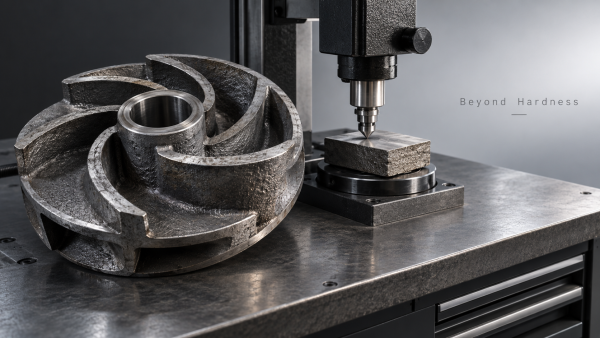
For duties dominated by fine, abrasive solids, high-chrome white iron is widely considered because it offers strong resistance to sliding abrasion under suitable conditions. Its hardness is useful when particle impacts are not severe enough to cause cracking or chipping. However, hard iron alloys are not a universal answer. Large, sharp particles, intermittent tramp material, or severe impact duty may call for a different material strategy, more generous internal passages, reduced speed, or replaceable sacrificial components.
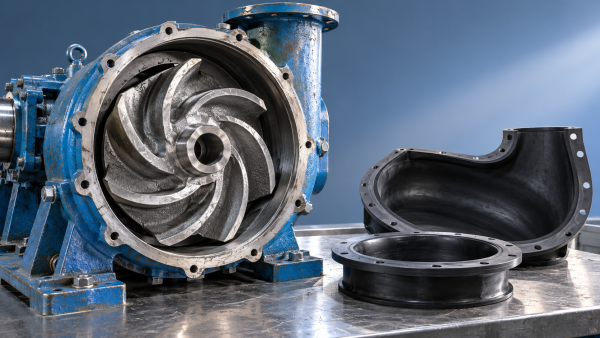
Elastomer linings can perform well where particles are relatively fine, slurry chemistry is compatible, and the duty benefits from the resilience of rubber. The material can absorb some impact energy and resist certain forms of fine-particle erosion. Yet rubber is not appropriate for every stream. Coarse sharp solids, elevated temperatures, hydrocarbons, or incompatible chemical conditions can shorten its service life. The decision should be based on the actual slurry chemistry and particle morphology, not an assumption that “rubber handles abrasion.”
Where particle size is broad or unpredictable, the hydraulic layout becomes especially important. A larger impeller eye, suitable passage dimensions, and a casing designed to pass the stated top size reduce the chance of blockage and local acceleration. The trade-off is real: very wide passages can reduce hydraulic efficiency, while narrow high-efficiency passages may become intolerant of occasional coarse material. Coal washing pump selection is often a controlled compromise between energy performance and operational forgiveness.
Velocity is part of the wear calculation
Wear depends heavily on local velocity. Raising pump speed may provide the required head with a smaller pump, but it can also accelerate erosion at vulnerable areas. Conversely, reducing velocity too far can allow solids to settle in suction lines, low points, or the pump casing. The practical target is not the lowest possible velocity; it is a stable transport velocity that avoids settling without creating unnecessary wear.
This is why piping and pump selection cannot be separated. An accurately selected slurry pump can still suffer if the suction line is poorly arranged, if reducers create air pockets, or if a long suction run introduces excessive losses. Reviewing the system curve against slurry conditions, rather than water-only assumptions, is essential before finalizing impeller diameter and rotational speed.
pH determines whether abrasion is the whole story
Abrasion is the obvious threat in coal handling, but corrosion can quietly change the material decision. Process water quality may vary with mine drainage, reagent addition, recirculated water, dissolved salts, and the source of make-up water. A slurry near neutral pH is not automatically benign. Chlorides, sulfates, dissolved oxygen, and galvanic interactions between materials can influence corrosion behavior, especially during idle periods or low-flow operation.
At acidic pH, metallic components may experience corrosion in addition to mechanical wear. This combined mechanism can remove material faster than either factor alone. In alkaline circuits, the risk may shift rather than disappear; chemical compatibility with elastomers, seal faces, flush arrangements, and auxiliary components still needs review. The correct choice is often based on corrosion resistance in the actual slurry, not simply a published resistance chart for a clean chemical solution.
For this reason, pH should be treated as a range, not a single design-point number. Ask whether pH is measured continuously, where it is measured, and whether it represents the pump suction stream. A reading taken upstream of a reagent addition or after dilution may not describe what reaches the wet end. When water chemistry changes seasonally or between production areas, that uncertainty should be visible in the equipment specification.
Do not treat froth service as conventional slurry pumping
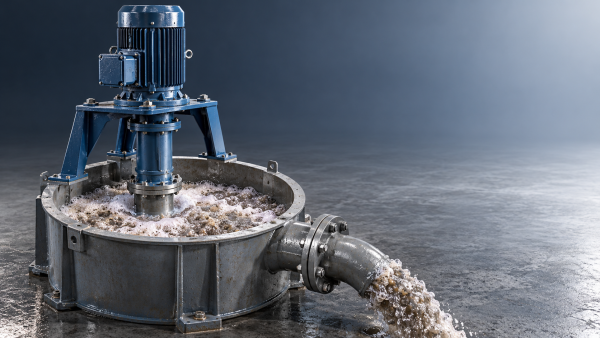
Flotation concentrate and tailings streams can contain a large amount of entrained air. That air changes the effective volume entering the pump and can lead to surging, reduced head, poor discharge control, or apparent cavitation symptoms that are not solved by simply increasing motor size. A standard centrifugal slurry pump may be workable in some installations, but it should not be assumed to be the right hydraulic design for a froth-rich duty.
The feed tank, inlet orientation, and freeboard are part of the solution. The pump must receive slurry in a manner that limits air locking and promotes a consistent feed to the impeller. Where the process stream is genuinely frothy, a dedicated design such as the Type DF(DHF) Froth Pump may warrant evaluation alongside the broader flotation-cell and sump arrangement. The key is to assess it as a system: air content, flow variability, solids loading, and tank behavior all affect the result.
Material selection must include seals, liners, and fasteners
A material discussion focused only on the impeller and casing can miss expensive failure paths. Throatbushes, expellers, shaft sleeves, gland components, mechanical seal faces, frame seals, and fasteners may see different exposure than the main wet end. Fine solids can enter seal water systems; corrosive liquid can attack components during standby; and dry-running or inadequate flush conditions can damage a seal independently of normal slurry wear.
The sealing choice should follow plant constraints. Expeller or dynamic seals can reduce the need for external seal water in appropriate services, but their suitability depends on suction conditions, pressure, and operating regime. Packed glands require disciplined flush-water management. Mechanical seals may be justified where leakage control is critical, but they need careful attention to solids, heat removal, and support arrangements. There is no universally low-maintenance seal; there is only a seal system matched—or mismatched—to its duty.
Ask suppliers to identify which wear parts are replaceable, whether wet-end materials can be mixed within the same pump family, and what clearances must be restored during maintenance. Replaceable liners can support lifecycle cost control, but only if plant personnel can access them safely and spare components are available when needed. A theoretically durable material has limited value if a routine change-out becomes a long outage.
Compare lifecycle cost through duty stability
Purchase price is a weak proxy for pump value in abrasive service. The more useful comparison includes expected wear-part consumption, power demand across the operating range, maintenance labor, downtime exposure, inventory requirements, and the consequences of a pump falling below required head before its scheduled maintenance window. Hydraulic efficiency matters, but it should be viewed over the interval between rebuilds rather than as a single clean-condition figure.
A pump operating near its best efficiency region usually experiences less internal recirculation than one operating far to the left or right of its curve. That does not eliminate wear, but it can reduce hydraulic instability and avoidable local damage. Variable-speed control can help where flow demand changes materially, provided the allowable speed range, minimum transport velocity, motor torque, and process-control philosophy are all checked.
It is also sensible to distinguish planned wear from unexplained wear. If liners consistently require replacement earlier than anticipated, the cause may be material incompatibility, but it may also be off-design operation, a changed particle-size profile, air ingestion, poor suction conditions, or an incorrect slurry density assumption. Recording suction and discharge pressure, flow where available, motor load, pH, density, and wear-part condition gives maintenance teams a basis for diagnosing the pattern instead of repeatedly changing materials by trial and error.
A practical specification review before release
Before issuing a purchase specification for Coal Washing Pumps, review the pump curve using slurry-corrected duty conditions and confirm the selected point at normal, minimum, and maximum flow. Define the top particle size and clarify whether it is a normal condition or an occasional upset condition. State the pH range and relevant water chemistry rather than giving a single nominal value. Then identify the required wetted materials, sealing method, drive arrangement, instrumentation, liner configuration, and maintenance access constraints.
The final technical clarification should also address what information remains uncertain. If particle morphology, chemical composition, or froth content has not been characterized, it is better to state that uncertainty than to disguise it with a generic slurry description. This allows the supplier to identify assumptions, propose alternatives, or flag a requirement for additional testing.
The best selection is rarely the pump with the hardest material or the highest published head. It is the unit whose hydraulics, wet-end materials, sealing arrangement, and maintenance plan match the actual coal preparation duty—including the conditions that occur when the plant is not running perfectly.
Related Information
 Oct 24, 2026
How Much Should a Froth Pump Be Oversized for Flotation Concentrate?
How much should a froth pump be oversized for flotation concentrate? Learn how inlet air, peak flow, and head affect sizing to avoid costly mistakes and select the right pump.- Oct 24, 2026
Is Higher Hardness Always Better for High-Chrome Pump Castings?
Is higher hardness always better for high chrome pump castings? Discover how toughness, carbide structure, and slurry conditions affect service life—and choose smarter to reduce downtime. - Oct 23, 2026
Which Leakage Test Should You Specify for a Zero-Leakage Knife Gate Valve?
Which leakage test should I specify when ordering a zero-leakage knife gate valve? Compare API 598 and ISO 5208, define seat leakage limits, and avoid costly purchasing mistakes. - Oct 23, 2026
Which Pump Material Lasts Longest in Limestone-Gypsum FGD Slurry?
Which pump material lasts longer in limestone-gypsum desulfurization slurry? Compare high-chrome iron, rubber and duplex steel to find the right fit, reduce downtime and extend service life.

{item.title}
Get a Quote
Please leave your information and email address, and we will contact you as soon as possible.