
How Much Should a Froth Pump Be Oversized for Flotation Concentrate?
A flotation concentrate froth pump should not be oversized by a single percentage applied to the slurry flow. Its required capacity depends on how much air reaches the pump inlet, how the selected pump handles that air, and the highest credible process flow. A pump selected at 20% above the air-free slurry rate may still be too small for aerated concentrate; a pump selected at three times that rate may be unnecessarily large if most of the froth collapses before entering it.
The defensible sizing basis is the peak slurry flow plus an explicitly defined allowance for entrained air, followed by a separate, justified operating margin. Capacity factors of 1.5, 2, or 3 correspond mathematically to inlet gas volume fractions of about 33%, 50%, or 67%. These are useful comparisons—not universal froth-pump sizing recommendations. The final selection must also meet the required head under aerated conditions and remain stable at normal and minimum flow.
What does “oversized” actually mean?
Froth-pump discussions can mix together three different quantities: the volumetric flow of solids and liquid, the expanded volume containing gas, and the pump’s rated capacity. Unless these are separated, two quotations can appear comparable while being based on substantially different duties.
The air-free slurry flow is the combined volume of concentrate solids and liquid, excluding entrained gas. It is not the water flow alone. If solids production and solids concentration by mass are known, it can be calculated as:
Qslurry = ṁsolids/ρsolids + ṁwater/ρwater
Here, mass flow divided by density gives each component’s volumetric flow. Consistent units are essential. Dilution water, seal water entering the process, and other contributing streams should be included where relevant.
If the gas volume fraction at the pump inlet is α, an elementary volume balance gives:
Qmixture = Qslurry ÷ (1 − α)
This equation describes the inlet mixture volume at the stated pressure and temperature. It does not predict the pump’s head, efficiency, or resistance to gas locking. Those require pump-specific performance information.
A supplier’s “froth factor” may instead be an empirical selection multiplier incorporating both volume expansion and pumping difficulty. Its definition must be confirmed before use. Multiplying by a gas-expansion factor and then applying a supplier factor that already includes the same effect can double-count the allowance.
Comparing a percentage margin with a froth-volume allowance
The distinction becomes clear when different allowances are applied to the same air-free slurry duty.
These calculated ratios explain why a modest percentage margin can be misleading. A pump with capacity equal to 120% of air-free flow has little volumetric reserve if the incoming mixture already occupies 125% of that flow. It may also suffer reduced head because of the gas, making the shortfall more serious than the volume balance alone suggests.
Conversely, selecting three times the slurry flow is not automatically conservative. Where inlet gas content is low, that selection can place normal operation far below the pump’s intended operating range. The relevant comparison is not “small versus large,” but capacity matched to the actual aerated duty versus capacity selected from an unexplained multiplier.
A worked comparison: the same concentrate, different pump duties
Consider a hypothetical concentrate stream with a normal air-free flow of 100 m³/h and a defined peak of 120 m³/h. Assume that inlet gas content at the peak condition is 40% by volume.
The corresponding inlet mixture flow is:
120 ÷ (1 − 0.40) = 200 m³/h
If the project then specifies a separate 10% capacity reserve, the selection check becomes 220 m³/h. That 10% is an illustrative project allowance, not an industry requirement.
Compared with the normal air-free flow, 220 m³/h looks like 120% oversizing. Compared with the peak aerated duty, it represents only 10% reserve. Most of the apparent oversizing is therefore accommodation of gas and peak production, not spare capacity.
Now assume the same peak slurry flow reaches the pump with only 10% gas because the receiving arrangement releases much of the air. The calculated mixture flow falls to approximately 133 m³/h, or about 147 m³/h with the same illustrative reserve. The difference arises from inlet conditions, not concentrate tonnage.
Neither calculation selects a pump by itself. A candidate rated for 220 m³/h on water is not necessarily capable of delivering the required slurry flow and head with 40% inlet gas. The supplier must establish how the stated capacity relates to aerated performance.
A larger slurry pump is not equivalent to a purpose-designed froth pump
Increasing the size of a conventional centrifugal slurry pump provides more nominal hydraulic capacity, but it does not necessarily resolve air accumulation near the impeller inlet. Gas can interrupt liquid contact, reduce developed head, and produce unstable delivery even when the water-based capacity appears adequate.
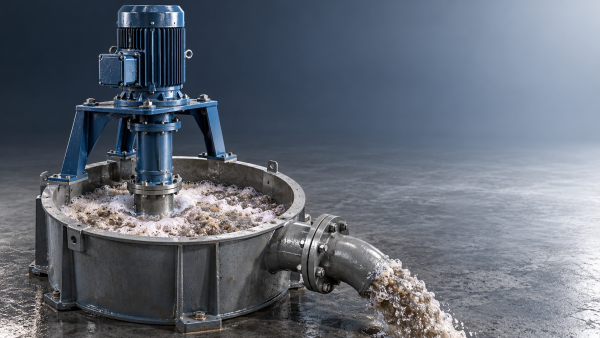
A purpose-designed froth pump may use a modified inlet, impeller geometry, or an integrated tank arrangement to improve froth entry and air handling. Vertical tank-type and horizontal froth pumps address the duty differently; neither should be evaluated solely by discharge diameter or nominal capacity.
A tank arrangement can provide space for air release and help establish inlet conditions, but its effectiveness depends on froth stability, residence time, and flow pattern. A horizontal installation depends strongly on the upstream sump, suction geometry, and the selected pump’s air-handling characteristics. Design labels alone do not establish performance.
The meaningful comparison is the guaranteed duty envelope: delivered slurry flow, required head, permissible inlet aeration, inlet level, and operating stability. A larger conventional pump without supporting aerated-duty evidence is not necessarily the lower-risk choice.
Measure the froth that reaches the inlet—not just the flotation launder
Froth appearance above a flotation cell is an unreliable substitute for the gas fraction entering the pump. Air can escape during transfer, while plunging flow and turbulence can introduce additional air. Stable, fine-bubble froth may behave very differently from froth that collapses readily in the receiving vessel.
Sampling can also distort the sizing basis. A sample allowed to stand may provide useful air-free slurry density but lose the gas volume that the pump must handle. Density inferred from an aerated stream can likewise misrepresent solids concentration unless the measurement method accounts for gas.
Useful duty information therefore includes paired observations of slurry production and inlet aeration under defined operating conditions. Where direct measurement is difficult, uncertainty should be carried as an explicit range and checked with the supplier rather than hidden inside an arbitrary multiplier.
The peak condition also needs a physical explanation. Maximum solids throughput, maximum dilution water, and maximum aeration do not necessarily occur together. Combining every independent maximum can create an unrealistically large duty; ignoring a credible simultaneous peak can leave the system unable to prevent overflow.
Flow allowance and head allowance solve different problems
A froth-capacity factor should not simply be applied to total dynamic head. Flow expansion, slurry friction, elevation, downstream pressure, and gas-related performance loss are separate effects.
The system head assessment should account for elevation difference, discharge pressure, pipe length, fittings, and the concentrate’s transport properties. Solids concentration and rheology matter, particularly where fine concentrate develops appreciable yield stress. Air can further complicate pressure loss, so a water-only calculation may be an inadequate representation of the duty.
Gas also changes volume as pressure changes. The inlet mixture volume should not automatically be treated as a constant volumetric flow throughout a pressurized discharge line. Where two-phase behavior materially affects the system, a suitable hydraulic assessment is needed rather than using the expanded inlet volume in every pipe calculation.
Excessive head allowance can be as damaging as insufficient capacity. A pump selected for an overstated head may require throttling or speed reduction to avoid excessive flow and sump drawdown. Meanwhile, a pump with generous nominal capacity but inadequate aerated head may still fail to clear the receiving vessel.
Suction conditions remain critical. Available inlet pressure, liquid level, temperature, suction losses, and geometry must be checked. Meeting a conventional net positive suction head requirement does not, by itself, demonstrate that an air-laden stream will pump reliably.
Where additional size stops providing useful protection
An oversized casing does not necessarily consume its full motor rating continuously, but operating far from the intended range can introduce recirculation, unstable loading, vibration, and uneven wear. These consequences depend on the pump design and operating point, not simply on installed power.
Minimum duty deserves particular attention. A pump selected around the highest expanded froth volume may spend much of its operating time handling a smaller, partly deaerated stream. If speed reduction pushes pipeline velocity below the concentrate’s transport requirement, solving the capacity problem can create a deposition problem.
A variable-speed drive broadens the operating envelope, but it does not eliminate minimum stable pump flow, pipeline transport limits, or inadequate air handling. Its useful speed range must be established against both the pump and system characteristics.
The motor should also be checked across credible operating states, including denser or less-aerated slurry. The frothiest condition is not automatically the highest-power condition. Selecting drive power only from a low bulk-density aerated case can overlook a more demanding operating state.
What makes a sizing recommendation defensible?
A meaningful recommendation should state the normal and peak air-free slurry flows, the inlet aeration basis, and whether the quoted capacity is an actual mixture flow or an empirical equivalent flow used for selection. It should identify any additional reserve separately.
The performance submission should then connect those assumptions to the selected impeller, speed, required head, motor rating, and acceptable operating range. Water curves remain useful reference information, but they are not proof of performance on flotation froth. Supporting evidence may include applicable aerated-duty data, relevant test results, or a clearly defined performance guarantee.
Where uncertainty remains large, improving the inlet arrangement or obtaining better duty measurements can be more valuable than buying the next pump size. Additional receiving volume, controlled entry, or air-release provisions may reduce the burden on the pump, although persistent froth cannot be assumed to collapse simply because a larger tank is installed.
The appropriate oversizing is therefore the smallest verified selection that handles the credible peak aerated duty while remaining acceptable at normal and minimum operation. A statement such as “twice the slurry flow” becomes useful only when its air-content basis, head capability, and operating limits are explicit. Without those qualifications, the multiplier describes a purchasing assumption rather than a reliable pumping solution.
Related Information
 Oct 24, 2026
How Much Should a Froth Pump Be Oversized for Flotation Concentrate?
How much should a froth pump be oversized for flotation concentrate? Learn how inlet air, peak flow, and head affect sizing to avoid costly mistakes and select the right pump.- Oct 24, 2026
Is Higher Hardness Always Better for High-Chrome Pump Castings?
Is higher hardness always better for high chrome pump castings? Discover how toughness, carbide structure, and slurry conditions affect service life—and choose smarter to reduce downtime. - Oct 23, 2026
Which Leakage Test Should You Specify for a Zero-Leakage Knife Gate Valve?
Which leakage test should I specify when ordering a zero-leakage knife gate valve? Compare API 598 and ISO 5208, define seat leakage limits, and avoid costly purchasing mistakes. - Oct 23, 2026
Which Pump Material Lasts Longest in Limestone-Gypsum FGD Slurry?
Which pump material lasts longer in limestone-gypsum desulfurization slurry? Compare high-chrome iron, rubber and duplex steel to find the right fit, reduce downtime and extend service life.


{item.title}
Get a Quote
Please leave your information and email address, and we will contact you as soon as possible.