
Which Pump Material Lasts Longest in Limestone-Gypsum FGD Slurry?
Which Pump Material Lasts Longest in Limestone-Gypsum FGD Slurry?
Choosing the right pump material is critical for reliable limestone-gypsum flue gas desulfurization (FGD) slurry handling. Abrasive particles, chloride ions, low pH, and continuous operation can quickly damage poorly selected components, leading to leakage, downtime, and rising maintenance costs. So, which pump material lasts longer in limestone-gypsum desulfurization slurry? The practical answer is not one universal material. Service life depends on the balance between abrasion, corrosion, temperature, solids concentration, particle size, and the pump’s hydraulic design.
For many heavy-duty FGD applications, high-chrome white iron is a strong choice when abrasive wear is the dominant failure mechanism. Rubber-lined construction can last longer where corrosion and moderate abrasion are more important than impact or sharp-particle cutting. Duplex or super duplex stainless steel may be preferred when chloride-related corrosion is severe, but these alloys are not automatically the best answer for highly abrasive slurry. The material decision must follow the actual duty rather than the material name alone.
Why limestone-gypsum FGD slurry is difficult to pump
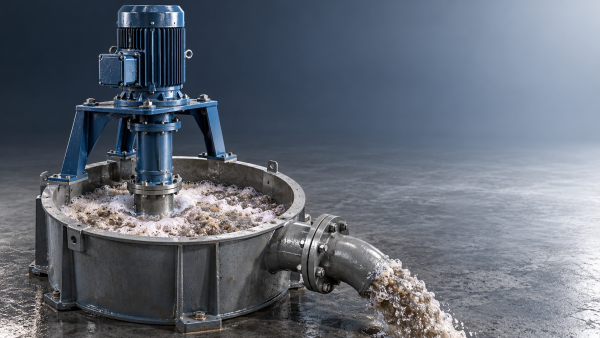
Limestone-gypsum FGD systems circulate slurry continuously through absorber vessels, oxidation sections, hydrocyclones, dewatering equipment, and related process lines. The liquid phase may contain dissolved chlorides and other salts, while the solid phase includes limestone, gypsum crystals, unreacted particles, and sometimes fine ash. Each component affects pump wear differently.
Abrasive solids remove material from impellers, volutes, suction liners, and wear plates. Larger or angular particles can cause impact wear, while fine particles moving at high velocity produce gradual cutting and sliding abrasion. Low pH and chloride ions attack metallic surfaces through corrosion mechanisms that may be difficult to see until the component has lost significant thickness. If corrosion roughens the hydraulic passage, abrasion often accelerates as well.
Operating conditions also matter. A pump running far from its best efficiency point may experience internal recirculation, turbulence, vibration, and uneven wear. Excessive speed increases slurry velocity and usually increases wear disproportionately. Air entrainment, blocked suction lines, and unstable feed conditions can create additional stress that no material upgrade can completely solve.
High-chrome white iron: often the leading option for severe abrasion
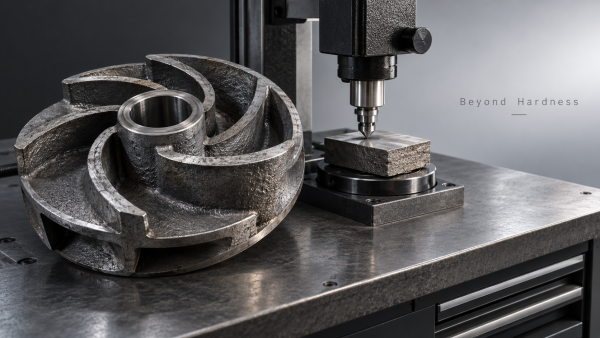
High-chrome white iron is widely used for wet abrasive slurry pump components because its hard chromium-rich carbide structure resists sliding wear better than ordinary cast iron or many standard stainless steels. It is commonly considered for impellers, volutes, liners, and other wetted parts in heavy-duty limestone and gypsum slurry service.
Its main advantage is wear resistance against hard mineral particles. When the slurry has a high solids load, sharp particles, or a relatively high circulating velocity, high-chrome alloy can provide a longer operating interval than softer metals. It is also less vulnerable than rubber to cutting, gouging, and direct particle impact.
However, high-chrome alloy should not be treated as corrosion-proof. The actual performance depends on alloy chemistry, heat treatment, casting quality, microstructure, slurry chemistry, and component design. High chloride concentration, low pH, and oxidizing conditions can still cause corrosion or corrosion-assisted wear. A high-chrome component may therefore be the best choice for a highly abrasive duty but a poor choice if the chemical environment is unusually aggressive.
The alloy grade should be selected from verified material data and the operating environment. Buyers should ask for the specified chemical composition, hardness range, heat-treatment condition, and inspection requirements rather than accepting a general description such as “wear-resistant alloy.”
Rubber lining: effective where corrosion and moderate abrasion dominate
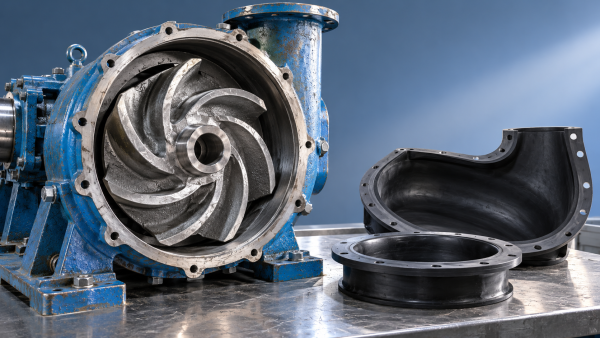
Rubber-lined slurry pumps are often selected for corrosive mineral slurries because the elastomer separates the process liquid from the metallic pressure shell. Natural rubber and other elastomer formulations can offer good resistance to acidic liquids and fine, relatively rounded particles. The lining also provides a smooth hydraulic surface and can reduce metal exposure to chloride-bearing slurry.
Rubber is not automatically the longest-lasting option. It can be damaged by large particles, sharp-edged solids, high impact, excessive temperature, dry running, and unsuitable chemical exposure. Mechanical damage may begin at the suction area, impeller leading edge, or fastener locations. Once the lining is cut or separated, the underlying metal can corrode rapidly.
A rubber-lined design is often sensible for absorber circulation or similar services with fine solids and strong chemical exposure, provided the temperature and particle characteristics fall within the lining manufacturer’s limits. It deserves careful evaluation when slurry chemistry is more aggressive than the rubber formulation can tolerate or when the process contains coarse gypsum crystals and hard contaminants.
Stainless, duplex, and super duplex alloys: corrosion resistance with limits
Austenitic stainless steels and duplex stainless steels may be considered when corrosion resistance is a primary concern. Duplex and super duplex grades generally offer higher resistance to chloride-related corrosion than common carbon steels, together with useful mechanical strength. They can be attractive for certain process sections, especially where corrosion risk is high and abrasive loading is not extreme.
The limitation is that corrosion resistance does not equal abrasion resistance. A stainless or duplex impeller can still wear quickly if it handles a high concentration of hard limestone or gypsum particles at excessive velocity. It may also suffer from localized corrosion if the actual chloride level, oxygen condition, temperature, or surface condition differs from the design assumptions.
These alloys should therefore be selected when their corrosion advantages solve a clearly identified problem. They should not be chosen simply because “stainless steel” sounds more durable. For many mixed corrosion-and-wear duties, a hybrid approach may be more appropriate: a wear-resistant alloy for the most exposed hydraulic parts, corrosion-resistant materials for shafts, fasteners, or auxiliary components, and a design that limits unnecessary slurry velocity.
A practical comparison of common pump materials
The pump design can matter more than the material grade
Material selection is only one part of service life. Two pumps made from a similar alloy can perform very differently if their hydraulic passages, clearances, speed, and operating points are not comparable. A component that forces the slurry through a narrow, high-velocity passage may wear faster than a slightly softer material operating under more favorable hydraulic conditions.
The impeller should be evaluated for vane geometry, passage size, balance, and resistance to blockage. The volute or liner needs appropriate thickness and a design that avoids sharp changes in flow direction. Replaceable wear parts can reduce maintenance exposure, but only if they can be inspected and replaced without excessive disassembly.
Pump speed is another major variable. When process conditions allow, reducing speed can reduce the severity of abrasive action, although the effect must be checked against required head and capacity. Running below or above the recommended operating range may create recirculation and uneven loading. A correctly sized pump often outlasts an oversized unit throttled far away from its efficient operating region.
What information should be confirmed before choosing the material?
A reliable material recommendation requires more than the words “FGD slurry.” The pump supplier or engineering team should review the actual duty conditions, including:
- Slurry flow rate, total head, density, and operating temperature.
- Weight concentration of solids and the expected particle-size distribution.
- Whether the solids are mainly fine limestone, gypsum crystals, ash, or mixed contaminants.
- pH, chloride concentration, oxidation conditions, and any known chemical additives.
- Required operating hours, standby arrangement, start-stop frequency, and risk tolerance for downtime.
- Available flushing, drainage, inspection, and replacement procedures.
It is also useful to identify the likely failure mode from existing equipment. If the impeller shows polished thinning and vane loss, abrasion is probably dominant. If the surface is pitted, cracked, or chemically attacked, corrosion may be controlling the service life. If rubber is peeling from the shell, the issue may involve bonding, temperature, chemical compatibility, or vacuum conditions rather than simple wear.
So, which pump material lasts longer?
If the question is limited to severe limestone-gypsum slurry abrasion, high-chrome white iron is often the first material to evaluate. It is especially suitable for hard mineral solids, high solids loading, and hydraulic sections exposed to continuous particle impact. If the service is more corrosion-dominant and contains fine solids at moderate velocity, a properly selected rubber-lined pump may provide better practical life and easier protection of the pressure casing.
Duplex or super duplex stainless steel can be the better answer when chloride corrosion is the principal threat, but it should be supported by an abrasion review rather than selected on corrosion resistance alone. In unusually demanding services, different materials may be used across the pump rather than forcing one material to solve every problem.
The most durable solution is therefore the one matched to the dominant wear mechanism, verified chemistry, and actual operating point. Before placing an order, compare the material specification, hydraulic design, replaceable wear parts, inspection method, and maintenance access together. That broader review usually gives a more reliable answer than choosing between “metal” and “rubber” by name alone.
Related Information
 Oct 24, 2026
How Much Should a Froth Pump Be Oversized for Flotation Concentrate?
How much should a froth pump be oversized for flotation concentrate? Learn how inlet air, peak flow, and head affect sizing to avoid costly mistakes and select the right pump.- Oct 24, 2026
Is Higher Hardness Always Better for High-Chrome Pump Castings?
Is higher hardness always better for high chrome pump castings? Discover how toughness, carbide structure, and slurry conditions affect service life—and choose smarter to reduce downtime. - Oct 23, 2026
Which Leakage Test Should You Specify for a Zero-Leakage Knife Gate Valve?
Which leakage test should I specify when ordering a zero-leakage knife gate valve? Compare API 598 and ISO 5208, define seat leakage limits, and avoid costly purchasing mistakes. - Oct 23, 2026
Which Pump Material Lasts Longest in Limestone-Gypsum FGD Slurry?
Which pump material lasts longer in limestone-gypsum desulfurization slurry? Compare high-chrome iron, rubber and duplex steel to find the right fit, reduce downtime and extend service life.

{item.title}
Get a Quote
Please leave your information and email address, and we will contact you as soon as possible.