
Is Higher Hardness Always Better for High-Chrome Pump Castings?
Is higher hardness always better for high chrome pump castings? Not necessarily. Hardness is an important indicator of abrasive wear resistance, but it is only one part of a casting’s performance. In a slurry pump, the material must also withstand impact, hydraulic pressure, thermal variation, stress concentration, and the occasional passage of oversized particles. A casting that is extremely hard but too brittle may crack, chip, or fail suddenly before its superior wear resistance creates any practical benefit.
For this reason, pump operators and equipment buyers should compare high chrome castings as complete material systems rather than selecting the highest hardness value on a test report. Alloy chemistry, carbide morphology, heat treatment, section thickness, impeller or liner design, and actual slurry conditions all influence service life. The best choice is usually not the hardest casting available, but the one that offers the right balance between abrasion resistance and structural reliability.
What hardness tells you—and what it does not
High chrome pump castings are commonly used in abrasive slurry applications because their microstructure contains hard chromium-rich carbides within a metallic matrix. These carbides resist cutting, scratching, and gradual material removal caused by particles in the slurry. Higher measured hardness often suggests a stronger resistance to certain forms of abrasive wear, especially when the particles are hard and the impact level is relatively low.
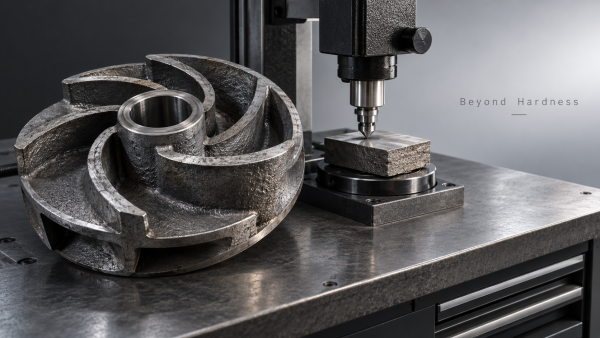
However, hardness testing measures resistance to localized indentation. It does not directly measure how a casting will behave when struck by a large particle, exposed to repeated vibration, or subjected to a sudden change in hydraulic load. Nor does it reveal whether carbides are evenly distributed, whether they are interconnected, or whether the matrix can support them under operating stress.
Two castings may show similar hardness values while delivering different results in the field. One may contain a fine, well-supported carbide structure and perform consistently. Another may have coarse or continuous carbides, residual stress, or an unsuitable matrix condition. The second casting could appear attractive on paper but be more vulnerable to edge chipping and cracking.
Hardness versus toughness: the central trade-off
The most important comparison is not “hard versus soft.” It is wear resistance versus damage tolerance.
In a closed-circuit mineral process with fine particles and steady flow, abrasion may dominate the failure mechanism. In that environment, a harder high chrome alloy can be an effective choice. By contrast, a dredging operation, mining duty with coarse solids, or a system prone to blockage may expose the pump to repeated impact. A slightly lower hardness level with better toughness can produce longer actual service life because the component remains intact.
This is why a hardness number should be treated as a selection reference, not as a universal ranking system.
Why carbide structure matters as much as the hardness value
High chrome white irons depend heavily on their carbide network. Chromium-rich carbides, often described as M7C3-type carbides, provide the hard phase that resists abrasive particles. Their size, shape, orientation, spacing, and connection to the surrounding matrix all affect performance.
Fine and relatively well-distributed carbides can provide a useful combination of wear resistance and support. They help resist abrasion without creating as many large, sharp internal stress points. Coarse carbides or nearly continuous carbide networks may increase apparent hardness, but they can also create preferential crack paths. Once a crack begins near a carbide cluster, repeated impact may allow it to spread through the casting.
The matrix surrounding the carbides is equally important. Depending on the alloy and heat treatment, it may contain martensitic, austenitic, or mixed structures. A hard matrix can improve wear resistance, while a more resilient matrix may better absorb impact. The appropriate condition depends on the service environment rather than on a simple preference for maximum hardness.
For buyers comparing suppliers, it is therefore reasonable to ask for more than a hardness value. Useful technical information may include the specified alloy grade, heat-treatment condition, metallographic examination method, and the location where hardness was measured. A single reading taken from an easily accessible area may not represent the condition of a complex casting, particularly when section thickness varies.
Operating conditions can change the “best” material choice
The same high chrome pump casting may behave differently in two installations. Before choosing a harder grade, engineers should examine the actual duty cycle.
- Particle size: Fine particles mainly create sliding or cutting abrasion, while coarse particles can generate impact and localized stress.
- Particle hardness: Quartz-rich or other highly abrasive solids can remove material rapidly, but the failure mode also depends on particle shape.
- Solids concentration: A dense slurry can increase wear, loading, and hydraulic stress compared with a dilute mixture.
- Pump speed: Higher peripheral velocity generally increases the energy of particle impacts and may accelerate both abrasion and erosion.
- Flow stability: Entrained air, unstable operation, recirculation, or frequent start-stop cycles can introduce additional stress.
- Blockage risk: If oversized particles may enter the pump, impact toughness becomes more important than a small increase in hardness.
- Component geometry: Thin edges, sharp transitions, bolt holes, and changes in section thickness can act as stress concentrators.
These factors explain why a wear part that lasts well in one plant may fail prematurely in another. Material selection should follow the dominant wear and failure mechanisms, not simply the most impressive laboratory number.
When higher hardness is likely to be beneficial
A harder high chrome casting can be advantageous when the pump handles fine, hard particles under stable operating conditions. If the main mechanism is low-impact sliding abrasion, increasing the resistance of the matrix and carbide-supported structure may slow dimensional loss on impellers, liners, suction covers, and other wetted components.
Higher hardness may also be useful when the component has sufficient thickness, a sound design, and limited exposure to sudden impact. In such cases, the casting can take advantage of its wear-resistant phase without facing severe mechanical shocks. Even then, the increase should remain within the range supported by the alloy and heat-treatment process. Pushing hardness beyond a practical level can introduce residual stress or reduce the margin against cracking.
Hardness should also be compared with the required maintenance interval. If a component is easy to inspect and replaced before severe damage occurs, a wear-focused material may be suitable. If failure requires an extended shutdown or risks damaging adjacent components, greater toughness may carry more value than an incremental increase in wear resistance.
When a harder casting may perform worse
Maximum hardness can be counterproductive in applications with significant impact. Coarse rocks, tramp metal, sudden flow changes, or repeated cavitation-related events can subject the casting to loads that abrasive wear tests do not reproduce. Under these conditions, a brittle casting may chip at leading edges or develop cracks around fastener locations and geometry changes.
Chipping is not merely a cosmetic problem. Damaged edges can disturb slurry flow, increase turbulence, and expose new areas to erosion. Detached fragments may also damage other pump components. A casting with a slightly lower hardness but stronger resistance to impact may therefore deliver more stable performance and lower total operating cost.
Another risk appears when hardness is achieved without adequate control of the casting process. Poor feeding, shrinkage, inclusions, porosity, or an uneven microstructure can weaken a component regardless of its nominal hardness. Heat treatment that is too aggressive, insufficiently controlled, or poorly matched to the section size may also create internal stress. In these situations, a higher hardness specification may give a false sense of security.
How to compare high chrome pump castings more intelligently
A practical comparison starts with the failure history of the existing component. Examine where the part is losing material and how it is being damaged. Uniform thinning suggests a different solution from edge chipping, deep grooves, localized cracking, or fracture through a bolt hole.
Next, match the material choice to the dominant mechanism:
- For cutting and sliding abrasion, prioritize a suitable carbide structure, controlled heat treatment, and adequate hardness.
- For impact-dominated service, place greater weight on toughness, matrix support, casting integrity, and geometry.
- For mixed wear, avoid extreme specifications and seek a balanced grade that can tolerate both abrasion and intermittent impact.
- For unstable operating conditions, review pump speed, suction conditions, solids concentration, and blockage events before changing material alone.
It is also useful to evaluate the whole supply and quality-control process. Questions about chemical composition, heat-treatment records, hardness mapping, metallographic inspection, dimensional accuracy, and non-destructive testing can reveal whether a high hardness result is supported by consistent manufacturing quality. The precise inspection requirements will depend on the component and application, but the principle is simple: reliable performance requires both the right material and a sound casting.
The better question is not “How hard is it?”
A more useful question is: “Is this hardness level appropriate for the wear, impact, and operating conditions of the pump?”
High chrome pump castings should be selected as engineered components, not as isolated hardness samples. Hardness can improve resistance to abrasive wear, but it cannot compensate for unsuitable microstructure, poor heat treatment, weak casting quality, or excessive impact. In demanding slurry service, the most durable solution is often the one that balances carbide hardness with matrix support and damage tolerance.
For buyers and maintenance teams, that balanced approach reduces the risk of replacing a component with another that looks better on paper but fails in the same way—or fails even more suddenly. The right casting may not have the highest hardness available. It should have the material condition, structure, and mechanical behavior needed to keep the pump working reliably in its actual environment.
Related Information
 Oct 24, 2026
How Much Should a Froth Pump Be Oversized for Flotation Concentrate?
How much should a froth pump be oversized for flotation concentrate? Learn how inlet air, peak flow, and head affect sizing to avoid costly mistakes and select the right pump.- Oct 24, 2026
Is Higher Hardness Always Better for High-Chrome Pump Castings?
Is higher hardness always better for high chrome pump castings? Discover how toughness, carbide structure, and slurry conditions affect service life—and choose smarter to reduce downtime. - Oct 23, 2026
Which Leakage Test Should You Specify for a Zero-Leakage Knife Gate Valve?
Which leakage test should I specify when ordering a zero-leakage knife gate valve? Compare API 598 and ISO 5208, define seat leakage limits, and avoid costly purchasing mistakes. - Oct 23, 2026
Which Pump Material Lasts Longest in Limestone-Gypsum FGD Slurry?
Which pump material lasts longer in limestone-gypsum desulfurization slurry? Compare high-chrome iron, rubber and duplex steel to find the right fit, reduce downtime and extend service life.

{item.title}
Get a Quote
Please leave your information and email address, and we will contact you as soon as possible.