
Which Slurry Pump Spares Should You Stock at a Remote Mining Site?
Which Slurry Pump Spares Should You Stock at a Remote Mining Site?
When a slurry pump fails at a remote mining site, the repair itself may not be the longest part of the shutdown. Finding the correct liner, arranging freight, and getting a replacement through the final stretch of road can take much longer. A relatively inexpensive missing component can keep an otherwise repairable pump out of service.
So, what slurry pump spares should I buy for a remote mining site? Start with complete wet-end wear parts, the sealing components used by your specific pump, and the small items required to finish a rebuild. Then decide whether bearings, a rotating assembly, or a complete replacement pump deserve shelf space. That decision depends less on purchase price than on production exposure, repair capability, and realistic replenishment time.
The strongest inventory is not necessarily the largest. It is the one that lets your crew complete the repairs most likely to occur, without discovering halfway through that one essential part was never ordered.
Separate predictable wear from failures that stop production
Wet-end components are usually the starting point because they face abrasive solids directly. Impellers, throatbushes, and liners deteriorate with service, although the rate varies with particle characteristics, slurry chemistry, operating speed, and duty point. Their replacement demand can often be estimated from inspection records and previous rebuilds.
Bearing assemblies, shafts, and structural components belong in a different category. They may be replaced less often, but their failure can require a longer repair and more workshop capability. Low consumption does not automatically make a part unimportant.
Also distinguish an installed standby from a warehouse spare. A standby pump only reduces downtime if it can actually take over: valves must operate, its suction must remain usable, and its controls and sealing arrangements must be ready. A neglected standby should not be treated as dependable inventory coverage.
Buy wet-end parts as a repair package
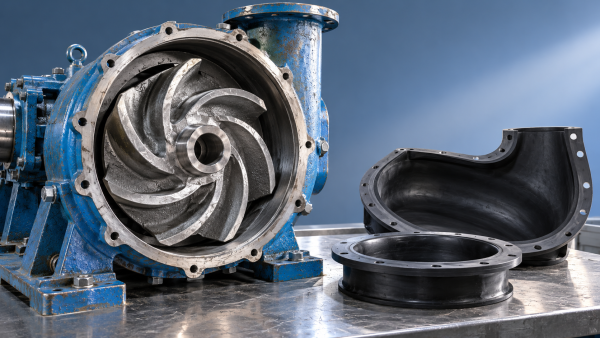
For many lined centrifugal slurry pumps, the core package includes an impeller, throatbush, frame plate liner or rear liner, and the relevant casing liners. Exact names and arrangements vary by manufacturer. Unlined metal pumps and other slurry pump designs need different bills of materials, so do not purchase from a generic list alone.
Inspect mating parts together. Replacing an impeller while retaining a badly worn throatbush can leave excessive clearances and disappointing performance. Conversely, replacing every wet-end component at every shutdown may waste usable life. Stock enough to support the likely repair scope, then make replacement decisions against the manufacturer’s inspection criteria and the next operating interval.
The useful compromise is a complete rebuild kit backed by extra quantities of the parts your records show wearing fastest. If throatbushes consistently require attention before the rest of the wet end, equal quantities of every component are unlikely to be the best use of inventory money.
Metal versus elastomer: do not turn inventory into an uncontrolled trial
High-chrome alloys are commonly considered for abrasive duties, while rubber or other elastomers may suit certain particle sizes and slurry conditions. Neither is universally better. Sharp or oversized particles, temperature, chemical exposure, and operating conditions can rule out an otherwise attractive material.
For emergency stock, keep the proven material specification unless a reviewed change has been approved. A liner that fits physically may still be wrong for the duty. Material substitutions should be checked against the pump supplier’s application guidance, including any implications for component combinations, clearances, speed, and performance.
Match sealing spares to the actual arrangement
“Seal kit” is too vague for a remote-site purchase order. A packed gland, an expeller arrangement, and a mechanical seal need different parts and different maintenance support.
For a packed gland, consider the specified packing, shaft sleeve, lantern ring where fitted, gland hardware, and associated seals. Inspect sleeve condition when repacking: fresh packing against a deeply grooved sleeve may not restore acceptable operation. If the arrangement requires gland water, maintain the relevant strainers, regulators, gauges, and fittings as well. Spare packing cannot compensate for a failed water supply.
For an expeller-sealed pump, confirm the dynamic sealing components and the static sealing arrangement used when the pump stops. For a mechanical seal, an approved cartridge or assembly may be more practical than loose repair components if suitable rebuilding facilities are unavailable. Confirm its support-system requirements and storage instructions before purchase.
Repeated seal failures deserve investigation rather than simply larger stock orders. Dry running, inadequate flush conditions, shaft movement, and operation outside the intended duty can consume replacement parts without addressing the cause.
Loose bearings or a ready-to-fit assembly?
Loose bearings cost less to hold than a complete assembly, but they are only useful if the site can install them correctly. The job may require controlled heating, suitable pullers, accurate measurement, clean working conditions, and personnel familiar with the manufacturer’s setting procedure.
Where that capability is limited, a prepared bearing assembly can shorten the work performed at the pump. Confirm exactly what “assembly” includes: shaft, bearings, housing, end covers, seals, and adjustment components are not necessarily supplied together.
A complete spare pump becomes more attractive when several critical positions use the same configuration and a changeout can be executed safely with available lifting equipment. However, apparent similarity is not enough. Check shaft height, nozzle orientation, baseplate interfaces, drive arrangement, impeller diameter, and sealing connections. A warehouse pump needing substantial modification is not a quick-change spare.
Set quantities around the replenishment gap
Supplier lead time should mean delivery to the mine, not dispatch from a factory. Include order approval, manufacture if applicable, freight consolidation, customs where relevant, and the final delivery leg. Seasonal access restrictions can make the difference between a routine order and an extended production risk.
For regularly consumed wear parts, a practical starting point is expected consumption during replenishment time, plus a buffer for uncertainty. Base consumption on operating hours and inspection history where possible, not calendar age alone. Reassess the estimate after changes in ore characteristics, throughput, pump speed, or process routing.
That approach is less useful for rare but severe failures. A critical bearing assembly may justify stock despite having little recent consumption. Ask a different question: if this fails today, can the plant tolerate the time needed to obtain and install a replacement?
Shared stock can reduce duplication across identical pumps, but it creates exposure when several units approach overhaul together. Reserve planned-shutdown parts explicitly. Otherwise, an emergency repair can quietly consume the kit intended for next week’s maintenance.
The small items that decide whether a rebuild gets finished
Remote repairs often stall on items that barely register in the purchasing budget. Review the disassembly procedure and identify everything that must be renewed, is easily damaged, or cannot reliably be recovered.
- Correct O-rings, gaskets, and joint seals, with specified material compatibility.
- Application-specific studs, bolts, nuts, and washers in the required grades.
- Shaft keys, locking devices, spacers, and adjustment hardware where applicable.
- Specified lubricants and approved assembly consumables.
- Special removal tools, lifting attachments, and measurement equipment required by the maintenance procedure.
Tools are not pump spares, but they belong in the readiness review. Having a replacement impeller on the shelf does little good if the crew cannot safely remove the old one.
Make the inventory usable before the next breakdown
Tie each stocked item to the pump asset, serial number, approved drawing revision, part number, and material specification. Record configuration changes after rebuilds. Nominal pump size alone does not establish interchangeability, particularly when different generations or suppliers are involved.
Alternative suppliers can be worth evaluating, but emergency repairs are a poor time to discover fit or material differences. Check dimensional interfaces, documented material specifications, and assembly compatibility before accepting a substitute as critical stock.
Storage also needs ownership. Protect machined metal surfaces from corrosion, keep bearings sealed and dry, and store elastomers according to supplier guidance on temperature, light, deformation, and shelf life. Apply the manufacturer’s preservation procedure to assembled units and inspect them periodically.
Before placing the next order, walk through one wet-end rebuild and one bearing or seal failure against the actual shelf contents. Check parts, tools, lifting access, and the replenishment route. Any point where the repair must stop is a more useful purchasing priority than another spare chosen simply because it appears on a standard list.
Related Information
 Oct 24, 2026
How Much Should a Froth Pump Be Oversized for Flotation Concentrate?
How much should a froth pump be oversized for flotation concentrate? Learn how inlet air, peak flow, and head affect sizing to avoid costly mistakes and select the right pump.- Oct 24, 2026
Is Higher Hardness Always Better for High-Chrome Pump Castings?
Is higher hardness always better for high chrome pump castings? Discover how toughness, carbide structure, and slurry conditions affect service life—and choose smarter to reduce downtime. - Oct 23, 2026
Which Leakage Test Should You Specify for a Zero-Leakage Knife Gate Valve?
Which leakage test should I specify when ordering a zero-leakage knife gate valve? Compare API 598 and ISO 5208, define seat leakage limits, and avoid costly purchasing mistakes. - Oct 23, 2026
Which Pump Material Lasts Longest in Limestone-Gypsum FGD Slurry?
Which pump material lasts longer in limestone-gypsum desulfurization slurry? Compare high-chrome iron, rubber and duplex steel to find the right fit, reduce downtime and extend service life.

{item.title}
Get a Quote
Please leave your information and email address, and we will contact you as soon as possible.