
Wear-Resistant vs Standard Slurry Pumps: What Drives Service Life?
A slurry pump can look acceptable during a walk-through and still be creating a costly problem. This often becomes visible when a maintenance shutdown is moved forward because a casing has worn thin, a wet end has lost efficiency, or a seal begins leaking after solids conditions changed. The immediate repair may be manageable. The more difficult issue is that production planning, spare-parts availability, labor scheduling, and downtime risk all become less predictable.
Many purchasing decisions begin with a simple question: should the operation buy a standard pump and replace wear parts as needed, or specify a wear-resistant design from the start? The answer is rarely found by comparing purchase prices alone. A useful comparison of wear resistant slurry pump vs standard pump lifespan starts with the slurry itself, then examines how pump construction, duty point, maintenance practices, and process variability affect the actual service interval.
The problem behind “premature” pump wear
In abrasive slurry service, a pump does not wear at one uniform rate. Particles strike different areas with different energy. The impeller vanes, throatbush, volute liner, suction-side passages, shaft seal area, and pipe bends may all deteriorate differently. A pump can continue running while its hydraulic performance is already slipping. Operators may respond by increasing speed, opening or closing valves, or accepting lower flow. Those adjustments can temporarily hide the real problem while accelerating wear elsewhere.
Standard slurry-capable pumps are not automatically poor choices. They can be appropriate where solids are soft, concentrations are modest, runs are intermittent, or the material can be handled with readily available replacement components. Trouble begins when a standard design intended for lighter duty is selected for a service with sharp mineral particles, high solids loading, frequent density swings, or long unattended operating periods.
The resulting cost is broader than the failed component. A shortened wear interval can mean more emergency procurement, more exposure during maintenance, disrupted downstream equipment, and uncertainty in the operating budget. For a project that depends on continuous transfer, the difference between planned liner replacement and an unplanned pump outage matters more than the invoice value of one impeller.
Start with the slurry, not the pump brochure
The most reliable service-life assessment begins with an honest description of the material being pumped. “Slurry” is too broad to support a sound decision. Two streams with a similar solids percentage may produce very different wear because the particles differ in hardness, shape, size distribution, and tendency to settle.
Angular particles generally cut and gouge more aggressively than rounded particles. Coarse solids may cause localized impact damage, while fine hard solids can create sustained erosive wear across passages. Some slurries are abrasive and corrosive at the same time, which complicates material selection: a material that resists abrasion well may not be the best answer when chemical attack is significant.
Before comparing pump options, gather operating information from the process rather than relying on nominal design conditions alone:
- Expected solids concentration, including normal and upset conditions.
- Particle size range, maximum particle size, and whether particles are sharp or rounded.
- Particle hardness and any corrosive characteristics of the carrier liquid.
- Required flow and head during startup, normal operation, and process changes.
- Daily operating hours, planned stoppages, and whether dry-running or low-flow events can occur.
- Suction conditions, pipe length, elevation changes, and the likelihood of sediment settling.
This information changes the decision. A pump running a stable, low-abrasion mixture may not need a premium wet-end material. A pump exposed to variable feed conditions may need added wear margin even if its average slurry properties appear moderate. Average values are helpful, but the extremes often determine service life.
Where a wear-resistant pump gains its service-life advantage
A wear-resistant slurry pump is usually distinguished by more than one component material. Its advantage comes from the relationship between materials, geometry, clearance allowance, and maintainability. In severe duty, the wet end is designed to tolerate gradual loss of material without immediately losing its ability to develop the required head and flow.
Wet-end materials and thickness allowance
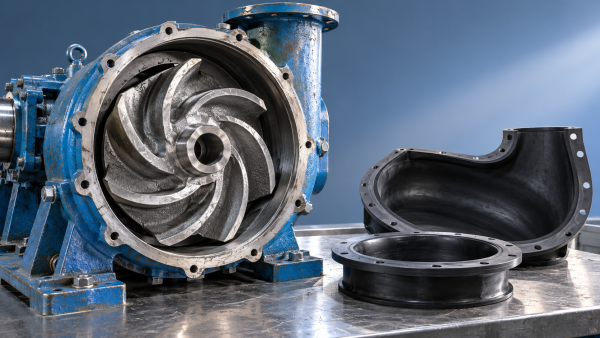
High-chrome white iron and selected elastomer linings are common approaches for abrasive service, but they are not interchangeable. Hard metal components are often suited to sharp, coarse, high-impact particles. Elastomer linings can perform well in conditions involving fine particles and may absorb certain impacts better, but they can be damaged by unsuitable particle size, high temperature, hydrocarbons, or incompatible chemicals. The correct choice depends on the specific duty, not on a general claim that one material lasts longer.
Wear-resistant designs may also provide thicker liners or replaceable components in high-wear zones. Thickness alone does not guarantee a longer interval; a thick component with poor hydraulic fit can still suffer concentrated erosion. However, well-designed replaceable liners allow wear to be managed as planned maintenance instead of forcing replacement of a larger assembly.
Hydraulic passage design
Passage shape affects particle velocity and impact angle. Tight passages may improve a compact design but can increase blockage risk and localized wear when solids are coarse. Pumps built for demanding slurry duties commonly use impeller and casing geometry intended to pass solids while limiting destructive recirculation patterns.
Internal clearances are important here. As the gap between the impeller and adjacent wear components grows, liquid recirculates from high-pressure zones back toward lower-pressure zones. Head and efficiency decline, and the pump may need to run harder to meet process demand. A design with adjustable clearance or replaceable throat components can help restore performance before the entire wet end reaches its limit.
Mechanical arrangement and access
Service life should not be confused with the life of the casing alone. Bearing condition, shaft deflection, seal selection, and alignment all influence whether a pump remains usable between wet-end replacements. A robust slurry pump arrangement may use a shaft and bearing assembly sized for the radial loads associated with slurry duty. It may also make the wet end accessible without disturbing connected pipework, depending on configuration.
That access does not make maintenance unnecessary. It makes planned maintenance more realistic. When inspection or liner adjustment requires major disassembly, teams are more likely to delay it. Delayed attention can turn a controllable wear issue into damage involving shafts, seals, frames, or connected piping.
When a standard pump remains the sensible purchase
It is easy to overcorrect and specify the heaviest available pump for every solids-handling application. That can create its own disadvantages: higher capital cost, more weight, more power demand, or unnecessary complexity in a light-duty process.
A standard pump may be a rational choice when the liquid contains only occasional soft solids, abrasive exposure is limited, the pump runs for short periods, or process shutdowns are already frequent enough to accommodate inspection and component replacement. It can also be suitable where the operating point is stable and where spare components are simple to hold on site.
The key is to avoid calling a pump “standard” or “wear-resistant” as though those labels define the outcome. A standard centrifugal pump with compatible materials and conservative operating conditions may provide acceptable life. Conversely, a heavy-duty slurry pump selected at the wrong duty point can suffer rapid wear and poor reliability.
For work involving sediment removal, sand-bearing water, mineral-bearing streams, or similar abrasive mixtures, it is useful to review equipment options intended for the Dredging Industry as part of the broader duty assessment. The point is not that every process needs dredging equipment; it is that applications with persistent abrasive solids often require pump construction that reflects the real solids burden.
Do not compare lifespan without comparing the operating point
One of the most common purchasing errors is evaluating wear material while ignoring where the pump will operate on its curve. A pump should be selected near an efficient, stable operating region for the required duty. When a unit runs far to the left or right of that region, internal recirculation, vibration, radial loading, and turbulence can rise. In slurry service, those hydraulic penalties also become wear penalties.
For example, throttling a pump heavily to reduce excess flow may leave it operating inefficiently for long periods. Running too slowly may allow solids to settle in the line if velocity becomes inadequate. Running too fast can increase particle impact energy and shorten wet-end life. None of these conditions is solved merely by choosing a harder impeller.
During evaluation, request a duty review based on the expected system curve, not just one flow-and-head number. Confirm the minimum and maximum operating conditions. Ask whether the selected impeller diameter, speed, and passage size remain appropriate if slurry density rises or pipe friction increases. If variable speed operation is being considered, assess the full expected speed range rather than assuming the pump will remain near its preferred duty point.
A practical way to compare ownership cost
Purchase price is visible, while wear cost is often scattered across maintenance records and production reports. A more useful decision compares the likely ownership burden over the equipment’s intended role. This does not require invented precision. It requires identifying which costs are sensitive to wear.
Separate the evaluation into several questions. How often are wet-end parts likely to need inspection? Which components are expected to be sacrificial? Can those parts be changed during a scheduled stoppage? Is a standby pump available? Are components standardized enough to stock without holding an excessive inventory? Does a worn pump cause meaningful losses in flow, pressure, product recovery, or process stability before it actually fails?
A lower-cost standard pump can be economical if its replacement cycle fits the operating calendar and its wear parts are easy to obtain. A wear-resistant pump often becomes preferable when unplanned interruptions are expensive, access for maintenance is difficult, abrasive duty is continuous, or loss of hydraulic performance creates a process bottleneck. The comparison is therefore not “longer life versus lower price.” It is “predictable planned cost versus the combined risk of frequent intervention and operational disruption.”
It is also wise to distinguish between consumable wear parts and major structural damage. Replacing an impeller or liner at a planned interval is part of normal slurry-pump ownership. Replacing a casing, shaft, bearing frame, or seal system because wear was ignored is a different category of expense. The chosen design should make normal wear visible and manageable before it reaches critical components.
Questions that expose a weak specification
When reviewing quotations or internal equipment proposals, certain questions bring the real differences into view. Ask which wet-end components are replaceable, what material is proposed for each one, and why that combination suits the slurry. Ask how impeller clearance is adjusted and what performance signs indicate adjustment is needed. If the supplier only identifies a broad alloy grade without linking it to particle characteristics and chemistry, the comparison is incomplete.
Also ask about the sealing arrangement in relation to the actual site conditions. A seal system suitable for clean water may not suit abrasive slurry, intermittent operation, fluctuating suction conditions, or limited flush-water availability. Seal failure may be blamed on slurry abrasion when the root cause is dry running, misalignment, insufficient cooling or flushing, or solids accumulation around the seal chamber.
Finally, examine the maintenance path. Can personnel inspect wear surfaces without removing major pipe sections? Are lifting points and component weights practical for the maintenance area? Is there enough room to withdraw rotating parts? The strongest material selection does not provide full value if the pump cannot be serviced safely and consistently.
Reducing wear after the pump is installed
Selection sets the baseline, but operating discipline determines whether the pump reaches its expected service interval. Establish a condition-monitoring routine that reflects the duty. Trend discharge pressure, flow where available, power draw, vibration, seal leakage, bearing temperature, and adjustment history. A single reading rarely explains wear. A gradual change across several indicators often reveals a developing clearance or internal erosion problem.
Pay attention to the suction side. Air ingress, poor sump level control, vortexing, blocked strainers where applicable, and settled material can produce unstable operation. Cavitation and entrained air can damage surfaces and create vibration that affects seals and bearings. Operators may hear unusual noise before a measurable performance loss appears, so field observations deserve a place in maintenance records.
When wear inspection is performed, document the location and pattern rather than simply recording that parts were replaced. Leading-edge erosion, uneven liner loss, concentrated damage near a throat area, or repeated seal contamination can point to different causes. Over several service cycles, these observations help determine whether the material choice, speed, piping arrangement, or process control needs adjustment.
Making the final choice
The service-life question should be framed around duty severity and interruption risk. Choose a wear-resistant slurry pump when abrasive solids are a routine part of the process, when the slurry can vary beyond a narrow range, when pump performance must remain stable between planned outages, or when maintenance access makes frequent intervention undesirable. Choose a standard pump when the duty is genuinely light, operating conditions are controlled, and the cost of routine replacement is low relative to the value of heavier construction.
For any abrasive application, avoid making the decision from material labels or initial price alone. Verify the slurry characteristics, evaluate the full operating range, review wear-part design and service access, and estimate the consequences of performance decline before failure. That approach turns the wear resistant slurry pump vs standard pump lifespan comparison into a practical purchasing decision rather than a guess based on catalog descriptions.
Related Information
 Oct 24, 2026
How Much Should a Froth Pump Be Oversized for Flotation Concentrate?
How much should a froth pump be oversized for flotation concentrate? Learn how inlet air, peak flow, and head affect sizing to avoid costly mistakes and select the right pump.- Oct 24, 2026
Is Higher Hardness Always Better for High-Chrome Pump Castings?
Is higher hardness always better for high chrome pump castings? Discover how toughness, carbide structure, and slurry conditions affect service life—and choose smarter to reduce downtime. - Oct 23, 2026
Which Leakage Test Should You Specify for a Zero-Leakage Knife Gate Valve?
Which leakage test should I specify when ordering a zero-leakage knife gate valve? Compare API 598 and ISO 5208, define seat leakage limits, and avoid costly purchasing mistakes. - Oct 23, 2026
Which Pump Material Lasts Longest in Limestone-Gypsum FGD Slurry?
Which pump material lasts longer in limestone-gypsum desulfurization slurry? Compare high-chrome iron, rubber and duplex steel to find the right fit, reduce downtime and extend service life.

{item.title}
Get a Quote
Please leave your information and email address, and we will contact you as soon as possible.