
How Do You Select Slurry Pump Materials for Acidic Slurries?
Selecting the wrong pump material for an acidic slurry can accelerate corrosion, increase wear, and lead to costly downtime. Effective acidic slurry pump material selection requires more than checking pH: particle hardness, acid concentration, temperature, and operating conditions all influence service life. This guide explains how to assess these factors and compare common metal and elastomer options, helping you choose wetted components that balance chemical resistance, abrasion resistance, and total operating cost.
What should you know about the slurry before choosing a material?
Start with the process chemistry, not a pump brochure. Identify each acid present, its concentration range, and the normal and maximum operating temperatures. Include chlorides, oxidizing agents, dissolved metals, and any cleaning chemicals that may reach the pump. A material that handles the normal slurry may be vulnerable during a hot cleaning cycle or an upset that changes the chemistry.
Then describe the solids. Record their concentration by weight or volume, particle size distribution, shape, and hardness where known. Sharp mineral particles behave differently from fine, rounded solids, even when the liquid phase is identical. Settling tendency matters too: deposits in a stopped pump can create localized chemical conditions that are not represented by a sample of well-mixed liquid.
If the process varies, provide ranges rather than a single laboratory result. A sample taken during stable operation may not capture startup, shutdown, dilution water changes, or excursions in acid concentration. For a critical duty, those less frequent conditions can determine which material fails first.
Why is pH alone a poor guide to pump material compatibility?
pH describes acidity, but it does not identify the acid or the other chemicals in solution. Sulfuric acid, hydrochloric acid, and mixed-acid streams can attack the same alloy in very different ways. Concentration can also change the corrosion mechanism; more concentrated does not always mean proportionally more corrosive for every metal.
Temperature, dissolved oxygen, and chlorides add further complications. Some stainless steels depend on a protective passive film, yet chloride-containing conditions can promote localized attack. Slurry particles can also damage that film, exposing fresh metal to the liquid. This combined erosion-corrosion effect is one reason a material that performs well in a static acid test may disappoint in a running pump.
Use chemical resistance charts to narrow the options, not to approve them on their own. Check that the chart covers the actual acid, concentration, and temperature, and ask whether its ratings refer to an unfilled liquid or conditions relevant to slurry service.
Which pump materials are commonly considered for acidic slurries?
There is no universal winner. The choice depends on whether chemical attack, particle wear, temperature, or mechanical loading sets the tighter limit. The following options are starting points for discussion with a pump and materials specialist.
High-chrome white iron
High-chrome white irons are commonly used where abrasive solids demand a hard wear surface. They can be attractive for coarse mineral slurries, but abrasion resistance should not be confused with broad acid resistance. Their suitability varies with alloy grade and chemistry, and corrosive attack can undermine wear performance. Confirm the exact casting composition and test or document its behavior in the intended liquid before selecting it for an acidic duty.
Stainless steels and corrosion-resistant alloys
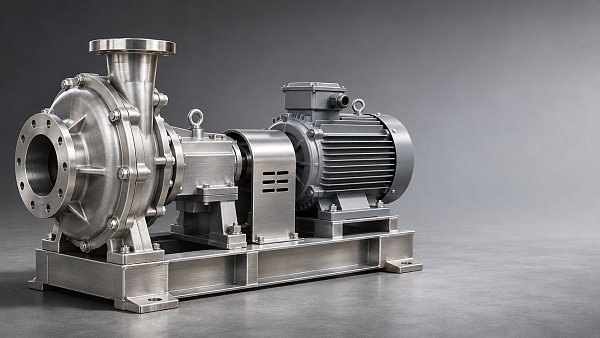
Stainless steels and higher-alloy materials may offer better corrosion resistance in selected acidic environments, but performance depends strongly on the specific grade and solution. A grade suitable for one acid concentration may not be suitable for another, particularly when chlorides or elevated temperatures are present.
Corrosion resistance alone is not enough if the impeller sees severe particle impact. Ask how the candidate alloy performs under slurry wear, not just whether it appears on a chemical compatibility list. Availability also matters: a technically attractive alloy may be a poor operational choice if replacement castings have long lead times.
Rubber and other elastomer linings
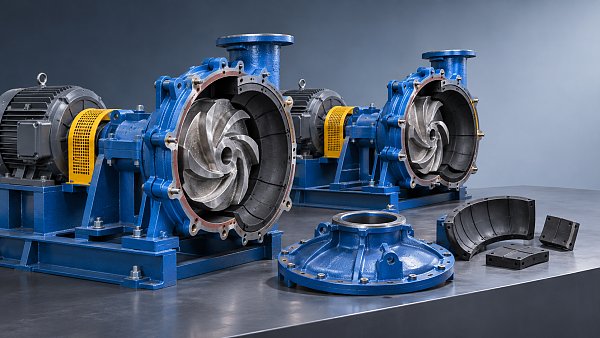
Elastomer-lined pumps can be effective in some acidic slurries, especially where fine particles would erode a metal surface. Natural rubber may resist wear from certain fine solids, while synthetic elastomers are selected for particular chemical and temperature requirements. Each compound must be checked individually; a generic “rubber lined” description is not a compatibility guarantee.
Coarse, sharp particles and high particle impact can damage an elastomer lining. Swelling, softening, hardening, and loss of bond are also possible when the compound is mismatched to the liquid or temperature. Review the maximum continuous temperature as well as short-duration excursions, and check the manufacturer’s limits for particle size and operating speed.
Thermoplastics and fluoropolymer linings
Certain polymeric materials can provide useful chemical resistance, but they are not automatically suitable for abrasive slurry duty. Mechanical strength, temperature, particle impact, liner thickness, and support behind the lining all matter. A chemically resistant lining that is cut through by solids can expose the underlying casing to rapid attack. Consider these materials when the pump design and manufacturer specifically support the full slurry service, not merely the acid.
Should you choose the hardest material available?
Not necessarily. Hardness can help resist abrasion, but it does not establish chemical compatibility, and very hard cast materials can be vulnerable to impact or cracking in some duties. Conversely, a softer elastomer can absorb particle impacts that would damage another surface, provided the particles and operating conditions are within its capability.
Consider two common process situations. A fine acidic slurry with moderate particle impact may favor a compatible elastomer lining. A slurry containing coarse, angular solids may require a hard metal, but only if the selected alloy can withstand the acid. If neither option is clearly suitable, the answer may involve a different pump design, changes to operating conditions, or a trial of competing materials—not simply a harder impeller.
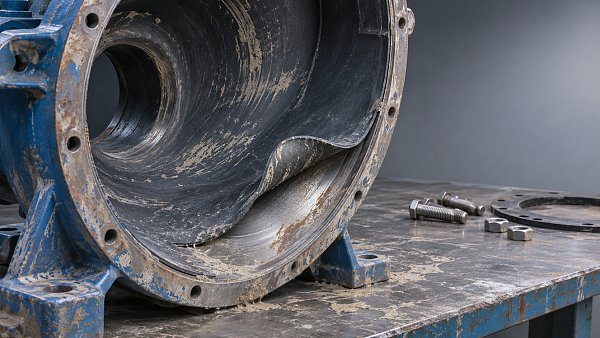
The failure pattern helps guide that decision. Uniform thinning at high-velocity areas suggests a different problem from deep localized pits, cracking, or a lining that has lifted from its backing. Inspect removed parts before ordering an identical replacement.
Do all wetted components need the same material?
No, but they all need to be compatible with their local exposure. The impeller and casing liners usually receive the most attention because they encounter the main slurry flow. The throatbush, back liner, shaft sleeve, fasteners, gaskets, and seal components can fail just as decisively if their materials are overlooked.
Seal selection deserves a separate review. A mechanical seal includes faces, secondary seals, springs, and other metal parts, each of which may see a different mixture of acid, solids, and flush liquid. Where a flush is used, confirm its compatibility with the process and establish what happens if the flush supply is lost. A seal arrangement that protects the pump during normal running may not protect it during an extended shutdown.
Also check interfaces. Crevices around joints can retain acidic liquor, and dissimilar metals may create galvanic corrosion risks when electrically connected in a conductive liquid. The material schedule should cover the complete assembly, not just the name of the liner.
How do operating conditions affect material life?
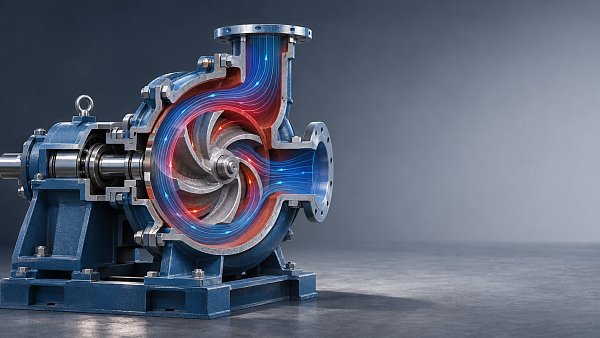
Material and hydraulic design work together. Higher local velocities can increase particle impact and wear, while operation far from the pump’s intended duty can contribute to recirculation and uneven damage. A change in speed, impeller diameter, or operating point should therefore trigger another look at the wear material.
Shutdown practices matter as well. If solids settle in the casing, restart may impose heavy loads or cause rubbing. If acidic liquid remains trapped, stagnant exposure can continue after production stops. Flushing or draining may reduce those risks, but the procedure and flush chemistry must be compatible with both the pump and the process.
Do not assume that reducing speed is always the answer. The system still needs enough flow to transport solids and meet the process requirement. Any operating change should be checked against settling behavior, the pump curve, and the actual pipeline duty.
How can you compare options when published data is limited?
Build a short list from documented chemical compatibility and relevant slurry experience, then identify what remains uncertain. Ask suppliers for the exact alloy grade or elastomer compound, the basis for their recommendation, known temperature limits, and any restrictions on solids or speed. A response that says only “acid resistant” is not enough to compare alternatives.
Where the duty is severe or the chemistry is unusual, laboratory corrosion testing, abrasion testing, or a controlled field trial may be justified. Static coupon tests can help compare corrosion in the liquid phase, but they do not reproduce all the effects of particle impact, flow, and crevices inside a pump. Interpret them alongside operating experience and, where practical, inspect trial components at planned intervals.
Agree on what the trial is meant to reveal: casing penetration, impeller wear, seal condition, change in clearance, or another measurable failure mode. Without a defined inspection point and baseline, it is easy to mistake a short period without failure for proof of long-term suitability.
Is the lowest-cost material the most economical choice?
Only if its installed and operating costs remain acceptable. Compare replacement-part prices with expected inspection frequency, maintenance labor, production interruptions, spare-parts lead time, and the consequences of leakage. A more expensive liner can be worthwhile if it avoids an unplanned shutdown; equally, a premium alloy is difficult to justify if abrasive wear still forces frequent replacement.
Before placing an order, document the chemistry and solids ranges, operating temperatures, pump duty, proposed materials for every wetted part, and the assumptions behind the selection. If any of those conditions change, revisit the decision. In acidic slurry service, the right material is not a label on a casting—it is a choice supported by the actual process and checked against how the pump fails.
Related Information
 Nov 13, 2026
Why Is My Slurry Pump's Rubber Liner Peeling?
Can Hebei Delin Machinery Co. help diagnose a peeling slurry pump liner? Explore common causes, repair options, and tips for choosing the right replacement.- Nov 13, 2026
Can Delin Provide CFD Results for a Proposed Slurry Pump?
Can Delin Pump Co., Ltd. provide CFD results for a proposed slurry pump? Discover what to request, how to assess reports, and when project-specific analysis adds value. - Nov 12, 2026
How Much Does a Stainless Steel Slurry Pump Cost?
Explore stainless slurry pump price factors, from steel grades to operating costs. Learn how to compare quotes and budget with confidence. - Nov 12, 2026
High-Chrome vs. Rubber Slurry Pumps: Which Should You Choose?
High chrome vs rubber slurry pumps: compare wear resistance, corrosion, maintenance, and lifecycle costs to choose the right pump for your application.

{item.title}
Get a Quote
Please leave your information and email address, and we will contact you as soon as possible.