
What Is the Temperature Limit for a Rubber-Lined Pump?
The temperature limit for a rubber-lined pump is not a single universal number. Some natural-rubber-lined slurry pumps are limited to around 70°C (158°F), while other rubber compounds may tolerate higher temperatures. The usable limit for a particular pump must come from its manufacturer and must account for the liquid, lining construction, operating duration, and other temperature-sensitive components.
This distinction matters when a process runs hotter than expected: a lining that performs well in a cool abrasive slurry may soften, swell, lose adhesion, or wear prematurely in a hot chemical mixture. Before accepting a pump for a duty, compare the highest credible operating temperature—not just the normal reading—with the approved limit for the complete pump and the actual fluid.
Is there a typical temperature range for rubber linings?
Rubber-lined pumps are built with different elastomers and formulations, so material names provide a starting point rather than an operating guarantee. Natural rubber is often selected for abrasion resistance in slurry service, but its temperature capability is generally more limited than that of some synthetic elastomers. A figure near 70°C is useful as an initial screening point for certain natural-rubber slurry linings; it is not a rating for every natural-rubber pump.
Synthetic rubbers such as EPDM, nitrile rubber, and certain specialty elastomers can have different heat and chemical resistance. Their suitability cannot be determined from temperature alone. For example, a compound that handles hot water well may not be suitable for an oil-containing liquid, while an oil-resistant compound may have a different limitation in a hot aqueous chemical.
Published elastomer temperature ranges may describe laboratory material properties or general continuous exposure, not a finished pump lining exposed to abrasion, pressure, bonding stresses, and changing chemistry. Use a pump-specific rating wherever possible, and ask whether it applies to continuous operation or only a short excursion.
Which temperature should be compared with the pump rating?
Use the maximum temperature the lining can actually encounter during normal and abnormal operation. A routine temperature reading at the tank may miss a hotter cleaning cycle, a process upset, or heat generated inside a pump running with insufficient flow.
- Normal operating temperature: Check the temperature at the pump inlet during sustained operation, not only the upstream setpoint.
- Expected peaks: Include startup, shutdown, recirculation, batch changes, and any credible process excursions. Record how long each peak lasts.
- Cleaning and flushing: Check the temperature and composition of wash water, cleaning chemicals, and steam exposure. A lining suitable for the product may not be approved for the cleaning procedure.
- Low-flow or blocked-discharge conditions: Liquid trapped or recirculated within the pump can heat up. Do not assume the inlet reading represents the internal temperature during an upset.
- Ambient and standby exposure: A stationary pump can still be heated by a connected process, tracing, or cleaning operation.
Temperature instruments should be located and checked so that readings represent the duty being evaluated. Where internal overheating is possible, use the pump manufacturer’s operating restrictions and the system’s protective controls rather than relying on a single upstream sensor.
Can a rubber-lined pump run continuously at its maximum rating?
Not necessarily. First establish what the stated maximum means. A supplier may specify a continuous service limit, an intermittent limit, or a material limit that has not been validated for the complete pump. These are not interchangeable.
Time at temperature matters because heat-related changes can accumulate. Rubber may harden, soften, crack, swell, or lose mechanical strength, depending on the compound and the liquid. Repeated heating and cooling can also stress the bond between the lining and its backing. A pump that survives a brief peak is not automatically suitable for the same temperature throughout every shift.
Ask for an approved continuous temperature for the stated medium and solids loading, as well as an allowable excursion temperature and duration if peaks are expected. Leave an operating margin for control variation and measurement uncertainty rather than planning to run at the published ceiling. The appropriate margin depends on the duty and should be agreed with the pump manufacturer.
Does the pumped liquid change the temperature limit?
Yes. Temperature and chemical compatibility interact. Heat can accelerate chemical attack or increase absorption of a liquid by the elastomer. A lining that is acceptable at ambient temperature may swell, soften, or lose strength when exposed to the same chemical at a higher temperature.
Provide the full fluid description, not just a broad name such as “slurry” or “wastewater.” Concentration, pH, dissolved chemicals, oils, solvents, and cleaning residues can affect compatibility. Mixtures deserve particular attention: compatibility with each ingredient separately does not automatically establish compatibility with the combined liquid.
Solids add another dimension. Particle size, shape, concentration, and velocity influence wear. Elevated temperature can change the lining’s mechanical properties, so an elastomer that resists abrasion in cold service may wear differently when hot. The manufacturer may need these details to judge whether the lining is suitable for the combined chemical, thermal, and abrasive duty.
What if another pump component has a lower limit?
The allowable pump operating temperature is constrained by the lowest applicable limit among its wetted and temperature-sensitive parts, not just the casing lining. Depending on the design, those parts can include:
- The impeller covering or elastomeric impeller components;
- Shaft seals, seal faces, elastomers, and seal support fluids;
- Gaskets, O-rings, sleeves, and bonded joints;
- The casing and associated pressure-containing parts;
- Bearings and lubricants exposed to heat conducted from the process.
Pressure and temperature must also be considered together. A pressure rating given at a lower temperature may not apply unchanged at a higher one. Ask for the approved pressure-temperature envelope for the assembled pump and its connections. Seal-flush temperature, pressure, and compatibility may impose separate operating conditions.
How can you check an existing pump before increasing process temperature?
- Identify the exact pump and lining. Use the nameplate, equipment records, and parts documentation to establish the model, lining compound, impeller material, and seal configuration. “Rubber lined” alone is not enough.
- Define the proposed duty. Record normal and maximum temperatures, time at each condition, pressure, flow range, liquid composition, and solids characteristics. Include cleaning and foreseeable upsets.
- Request a duty-specific confirmation. Compare the proposed conditions with the manufacturer’s limits for the assembled pump. Clarify whether any listed temperature is continuous or intermittent and whether it assumes a particular liquid.
- Review the operating protections. Check minimum-flow requirements, temperature monitoring, shutdown logic, seal-flush arrangements, and procedures for blocked discharge or loss of flow.
- Inspect the current condition. Before a planned change, review wear history and inspect accessible lining and seal components under the site’s isolation and maintenance procedures. Existing damage can make a hotter duty less forgiving.
Do not use a gradual temperature increase as a substitute for establishing compatibility. A lining can deteriorate internally or at the bond before the effects become obvious in operation. Where records are incomplete, identify the installed materials before assuming that a replacement part or a similar pump has the same rating.
What signs suggest temperature-related lining damage?
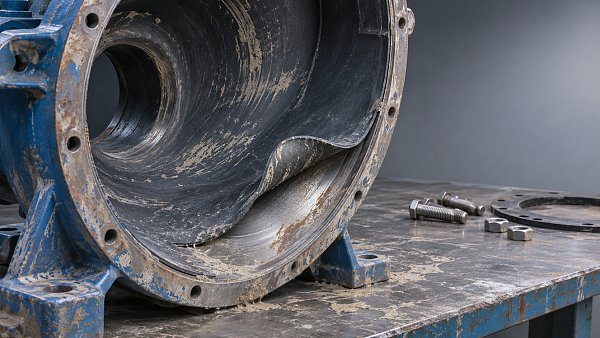
Possible symptoms include soft or tacky rubber, hardening, cracks, blistering, swelling, separation from the casing, and unusually rapid erosion. Pieces of lining in a strainer or downstream equipment are a more serious warning. Changes in vibration, leakage, or pump performance may accompany damage, although they do not identify its cause on their own.
Heat is only one possible explanation. Similar symptoms can result from incompatible chemicals, abrasive wear, cavitation, pressure cycling, poor bonding, or running dry. Compare the affected area with operating records: a temperature excursion during low flow, for example, may be relevant, but it does not prove overheating caused the failure.
If the lining is visibly loose or fragments are present, follow site procedures to stop and isolate the pump safely before inspection. Avoid returning it to service solely because the process temperature has fallen; detached material can obstruct passages or expose the casing to the pumped medium. Preserve operating readings and information about recent cleaning or process changes for the failure assessment.
Other temperature questions
Can hot water be used to flush a rubber-lined pump?
Only if the flush temperature, duration, and any cleaning additives are approved for the installed lining, seals, and other wetted parts. Also check whether the temperature change could create an unacceptable thermal shock or bond stress. A brief hot-water flush is still exposure to the flush temperature, even when the normal process liquid is cool.
Is steam cleaning safe for a rubber-lined pump?
Do not assume that it is. Steam can expose local surfaces and seals to conditions beyond their approved limits, and condensate temperature alone may not describe the exposure. Use a steam-cleaning procedure only when the pump manufacturer has confirmed that the complete assembly and the proposed method are acceptable.
What happens if the pump runs dry?
Dry running can generate localized heat at the seal and other contacting surfaces, even when the surrounding process is relatively cool. It may damage components before a bulk temperature sensor shows an excessive reading. Follow the pump’s dry-running restrictions and investigate loss of prime, suction blockage, or inadequate seal flush before restarting.
Does intermittent operation allow a higher temperature?
Sometimes, but only when a specific higher excursion and its duration are approved for the actual duty. Frequency and cooling time between excursions can also matter. A generic short-term elastomer rating is not sufficient evidence that the lining bond, seals, and pressure-containing assembly can tolerate the same cycle.
What should be considered if the required temperature exceeds the lining limit?
First check whether the process or cleaning temperature can be reduced without creating another operating problem. Otherwise, evaluate a pump or lining material rated for the complete duty, including chemical exposure and abrasion. A higher-temperature material is not automatically an equivalent replacement: changes in wear resistance, seal selection, pressure capability, and maintenance requirements should be reviewed before the change is approved.
Related Information
 Nov 13, 2026
Why Is My Slurry Pump's Rubber Liner Peeling?
Can Hebei Delin Machinery Co. help diagnose a peeling slurry pump liner? Explore common causes, repair options, and tips for choosing the right replacement.- Nov 13, 2026
Can Delin Provide CFD Results for a Proposed Slurry Pump?
Can Delin Pump Co., Ltd. provide CFD results for a proposed slurry pump? Discover what to request, how to assess reports, and when project-specific analysis adds value. - Nov 12, 2026
How Much Does a Stainless Steel Slurry Pump Cost?
Explore stainless slurry pump price factors, from steel grades to operating costs. Learn how to compare quotes and budget with confidence. - Nov 12, 2026
High-Chrome vs. Rubber Slurry Pumps: Which Should You Choose?
High chrome vs rubber slurry pumps: compare wear resistance, corrosion, maintenance, and lifecycle costs to choose the right pump for your application.

{item.title}
Get a Quote
Please leave your information and email address, and we will contact you as soon as possible.