
Which Spare Parts Should You Stock for Slurry Pump Breakdowns?
Which Spare Parts Should You Stock for Slurry Pump Breakdowns?
A slurry pump breakdown can bring an entire processing line to a halt, making the right spare parts inventory essential for minimizing downtime. If you’re asking, “What spare parts should I keep in stock for slurry pump breakdowns,” start with components exposed to abrasive wear and common failure modes: impellers, liners, shaft sleeves, seals, and bearings. However, the best stocking strategy depends on your pump design, slurry characteristics, operating conditions, and supplier lead times.
The practical question is not simply which parts can fail. It is which failures your maintenance team must be able to recover from before production losses become unacceptable. A warehouse full of loose components is little help if one missing sleeve, gasket, or mounting detail prevents reassembly.
This guide focuses primarily on centrifugal slurry pumps used in mineral processing, aggregate washing, and other solids-handling applications. Positive-displacement slurry pumps require different spare lists, including design-specific diaphragms, valves, or rotors.
Build the core inventory around wear and repair tasks
For a centrifugal slurry pump without immediately available standby capacity, the starting point is a compatible wet-end repair set, the correct sealing components, and the parts needed to restore the bearing assembly. Exactly what belongs in each set should come from the pump’s assembly drawing and maintenance manual—not a generic catalogue description.
Impellers and wet-end liners
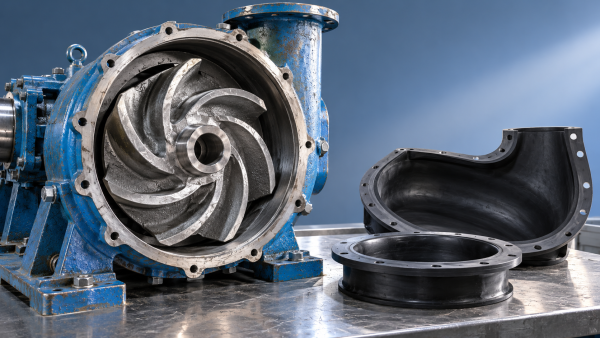
Impellers, throatbushes, frame-plate liner inserts, and casing liners are priority candidates where fitted. These surfaces encounter solids directly, so wear can change internal clearances, reduce hydraulic performance, and eventually cause leakage or structural damage. Terminology varies by manufacturer; some designs use an unlined metal casing rather than replaceable liners.
Stock these parts as a repair group when inspection history shows they reach their replacement limits together. An impeller alone may not restore performance if the adjacent throatbush is badly worn. Conversely, replacing every wet-end component at each intervention can waste usable service life. Base the grouping on measured wear and the manufacturer’s inspection criteria.
Material selection matters as much as dimensions. High-chrome alloys and elastomers respond differently to abrasion, corrosion, particle shape, temperature, and chemical exposure. Do not substitute one for another simply because it is available sooner. A material change may also require matching components or a review of the operating conditions.
Shaft sleeves and sealing components
A worn sleeve can undermine a sealing repair. Where the seal arrangement uses a replaceable shaft sleeve, keep the correct sleeve and its associated O-rings or gaskets alongside the sealing parts.
For packed pumps, retain the specified packing material and size, plus lantern rings and gland hardware where replacement is justified. Packing length alone does not establish suitability: slurry chemistry, shaft speed, temperature, and flush-water requirements also matter.
Mechanical-seal pumps may justify a complete replacement cartridge or assembly rather than loose faces and elastomers. This depends on the seal design and whether your workshop can rebuild and verify it correctly. Expeller-sealed pumps need their own assessment, including the expeller and any secondary sealing components. These arrangements are not interchangeable spare-parts packages.
Bearings and bearing-assembly parts
Stock bearings using the complete specified designation, including any required clearance, precision, or arrangement details. Matching bore and outside diameter is not enough. Include housing seals, locking devices, gaskets, and specified lubricant when they are necessary to complete the repair.
On a critical pump, a complete interchangeable bearing assembly may reduce restoration time more effectively than loose bearings. It can move precision assembly work off the immediate breakdown path. Confirm, however, that the replacement assembly matches the shaft, frame, drive connection, and adjustment arrangement, and that installation still includes the required alignment checks.
Do not overlook the inexpensive parts that stop reassembly
Small items are easy to omit because they attract little purchasing attention. They can still determine whether the pump returns to service during the maintenance window.
- Joint seals and gaskets: Keep the design-specific items required when opening the casing, seal housing, or bearing housing.
- Fasteners and retention hardware: Include specified studs, nuts, washers, keys, and locking components that are damaged during removal or require renewal.
- Drive consumables: Where fitted, hold the correct coupling element or belt set. Belt profiles, lengths, and matching requirements must follow the drive specification.
- Seal-water service parts: Assess strainers, regulators, valves, and instrumentation whose failure could disable the sealing system.
Package these items by repair task. A wet-end replacement kit should contain the consumables needed to open and rebuild that wet end—not an assortment of similar-looking seals. Keep the kit contents visible so replenishment does not depend on someone remembering what was used.
Decide what belongs on site—and what can wait
Not every component deserves a shelf position. Separate predictable wear consumption from low-frequency, high-consequence failures.
Wet-end parts may need routine replenishment because their consumption follows operating hours and slurry duty. A shaft, casing, or motor may fail less often, yet become a priority if it has a long replenishment lead time and there is no workable backup. Purchase price alone is a poor measure of stocking importance.
For each pump, check four things: the production consequence of failure, usable standby capacity, the likely repair scope, and the time required to obtain a verified replacement. Standby capacity should mean a pump that is connected, maintained, and capable of handling the current duty—not merely one listed on an asset register.
Supplier availability also needs scrutiny. “In stock” may refer to an unfinished casting, a different material, or stock held far from the site. Ask whether quoted lead time includes machining, inspection, shipment, and any relevant import procedures.
For a severe production bottleneck, compare individual spares with a complete rotating assembly or a ready-to-install spare pump. The larger purchase can be justified when workshop rebuilding is slower than the permitted outage. Installation access, lifting capacity, alignment, and commissioning requirements still affect the actual recovery time.
Set quantities from consumption and replenishment exposure
There is no reliable universal rule such as “one impeller per pump” or “two sets for every plant.” A shared inventory can cover identical pumps, but only if their parts are genuinely interchangeable and simultaneous demand has been considered.
A useful planning basis is expected consumption during replenishment lead time, plus an allowance for uncertainty. Calculate consumption from your maintenance records wherever possible. Distinguish planned replacements from emergency failures; combining them can hide whether demand is predictable or driven by abnormal operation.
For a new installation without service history, begin with the manufacturer’s recommended commissioning and operating spares, then review the list after actual inspections. Track operating hours, wear measurements, slurry changes, and replacement reasons. Calendar intervals alone can be misleading when production rates vary.
Reorder before the next expected repair consumes the final serviceable set. Where several pumps process the same abrasive material, a process change may shorten wear life across the fleet at once. Historical average consumption will not fully capture that exposure.
Verify fit before the breakdown
A part that looks correct can still be unusable. Pump size, model family, and a supplier’s cross-reference are starting points, not final proof of compatibility.
Record the equipment serial number, assembly revision, part number, material specification, and sealing arrangement. For components affected by rotation or attachment details, confirm those details too. Document any field modifications; older pumps may no longer match their original configuration.
Alternative suppliers can improve availability, but dimensional fit is only one part of qualification. Depending on the component, review material documentation, manufacturing tolerances, impeller balance requirements, and inspection records. A trial on a suitable noncritical duty may be more prudent than introducing an unverified part during an emergency shutdown.
Inspect incoming spares promptly. Discovering transit damage or an incorrect sleeve length at receipt leaves time to resolve it; discovering it during a breakdown does not.
Keep spares usable, and investigate repeat failures
Inventory is only useful if it remains serviceable. Protect machined surfaces from corrosion and impact, retain bearing packaging, and store elastomers according to the supplier’s environmental and shelf-life instructions. Heavy liners and impellers need secure supports that prevent deformation or damage. Stored assemblies may also require periodic preservation checks.
Keep each item traceable to its approved application. Separate unused stock from removed parts awaiting inspection; “probably reusable” is not an acceptable status for an emergency spare.
Repeated failures should trigger diagnosis, not just a higher stock level. Bearing damage may involve lubrication, contamination, alignment, or loading. Seal failures may involve inadequate flushing or unsuitable operating conditions. Rapid wet-end wear may reflect slurry changes, excessive speed, or operation outside the intended duty range.
Before restarting after a breakdown, follow the manufacturer’s checks and site isolation procedures, and address the cause as far as practicable. Otherwise, the spare can inherit the same failure mechanism.
Start with the pump whose outage would cause the greatest disruption. Walk through one complete repair using its drawing, stocked parts, tools, and lifting arrangements. Any missing item is a concrete inventory gap. That exercise produces a more useful stocking plan than buying a broad list of components without knowing whether they can restore the pump.
Related Information
 Oct 24, 2026
How Much Should a Froth Pump Be Oversized for Flotation Concentrate?
How much should a froth pump be oversized for flotation concentrate? Learn how inlet air, peak flow, and head affect sizing to avoid costly mistakes and select the right pump.- Oct 24, 2026
Is Higher Hardness Always Better for High-Chrome Pump Castings?
Is higher hardness always better for high chrome pump castings? Discover how toughness, carbide structure, and slurry conditions affect service life—and choose smarter to reduce downtime. - Oct 23, 2026
Which Leakage Test Should You Specify for a Zero-Leakage Knife Gate Valve?
Which leakage test should I specify when ordering a zero-leakage knife gate valve? Compare API 598 and ISO 5208, define seat leakage limits, and avoid costly purchasing mistakes. - Oct 23, 2026
Which Pump Material Lasts Longest in Limestone-Gypsum FGD Slurry?
Which pump material lasts longer in limestone-gypsum desulfurization slurry? Compare high-chrome iron, rubber and duplex steel to find the right fit, reduce downtime and extend service life.

{item.title}
Get a Quote
Please leave your information and email address, and we will contact you as soon as possible.