
How to Select a High-Concentration Slurry Pump for Tailings Disposal
How to Select a High-Concentration Slurry Pump for Tailings Disposal
Selecting a high-concentration slurry pump for tailings disposal starts with understanding the actual slurry, pipeline duty, and operating risks rather than simply choosing the largest available pump.
The correct selection balances solids concentration, particle abrasiveness, required head, pipeline length, material wear, seal reliability, and lifecycle cost across normal and upset operating conditions.
For mine operators and mineral-processing teams, the key question is straightforward: can the pump transport dense tailings consistently without excessive energy use, repeated blockages, or premature component failure?
A pump that appears adequate at design flow may still underperform when tailings density rises, particle distribution changes, or the discharge line develops additional resistance over time.
This guide explains how to evaluate a high concentration slurry pump for tailings disposal using operating data, hydraulic calculations, material selection, and maintainability criteria that support informed purchasing decisions.
Start With the Tailings Characteristics, Not the Pump Catalog
The slurry itself determines the selection window. Before comparing pumps, collect representative data on solids concentration, slurry density, particle size distribution, hardness, shape, temperature, and chemical composition.
High-concentration tailings commonly contain enough solids to alter viscosity, settling behavior, and friction losses substantially. Water-based pump curves alone cannot accurately predict performance under these conditions.
Express solids concentration by weight and volume, because both matter. Weight concentration helps define mass transport, while volume concentration strongly affects slurry rheology and hydraulic resistance.
Slurry density is particularly important because it affects pump power demand. A denser mixture requires more torque, increasing the risk of motor overload when operating conditions change.
Particle size distribution should include both coarse and fine fractions. Coarse particles influence settling velocity and wear, while fines can raise viscosity and create non-Newtonian flow behavior.
Hard, angular particles usually produce more aggressive erosive wear than rounded particles of the same size. Mineralogy therefore matters alongside nominal particle diameter.
Ask whether the tailings contain corrosive process water, chlorides, acids, or reagents. Corrosion and abrasion together can shorten wet-end life much faster than abrasion alone.
Operators should also identify maximum credible solids concentration, not only the average value. Tailings systems must survive thickener fluctuations, process upsets, and temporary reductions in dilution water.
A practical data sheet should state normal, minimum, and maximum flow rates; expected density range; solids size range; largest particle; temperature; pH; and available suction conditions.
Without that information, suppliers may select from broad assumptions. The resulting pump can be inefficient, undersized for upset conditions, or unnecessarily expensive for the actual duty.
Calculate Flow, Head, and Pipeline Resistance as One System
A high concentration slurry pump for tailings disposal cannot be selected from flow rate alone. The pump must overcome total dynamic head across the entire transport system.
Total dynamic head includes static elevation, pipeline friction, fittings, valves, bends, discharge equipment, and pressure losses caused by slurry behavior rather than clean-water flow.
Long tailings lines often make friction head the dominant design factor. Small errors in estimating friction loss can translate into major differences in required pump pressure and energy consumption.
Pipeline diameter deserves close attention. A smaller line reduces initial pipe cost but increases velocity, wear, friction losses, and power demand throughout the system’s operating life.
An oversized pipe can reduce friction but may allow solids to settle during low-flow operation. The preferred diameter maintains adequate transport velocity without creating avoidable wear.
Determine the minimum settling or deposition velocity for the tailings. The pump and control system should keep actual velocity above that threshold across realistic operating conditions.
Include elevation changes and route geometry in the model. High points, long horizontal sections, sharp bends, and unstable pipeline supports can create operational problems beyond simple head loss.
Consider pipe roughness and aging. Internal wear, scaling, deposits, and modified line sections change resistance over time, so the design should include an appropriate operating margin.
Use slurry-specific hydraulic modeling whenever possible. A qualified pump supplier or engineering consultant can apply measured slurry properties instead of relying on generic correction factors.
The final duty point should show a stable operating region on the pump curve. Continuous operation too far left or right of best efficiency can increase vibration, recirculation, wear, and energy use.
Choose a Pump Type Built for Dense, Abrasive Transport
Most tailings disposal applications use centrifugal slurry pumps because they provide continuous flow, practical maintenance access, and scalability for large pipeline systems.
However, not every centrifugal design is suitable for high-concentration service. The pump must have hydraulic passages and impeller geometry designed to pass solids without frequent blockage.
Large-particle tailings generally require wider passages and a larger impeller clearance allowance. Fine, viscous tailings may instead demand geometry that maintains efficiency under elevated friction losses.
Horizontal slurry pumps are common where access, space, and maintenance equipment are available. They are often preferred for primary transport stations and high-capacity tailings pipelines.
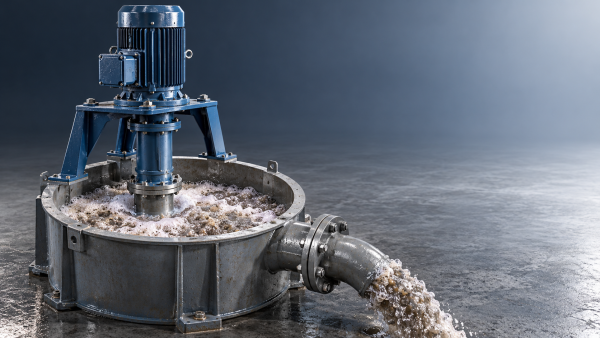
Vertical sump pumps can be useful for collection pits, thickener underflow areas, or locations where suction conditions are difficult. Their suitability depends on submergence, solids behavior, and service access.
For exceptionally dense pastes or strongly non-Newtonian materials, positive displacement equipment may be considered. These systems can provide higher pressure but introduce different maintenance and control requirements.
Multistage arrangements may be necessary when head requirements exceed a single pump’s practical capability. Series pumping must be engineered carefully to prevent unstable operation and pressure-related failures.
Do not assume a larger impeller automatically solves a difficult duty. Larger components may raise head, but they can also increase power draw, speed-related wear, and structural loading.
Review the pump’s published performance data for slurry service, not only water testing. Ask how the manufacturer adjusts head, efficiency, and power predictions for your specific tailings mixture.
A credible supplier should explain the limitations of the proposed duty point, recommended operating range, expected wear parts, and consequences if the slurry becomes denser than specified.
Select Wet-End Materials for the Actual Wear Mechanism
Wet-end material selection strongly influences operating cost. The impeller, casing, throatbush, liners, and other slurry-contact components must resist the dominant wear mechanism.
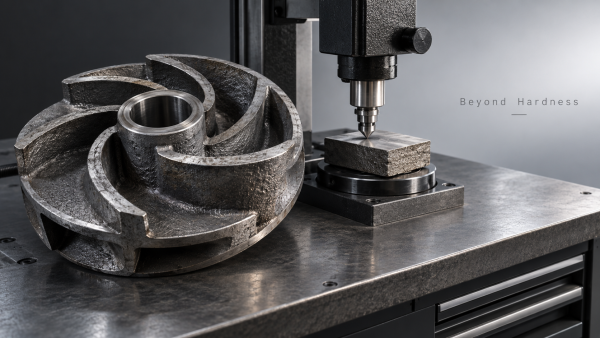
High-chrome white iron is widely used for abrasive tailings because it offers strong resistance to sliding abrasion. It is often effective when particles are hard and service conditions are not highly corrosive.
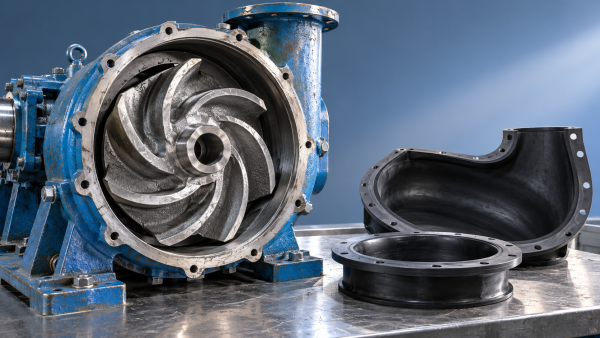
Rubber or elastomer linings may perform well with fine particles, lower impact conditions, and certain chemical environments. Their resilience can reduce damage from repeated particle contact.
Elastomer components are not universally suitable. Large, sharp, or high-velocity particles can tear or cut them, while elevated temperatures may limit their useful life.
Stainless steel, duplex alloys, specialty alloys, or composite materials may be required when chemical corrosion is significant. Material choice should be based on corrosion data, not general assumptions.
Consider component thickness and replacement design as well as alloy type. A more expensive material can be economically justified when it extends service intervals and reduces shutdown exposure.
Wear is rarely uniform across a pump. Impeller leading edges, casing cutwater areas, throatbushes, and seal regions may degrade at different rates depending on speed and particle trajectory.
Ask suppliers for estimated wear life based on comparable service, while recognizing that site-specific slurry variation can cause meaningful differences. Historical plant data is the most valuable benchmark.
Material selection should support predictable maintenance. A lower-cost liner that fails unpredictably can create more lost production than a higher-cost component with a stable replacement interval.
Confirm Suction Conditions and Seal Arrangement Early
Dense slurry pumping depends on reliable inlet conditions. Poor suction design can cause cavitation, air entrainment, unstable flow, excessive vibration, and accelerated wear before the slurry reaches the impeller.
Calculate available net positive suction head using the actual slurry conditions. Verify that it exceeds the pump requirement with sufficient margin during low tank levels and high-density operation.
Keep suction piping short, adequately sized, and free from unnecessary restrictions. Long suction runs, abrupt reducers, poorly positioned valves, and trapped air pockets create avoidable hydraulic instability.
Feed box design matters because high-concentration slurry may not distribute evenly into the pump inlet. Uneven entry can promote localized wear and reduce hydraulic performance.
Seal selection must reflect pressure, solids content, water availability, and environmental requirements. The correct seal arrangement helps prevent leakage without introducing excessive dilution to the tailings stream.
Expeller seals can reduce gland-water requirements in suitable slurry services. Mechanical seals may be appropriate where leakage control is critical, but they require compatible operating conditions and disciplined maintenance.
Gland packing remains practical in many mining applications, particularly where flush water is reliable. The tradeoff is water consumption, wear, adjustment needs, and potential contamination concerns.
Evaluate seal-water quality and pressure where applicable. Dirty or inadequate flush water can damage packing or mechanical seal faces and turn a manageable wear item into a chronic reliability issue.
For tailings circuits with restricted water balances, quantify every source of added water. Seal choices can affect downstream thickener performance, deposition plans, and overall water-recovery targets.
Size the Drive, Controls, and Operating Margin Correctly
The motor must be sized for maximum expected slurry density and operating head, not merely for the normal point. Underestimating power demand can cause overload trips and lost production.
Include a reasonable power margin, but avoid excessive oversizing. An oversized motor may increase capital cost and can obscure developing pump or process problems that should trigger investigation.
Variable-frequency drives can help operators accommodate changing tailings flow, density, and pipeline resistance. They are most useful when supported by a clear operating envelope and control strategy.
Speed reduction often lowers wear and power consumption when process demand allows it. However, reducing speed too far may drop pipeline velocity below the deposition threshold.
Install pressure, flow, density, vibration, bearing-temperature, and motor-load monitoring where the criticality justifies it. These signals allow operators to identify degradation before a failure develops.
Discharge pressure trending is especially valuable. A rising pressure at stable flow may indicate blockage or changing slurry characteristics, while falling pressure can signal internal wear or recirculation.
Automated protection logic should address low-flow operation, dry running, high vibration, high bearing temperature, and overload. Shutdown limits should reflect real process risk rather than generic settings.
Where pipelines are long or terrain is challenging, consider surge analysis. Rapid starts, stops, valve movement, and power failures can create transient pressures that exceed equipment ratings.
Compare Lifecycle Cost Instead of Purchase Price
The purchase price of a slurry pump is only one part of the decision. Energy, wear parts, labor, downtime, water use, spare inventory, and production disruption often dominate total cost.
A highly efficient pump may justify a higher initial cost when it runs continuously at significant power. Calculate annual energy consumption using realistic operating hours and slurry duty.
Wear-part replacement cost should include more than the component price. Account for maintenance labor, lifting equipment, planned outage time, emergency repairs, and the production consequences of an unplanned stop.
Standardized pumps can simplify spares management across a plant. Shared casings, impellers, seals, bearings, and drive components reduce inventory complexity and improve maintenance response times.
Availability is often more valuable than minor capital savings. A pump that operates predictably and can be rebuilt quickly supports stable tailings disposal, which protects upstream processing capacity.
Request a lifecycle cost comparison from shortlisted suppliers using the same duty assumptions. Check whether their estimates include energy price, wear rates, service intervals, and expected operating hours.
Be cautious with optimistic efficiency or wear-life claims that lack test conditions. The most useful proposals clearly identify assumptions and show how performance changes as density or flow varies.
Use a Practical Selection and Procurement Checklist
Before issuing a request for quotation, prepare a complete operating specification. This reduces ambiguity and makes supplier proposals easier to compare on technical and commercial merit.
Provide normal, minimum, and maximum slurry flow; solids concentration; density; particle data; temperature; pH; pipeline profile; required head; and anticipated future operating changes.
State whether the system must tolerate intermittent operation, standby starts, seasonal temperature changes, variable thickener underflow, or temporary pipeline extensions. These conditions can materially alter the design.
Ask suppliers to identify the selected pump size, speed, impeller diameter, efficiency, absorbed power, recommended motor, seal arrangement, wet-end material, and predicted operating range.
Require a description of minimum continuous stable flow and preferred operating range. This helps teams avoid selecting a pump that technically reaches the duty but operates unreliably in practice.
Request dimensional drawings, foundation loads, nozzle loads, maintenance clearances, lifting requirements, instrumentation recommendations, and spare-parts lists early enough to influence plant layout.
Review the supplier’s service capability, local parts availability, commissioning support, and repair experience. A technically capable pump is less valuable if critical components are difficult to obtain.
For high-risk duties, consider a site trial, slurry test loop, or reference visit. Evidence from comparable tailings applications is more reliable than generic product literature.
Conclusion: Select for Stable Transport, Not Just Rated Capacity
The best high concentration slurry pump for tailings disposal is the one that maintains stable transport across real operating conditions while controlling wear, energy use, and maintenance exposure.
Start with accurate tailings data, model the complete pipeline, and select materials, seals, drive capacity, and controls around the worst credible duty rather than average conditions.
When technical selection is paired with lifecycle cost analysis and realistic maintenance planning, operators can reduce pipeline interruptions, protect production continuity, and improve the long-term economics of tailings disposal.
Related Information
 Oct 24, 2026
How Much Should a Froth Pump Be Oversized for Flotation Concentrate?
How much should a froth pump be oversized for flotation concentrate? Learn how inlet air, peak flow, and head affect sizing to avoid costly mistakes and select the right pump.- Oct 24, 2026
Is Higher Hardness Always Better for High-Chrome Pump Castings?
Is higher hardness always better for high chrome pump castings? Discover how toughness, carbide structure, and slurry conditions affect service life—and choose smarter to reduce downtime. - Oct 23, 2026
Which Leakage Test Should You Specify for a Zero-Leakage Knife Gate Valve?
Which leakage test should I specify when ordering a zero-leakage knife gate valve? Compare API 598 and ISO 5208, define seat leakage limits, and avoid costly purchasing mistakes. - Oct 23, 2026
Which Pump Material Lasts Longest in Limestone-Gypsum FGD Slurry?
Which pump material lasts longer in limestone-gypsum desulfurization slurry? Compare high-chrome iron, rubber and duplex steel to find the right fit, reduce downtime and extend service life.

{item.title}
Get a Quote
Please leave your information and email address, and we will contact you as soon as possible.