
How to Choose a Corrosion-Resistant Pump for Acid Mine Drainage
Acid mine drainage is not simply “low-pH water.” It is a chemically variable slurry that can combine sulfuric acidity, dissolved iron and other metals, oxidizing conditions, chlorides, suspended fines, and intermittent solids loading. A pump that survives a clean acid transfer duty may fail quickly when those conditions occur together. The right corrosion-resistant pump is therefore selected from the actual fluid envelope and operating pattern, not from pH alone or from a generic claim of acid resistance.
The central trade-off is usually between chemical corrosion resistance and resistance to abrasion. Materials that tolerate acidic liquor may be vulnerable to sharp mineral solids; materials that perform well in abrasive slurry service may corrode when acidity, temperature, chloride concentration, or oxidation potential changes. A reliable selection has to resolve that trade-off at the wetted-component, seal, hydraulic, and maintenance-system levels.
Define the drainage stream before specifying the pump
Acid mine drainage can vary substantially between collection points, seasons, mine phases, and treatment stages. Water from a pit sump, an underground collection system, a sedimentation pond, and a treatment plant feed tank may all be described as AMD while imposing very different duties on a pump.
A usable pump specification should identify the following conditions across the expected operating range rather than relying on one laboratory sample:
- pH and free acidity: pH indicates hydrogen-ion concentration, but total acidity better reflects the neutralization demand and can reveal dissolved metal species that later precipitate.
- Major ions: sulfate is common in AMD, while chloride can materially change the suitability of stainless steels and some alloys. Fluoride, if present, requires separate material review because it can attack materials that otherwise resist mineral acids.
- Dissolved metals and oxidation state: ferric iron can create a more oxidizing environment than ferrous iron. Dissolved iron, aluminum, manganese, copper, zinc, and other metals can also precipitate as pH rises or as the fluid aerates.
- Solids concentration and particle characteristics: percentage by weight is useful, but particle size, hardness, shape, and settling velocity affect wear and blockage risk. Fine silt and sharp quartz-bearing particles do not erode a pump in the same way.
- Temperature: chemical compatibility changes with temperature. A polymer or elastomer suitable at ambient conditions may have a narrower margin at elevated temperature.
- Flow and head range: inflow surges, drawdown, variable discharge elevation, long pipelines, and treatment-plant cycling can move the pump far from its best efficiency point.
- Gas and air entrainment: turbulent sumps, cascading inflows, and inadequate submergence can introduce air. This affects hydraulic performance, seal stability, and corrosion behavior.
Sampling also needs to reflect where the pump will actually operate. A clarified AMD stream downstream of a settling process may be appropriate for a chemically resistant process pump. Raw drainage at the bottom of a collection sump may need a slurry-duty wet end and a sump arrangement that prevents settled solids from accumulating around the intake.
Material selection is a system decision, not a casing decision
It is easy to focus on the casing material and overlook the impeller, shaft sleeve, fasteners, mechanical seal faces, gland components, wear liners, and elastomeric O-rings. In acidic service, the failure point is often the least compatible wetted or intermittently wetted part. A metallic shaft protected by a polymer-lined casing, for example, still needs an appropriate sleeve and seal-area design.
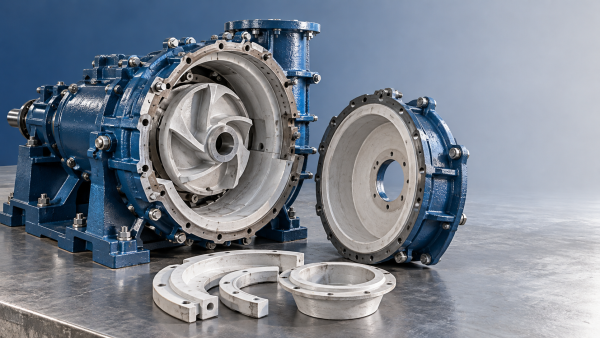
For raw AMD with meaningful abrasive solids, a rubber-lined centrifugal slurry pump is often evaluated because the liner can provide a corrosion barrier while accommodating particle wear. That is not a blanket recommendation. The elastomer must be selected against the actual liquor, and the pump’s allowable particle size, peripheral speed, and liner geometry must match the solids duty. A soft lining that is chemically sound can still be mechanically unsuitable for large, angular particles.
For low-solids drainage or treated acidic water, thermoplastic and fluoropolymer-based solutions may offer better chemical resistance than metallic alternatives. Polypropylene, HDPE, and PVDF each have different limits in acid concentration, temperature, and mechanical loading. PTFE-based wetted components can provide very broad chemical resistance, but design complexity, cost, and mechanical constraints make them more relevant to specialized chemical duties than to heavily abrasive drainage.
Metallic options require particular caution. Stainless steel is often assumed to be the safe upgrade from carbon steel, but acid resistance is not a single property. Sulfuric acid concentration, chlorides, dissolved oxidants, temperature, oxygen availability, and crevice conditions all influence performance. Material selection should be confirmed against the complete fluid analysis by the pump manufacturer or a corrosion specialist, especially where a metal alloy is being considered for continuous immersion.
The pump type must match solids behavior and installation geometry
Horizontal end-suction centrifugal pumps are practical where the liquid can be delivered reliably to a flooded suction and where maintenance access is important. They are common for transfer from ponds, process tanks, or collection stations. Their weakness in AMD service is often not the pump itself but the suction arrangement: long suction lines, air pockets, insufficient submergence, and settled solids can make an otherwise acceptable pump unstable.
Vertical sump pumps avoid some suction-line problems because the wet end operates below liquid level. They can be useful in pits and sumps where space is constrained or where the liquid level changes. The shaft, column, bearing arrangement, and splash-zone materials need close attention. Acid vapor and intermittent wetting can attack components above the normal liquid line, while solids accumulation at the sump floor can bury the inlet or create uneven loading.
Submersible pumps simplify installation in some collection duties, but they should not be selected merely because the pump will be immersed. The motor enclosure, cable jacket, cable entry, seals, cooling method, and abrasion resistance must all be appropriate for acidic slurry. A submersible unit may be operationally attractive where dry installation is impractical, yet retrieval arrangements and inspection intervals should be planned from the outset.
Where solids settle rapidly, the installation may require a sloped sump floor, agitation, recirculation, or a deliberate flushing arrangement. No wet-end material solves a duty in which dense deposits repeatedly enter the impeller in slugs beyond its solids capability. Conversely, an oversized slurry pump can produce unnecessary energy use and excessive internal velocity, accelerating liner and impeller wear.
Hydraulic selection should account for wear and changing system resistance
A corrosion-resistant pump can still be a poor choice if it spends most of its time far from its best efficiency point. AMD systems often operate under changing water levels, variable inflows, accumulating pipeline deposits, and changing treatment-plant backpressure. The duty point should therefore include minimum, normal, and maximum flow and head conditions.
Slurry increases density and may increase viscosity relative to clean water. These changes affect brake horsepower, head development, and efficiency. The correction should be based on slurry characteristics rather than a generic multiplier. A pump selected from a water curve alone can be undersized on motor power or unable to meet the required head after slurry corrections are applied.
Net positive suction head is equally important. Acidic drainage may contain entrained air, and warm or agitated liquid can reduce suction margin. Cavitation not only damages impellers; in corrosive liquid, it strips protective films and increases localized attack. Adequate NPSH available, conservative suction piping, correct inlet velocity, and stable submergence are more valuable than trying to compensate later with harder materials.
Variable-frequency drives can help manage fluctuating inflow and reduce throttling losses, but the operating envelope must be reviewed. At low speed, some pumps may not generate enough head to maintain line velocity. At high speed, wear rates, shaft deflection, vibration, and seal loading can rise. A VFD is a control tool, not a substitute for a properly sized hydraulic design.
Sealing strategy determines whether corrosion remains contained
Mechanical seals in AMD service face a difficult combination of corrosive liquid, abrasive particles, dry-running risk, and pressure variation. A standard seal arrangement designed for clean water may have a short and unpredictable service life in raw drainage.
For abrasive duties, an expeller or dynamic-seal arrangement may reduce leakage during operation, but it has limits during shutdown and may not be suitable where zero or very low emissions are required. Double mechanical seals with a compatible barrier or buffer system can provide added protection, particularly for hazardous or environmentally sensitive installations. Their value depends on support-system discipline: correct fluid, pressure control, temperature monitoring, and response to seal leakage.
Seal faces, secondary elastomers, springs, and metal hardware must all be compatible with the AMD chemistry. Silicon carbide is widely used for abrasion-resistant seal faces, but seal-face selection alone does not resolve chemical compatibility or dry-running exposure. In some sump applications, a seal-less vertical configuration or a cantilevered shaft arrangement may reduce dependence on a conventional mechanical seal, though this shifts attention to shaft stiffness, bearing location, and allowable immersion depth.
External flush plans should be treated carefully. Clean-water flushing can protect a seal, but it can also dilute process fluid, create contaminated effluent, or become a hidden failure mode if the water supply is interrupted. Where flushing is necessary, supply quality, flow verification, backflow prevention, and disposal of flush-contaminated liquid should be defined in the design basis.
Evaluate lifecycle cost through failure mechanisms
The lowest purchase price rarely identifies the lowest-cost solution for acid mine drainage. The more useful comparison is between anticipated failure mechanisms: liner wear, corrosion penetration, seal leakage, bearing damage, blockage, motor overload, unplanned lifting work, and treatment disruption.
A pump with replaceable liners and wear parts may be preferable when abrasive service is unavoidable and maintenance can be planned. A chemically robust polymer pump may be preferable for clarified acid where solids are controlled and corrosion is the dominant risk. A more expensive alloy may be justified only when its corrosion performance is established for the actual stream and when it removes a real maintenance or containment risk.
Spare-parts planning should follow the selected construction. Critical items commonly include impellers, liners or casings, shaft sleeves, seal cartridges or seal kits, bearings, gaskets, and compatible elastomers. Interchangeability matters in multi-pump sites: a fleet with several incompatible seal designs and wet-end materials can turn a straightforward maintenance task into a long outage.
Inspection points should reflect how the pump will fail. Wear monitoring may focus on casing thickness, liner condition, impeller clearance, vibration, motor current, seal leakage, and discharge pressure. A gradual fall in discharge pressure can indicate wear, recirculation, blockage, or system change; it should not automatically be interpreted as a need for more speed.
A defensible specification states the uncertainties
A well-chosen corrosion resistant pump for acid mine drainage is built around a documented fluid description, a realistic hydraulic envelope, and an installation review that includes solids management and containment. The specification should clearly distinguish raw drainage, settled slurry, clarified liquor, and treated water, because a pump suitable for one may be unsuitable for another.
When chemistry is variable, the appropriate response is not to select the most exotic material by default. It is to define the credible worst-case conditions, identify which variables materially affect compatibility, and require confirmation of all wetted materials and seal components against those conditions. That approach produces a pump selection that is easier to operate, maintain, and defend over its service life.
Related Information
 Oct 26, 2026
Why Slurry Pump Bearing Assemblies Overheat After Replacement
Slurry Pump Bearing Assemblies overheating after replacement? Discover how lubrication, preload, and alignment affect heat—and learn practical checks to prevent costly downtime.- Oct 26, 2026
Pump CFD Analysis: Identifying Recirculation and Erosion-Prone Zones
Pump CFD Analysis reveals recirculation and erosion-prone zones. Learn how to validate hotspots, guide design improvements, and support more reliable pump operation.  Oct 25, 2026
Are Double-Casing Slurry Pumps Cheaper to Maintain Than Single-Casing?
Is a double-casing slurry pump cheaper to maintain than a single-casing pump? Compare wear life, parts, labor, and downtime to find the best value for your operation.- Oct 25, 2026
How Do You Free a Slurry Knife Gate Valve Stuck Partly Open?
How do I free a slurry knife gate valve stuck partly open? Discover safe isolation steps, approved flushing methods, and repair checks to restore reliable operation and reduce downtime.


{item.title}
Get a Quote
Please leave your information and email address, and we will contact you as soon as possible.