
How Does the OEM Custom Order Process Work for Slurry Pumps?
How Does the OEM Custom Order Process Work for Slurry Pumps?
Understanding the Delin OEM slurry pump custom order process helps mining, mineral processing, and industrial buyers secure pumping solutions tailored to demanding operating conditions. From defining slurry characteristics and flow requirements to selecting materials, hydraulic designs, and sealing options, each stage affects pump reliability, efficiency, and service life. A slurry pump is rarely a simple catalogue purchase when abrasive solids, corrosive liquid, unstable feed conditions, or difficult installation constraints are involved.
The practical purpose of OEM customization is not to make every pump different. It is to identify which elements must be adapted to the duty and which proven components can remain standardized. That distinction matters. Excessive customization can add cost, complexity, and spare-parts risk, while an under-specified standard pump may wear quickly, consume unnecessary power, or operate too far from its best efficiency range.
A structured order process gives both the buyer and manufacturer a way to test assumptions before production begins. It turns a broad request such as “we need a pump for abrasive slurry” into a defined engineering scope: what is being pumped, how much, how far, at what pressure, in what environment, and with what maintenance expectations.
Customization Begins with the Pumping Duty, Not the Pump Model
Many custom pump discussions start with a reference model, an existing installation, or a competitor’s part number. Those details are useful, especially when interchangeability or plant layout is a concern. But they should not be the only basis for selection. A pump that performed acceptably in one circuit may fail in another because the slurry, pipework, elevation, or operating schedule has changed.
The manufacturer normally needs a duty point: required flow rate and total dynamic head. Total head is more than discharge pressure. It may include static lift, friction loss through pipework, losses through valves and cyclones, and the pressure required at the end-use equipment. If the system has variable operating conditions, one duty point is often not enough. The expected minimum, normal, and maximum operating conditions may all need review.
Slurry information is equally important. Relevant details typically include solids concentration, particle size distribution, particle shape, specific gravity, hardness, pH, temperature, and whether solids settle during shutdown. A fine tailings slurry behaves differently from coarse mineral concentrate, ash slurry, dredged sediment, or a chemically aggressive process stream. Even when laboratory data is unavailable, site observations can help: Does the line plug after a stop? Are wear liners eroding unevenly? Does the slurry contain occasional oversize particles or fibrous contaminants?
A good OEM review also asks how the pump will be used. Continuous operation, intermittent batch transfer, standby duty, and seasonal service can call for different design decisions. For example, a pump that starts frequently after solids have settled may require closer attention to suction conditions and starting torque than one operating steadily in a controlled circuit.
What Information Should a Buyer Prepare?
The best custom orders are built from a clear data package, but the package does not need to be perfect on day one. In many industrial projects, some process values are still being confirmed. The useful approach is to separate confirmed information from estimates and identify where uncertainty remains. This allows the pump supplier to flag decisions that should wait for validation rather than treating assumptions as fixed requirements.
- Required flow, head, operating hours, and expected duty range.
- Slurry composition, solids percentage, particle size, density, temperature, and chemical conditions where known.
- Suction arrangement, available liquid level, pipe diameters, line length, fittings, and discharge destination.
- Installation constraints such as footprint, baseplate arrangement, lifting access, noise limits, and connection orientation.
- Power supply, motor preference, control method, and whether variable-speed operation is planned.
- Required documentation, inspection expectations, packaging needs, and destination-market requirements.
- Existing pump drawings, photographs, wear-part samples, or dimensional requirements when replacement compatibility is needed.
For replacement projects, it is tempting to duplicate an old pump exactly. Sometimes that is necessary because pipework and foundations cannot be modified. Yet an OEM review may reveal that the old unit was oversized, repeatedly throttled, or fitted with materials unsuitable for the actual slurry. The replacement stage can therefore be an opportunity to correct a known weakness without forcing a major plant redesign.
Turning Process Data into a Pump Configuration
Once the duty is understood, the manufacturer evaluates hydraulic selection. This generally involves choosing a pump size, impeller diameter, rotational speed, and casing arrangement that can meet the required duty without operating in an unstable or excessively demanding part of the pump curve. Exact selection depends on the manufacturer’s hydraulic data and the final project conditions.
For slurry service, the selection cannot be based on clean-water assumptions alone. Solids can affect head, efficiency, wear rate, and suction behavior. The influence varies with particle size, concentration, density, and the particular slurry. A supplier should explain what assumptions have been made, especially where slurry test data is incomplete. Buyers do not need a lengthy theoretical calculation, but they should be able to see the selected duty, speed, power basis, and major design choices.
Wet-end materials and wear strategy
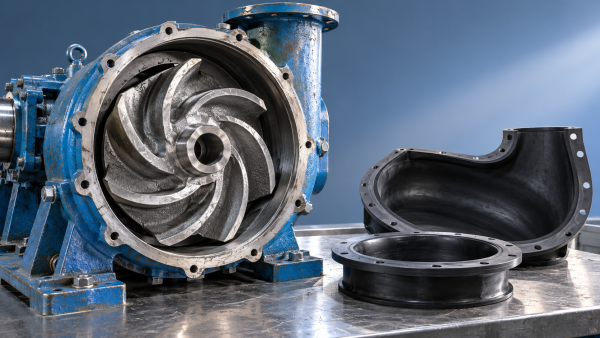
The wet end—typically including the casing, liners, impeller, throatbush, and other fluid-contact components—deserves close attention. Material selection is often a trade-off between abrasion resistance, corrosion resistance, impact tolerance, operating temperature, and replacement cost.
High-chrome white iron is commonly considered for abrasive slurry duties, while elastomer liners may be appropriate for selected fine-particle or less aggressive applications. Corrosive conditions can require alternative alloys or non-metallic materials. There is no universal “best” material. A hard alloy may resist sliding abrasion well but may not suit severe impact conditions; an elastomer may offer benefits in one particle regime and be unsuitable in another. The correct choice follows the actual wear mechanism, not a generic preference.
The OEM conversation should also cover whether the customer values the lowest initial cost, longer intervals between wet-end replacement, quicker maintenance, or a stocked spare-parts strategy. Those priorities can lead to different but valid configurations.
Sealing, shaft arrangement, and auxiliary systems
Sealing is another area where the process details matter. Depending on the application, a slurry pump may use an expeller-based arrangement, packing, a mechanical seal, or another engineered sealing solution. The right option depends on leakage tolerance, pressure conditions, availability and cleanliness of seal water, maintenance capability, and environmental or safety requirements.
Mechanical seals are not automatically the premium answer for every slurry application. They can be appropriate where controlled leakage is critical, but they also require correct supporting conditions. Packing may remain practical in services where minor leakage can be managed and maintenance access is straightforward. A well-run Delin OEM slurry pump custom order process should make these trade-offs visible rather than presenting the seal type as an isolated option.
Bearing arrangement, lubrication method, shaft design, drive type, guards, and baseplate details also affect reliability. In remote locations, maintenance teams may prefer arrangements that simplify routine inspection and use familiar components. In a confined processing plant, compact geometry and removable sections may matter more. These choices often appear minor on a quotation, but they become very real during a shutdown.
The Technical Proposal Should Be Reviewed, Not Just Approved
Before an order moves into production, buyers should review the technical proposal as an engineering document. At a minimum, it should communicate the proposed pump arrangement, rated duty, speed, motor or drive basis, materials, seal configuration, connection sizes, and any assumptions that affect performance or scope.
This is the stage to identify omissions. Is the motor included? Is the coupling guard part of the supply? Are instruments, seal-water piping, baseplates, bolts, or spare parts included or excluded? If a variable-frequency drive will be used, has the allowable speed range been considered? If the pump will be installed outdoors, are coating, enclosure, drainage, and storage conditions addressed?
A buyer’s approval should not mean “the drawing looks acceptable.” It should mean that process, mechanical, electrical, maintenance, and procurement stakeholders have reviewed the parts relevant to their responsibilities. This is especially useful on projects where the purchasing team is not the same group that will operate the equipment.
Production, Inspection, and Documentation
After technical approval, the order moves into manufacturing and assembly. The lead time depends on the configuration, material availability, machining requirements, motor selection, testing scope, and documentation requirements. For customized slurry pumps, the earliest realistic delivery discussion should happen before a purchase order is released, particularly if the project has a fixed shutdown window.
Inspection and testing requirements should be agreed in advance. Depending on the purchase specification, this may include dimensional checks, material-related records, assembly inspection, pressure testing where applicable, performance testing, or buyer witness arrangements. Not every order needs the same level of verification. The important point is that the agreed scope is clear and appropriate for the risk of the application.
Documentation is often treated as an administrative detail until equipment reaches site. In reality, outline drawings, installation instructions, operating guidance, parts lists, and recommended spare-parts information can reduce commissioning delays. If the pump is being exported, packing, marking, shipping dimensions, and destination-specific paperwork should also be clarified early rather than added at the end.
Common Mistakes That Create Avoidable Risk
The most common problem is incomplete slurry characterization. Buyers may provide a flow rate and a line size but omit solids concentration, particle information, or chemical conditions. The supplier can still make a preliminary proposal, but the uncertainty should remain visible. Treating an estimate as a confirmed process condition is a common route to disappointment.
Another issue is selecting the pump solely by discharge size or existing model name. Pipe connection size does not define the required hydraulic performance. Nor does a larger pump automatically provide a safer margin. Oversizing can lead to throttling, excess energy use, unstable operation, or avoidable wear depending on the system.
Buyers should also avoid separating the pump from the system around it. Poor suction pipe design, inadequate suction submergence, air ingress, incorrect valve arrangement, or a neglected seal-water system can undermine a sound pump selection. OEM customization is most effective when the pump and installation are considered together.
A Better Way to Approach a Custom Slurry Pump Order
A reliable custom order is a sequence of decisions, not a single request for a quotation. Start with the process duty and slurry characteristics. Confirm the system interfaces and operating range. Review the hydraulic and material basis before approving drawings. Then align inspection, documentation, spares, and delivery expectations with the actual project risk.
For buyers evaluating the Delin OEM slurry pump custom order process, the most useful next step is usually to assemble available process data, existing pump details, and site constraints into one technical brief. Where information is uncertain, identify it openly. That gives the manufacturer a better foundation for recommending a configuration that can be installed, maintained, and operated with fewer surprises.
Related Information
 Oct 24, 2026
How Much Should a Froth Pump Be Oversized for Flotation Concentrate?
How much should a froth pump be oversized for flotation concentrate? Learn how inlet air, peak flow, and head affect sizing to avoid costly mistakes and select the right pump.- Oct 24, 2026
Is Higher Hardness Always Better for High-Chrome Pump Castings?
Is higher hardness always better for high chrome pump castings? Discover how toughness, carbide structure, and slurry conditions affect service life—and choose smarter to reduce downtime. - Oct 23, 2026
Which Leakage Test Should You Specify for a Zero-Leakage Knife Gate Valve?
Which leakage test should I specify when ordering a zero-leakage knife gate valve? Compare API 598 and ISO 5208, define seat leakage limits, and avoid costly purchasing mistakes. - Oct 23, 2026
Which Pump Material Lasts Longest in Limestone-Gypsum FGD Slurry?
Which pump material lasts longer in limestone-gypsum desulfurization slurry? Compare high-chrome iron, rubber and duplex steel to find the right fit, reduce downtime and extend service life.


{item.title}
Get a Quote
Please leave your information and email address, and we will contact you as soon as possible.