
How to Choose a High-Chrome Slurry Pump Supplier
What Makes a High-Chrome Slurry Pump Supplier Worth Choosing?
A high-chrome slurry pump is usually purchased because the duty is abrasive enough that ordinary cast iron, rubber-lined components, or a lower-grade alloy will wear too quickly. In that setting, supplier selection has a direct effect on maintenance intervals, spare-parts spending, production interruptions, and the confidence operators have in the equipment.
The best supplier is rarely identified by a catalogue claim that a pump uses “high chrome alloy.” Buyers need to determine whether the supplier can match the wet-end material, hydraulic design, shaft sealing arrangement, and support model to the actual slurry duty. A supplier with a broad product range but weak application engineering may still deliver a pump that fits the connection points while performing poorly in service.
For mining, mineral processing, tailings, dredging, sand washing, ash handling, and similar work, start with the operating conditions rather than the pump model number. A credible supplier should be able to discuss those conditions in enough detail to explain why a proposed configuration is appropriate.
Begin With the Slurry, Not the Pump Nameplate
“High chrome” describes a wear-resistant family of iron alloys commonly used for slurry pump wet ends, but it does not solve every pumping problem by itself. The performance of the material depends on the abrasive particles, their size and shape, the slurry concentration, the liquid chemistry, temperature, flow velocity, and the pressure conditions inside the pump.
A hard high-chrome wet end can be a strong choice for abrasive mineral slurries, especially where particle impact and sliding wear dominate. It may be less suitable where the slurry is strongly corrosive, where large sharp particles cause repeated impact damage, or where changing process conditions create a mixed abrasion-corrosion problem. In those cases, material selection may require a different alloy, elastomer lining, polyurethane component, or a combination of design changes.
Before requesting quotations, prepare a duty sheet that includes:
- Required flow rate and total dynamic head, including normal and maximum duty points.
- Slurry specific gravity, solids concentration, particle size distribution, and the largest expected particle.
- Information on particle hardness, angularity, and whether oversize or tramp material can enter the line.
- Liquid pH, chloride content or other chemical factors where corrosion may be relevant.
- Operating temperature, suction conditions, elevation, and available net positive suction head information where available.
- Pipe diameter, pipeline length, valve arrangement, and expected changes in the system curve.
- Required operating hours, maintenance access constraints, and whether downtime affects a critical production line.
A supplier does not need perfect laboratory data to make a useful recommendation, but it should identify what information is missing and describe the consequences of uncertainty. A proposal based only on motor power, discharge size, or a competitor’s model reference should be treated as preliminary.
Check Whether “High Chrome” Is a Defined Material Offering
Material terminology can be vague in pump purchasing. Some suppliers use “high chrome” as a general marketing description, while others can identify the alloy used in the casing, impeller, throatbush, frame plate liner, and other wet-end parts. Those distinctions matter because the wet end does not always use one identical material across every component.
Ask the supplier to state the material grade or internal material designation for each major wear part, along with the intended service range. The purpose is not to force every supplier into the same naming convention. It is to establish whether the material claim is traceable to a controlled specification and whether replacement parts will remain consistent over time.
A useful discussion covers heat treatment, hardness control, casting quality practices, machining tolerances, and inspection methods for critical components. Buyers do not need to prescribe a foundry process, but they should understand how the supplier prevents common casting problems from becoming field failures. Porosity, poor dimensional control, inconsistent hardness, and weak sealing surfaces can shorten service life even when the nominal alloy category sounds correct.
There is also a practical compatibility issue. If a pump is selected partly because it can accept interchangeable wear components, confirm exactly which parts are interchangeable and under what revisions. Similar-looking components from different sources may have different tolerances, sealing arrangements, or material properties. A low purchase price for an individual impeller is less attractive if it compromises fit, hydraulic efficiency, or the life of adjacent parts.
Evaluate Hydraulic Selection and Wear Life Together
A slurry pump can meet a flow and head point on paper while still being a poor choice for the duty. Excessive speed, operation too far from the preferred range, or an oversized impeller trimmed without sufficient margin can increase wear and make performance unstable as clearances open.
Ask suppliers to provide a performance curve for the proposed pump and to identify the expected operating point, speed, impeller diameter, power requirement, and efficiency range. The proposed point should be considered against both the normal duty and foreseeable operating variation. A process plant may see changes in solids concentration, cyclone conditions, feed rate, pipeline resistance, or water addition. The selected pump should not be so narrowly sized that a moderate process change immediately causes overload, cavitation risk, low-flow recirculation, or inadequate head.
Wear is linked to hydraulic choice. Higher internal velocity can raise capacity, but it can also accelerate wear in high-impact zones. Larger pumps run more slowly may offer longer component life in certain duties, though they can require a higher initial investment and consume more space. There is no universal rule that the largest pump or the highest-efficiency point will produce the lowest lifecycle cost. The supplier should be able to explain the tradeoff for the specific service.
For difficult duties, request an itemized explanation of the selected wet-end geometry and sealing arrangement. This is especially important for frothy slurries, high-density concentrates, coarse tailings, mill discharge, and long-distance pipeline duties. A supplier that only confirms “suitable for slurry” has not yet completed an application review.
Do Not Treat Mechanical Design as Secondary
Wet-end wear gets most of the attention, yet many slurry pump problems originate in the bearing assembly, shaft, seal area, baseplate, drive arrangement, or installation details. The high-chrome parts may survive abrasion well while the pump still loses availability through bearing overheating, seal leakage, coupling misalignment, belt-drive issues, or structural vibration.
Review the mechanical arrangement in the context of the site. A seal solution that works on a clean-water flush system may be difficult to maintain where gland water is unreliable. A packed gland can be appropriate for some services, while an expeller seal, mechanical seal, or other arrangement may be preferred where dilution, leakage control, or flush-water availability changes the decision. No seal type is automatically best without considering pressure, suction condition, slurry behavior, operating discipline, and environmental requirements.
The same applies to drive selection. Direct coupling, belt drive, variable-speed control, and gearbox arrangements each affect adjustment flexibility, maintenance workload, and operating control. Ask who is responsible for the complete pump package, including motor sizing, guard design, baseplate stiffness, coupling alignment requirements, and instrumentation options. Responsibility gaps between a pump supplier, motor supplier, and installer are often discovered only after commissioning.
Assess Spare-Parts Support Before Ordering the First Pump
For an abrasive slurry application, wear parts are operating consumables rather than exceptional replacements. A supplier should be evaluated as much on its parts support as on the initial pump quote.
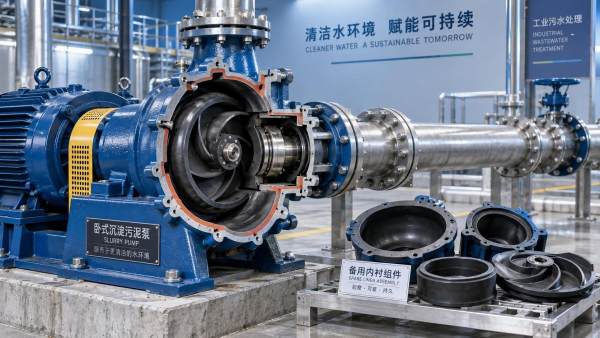
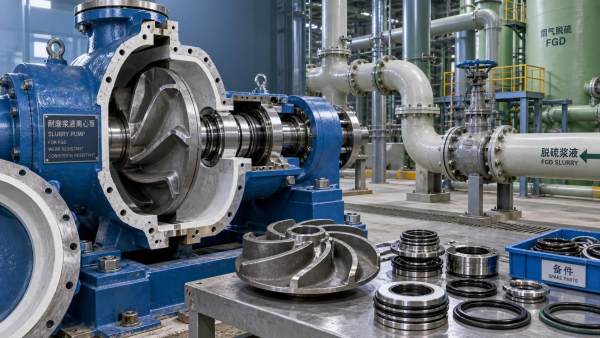
Clarify which components are recommended as commissioning spares, which parts are expected to wear first, and what lead times apply to common replacement items. The answer should distinguish between stock items, regularly produced items, and parts that require a new casting or special machining cycle. It should also cover the availability of gaskets, fasteners, bearings, seals, sleeves, and other smaller components that can stop a repair even when the major wet-end parts are on site.
Buyers should be cautious about a supplier that offers an attractive pump price but cannot give a clear spare-parts strategy. The cost of a missed production window can outweigh a modest saving on the initial machine. This does not mean every site should stock a full replacement pump. It means the stockholding plan should reflect duty criticality, expected wear rate, local repair capability, and replenishment time.
Confirm how the supplier manages product revisions. If a component changes, can it still be fitted to an earlier pump? Will it require matched parts? Are drawings, part numbers, and service manuals controlled well enough for maintenance teams to order accurately years later? These administrative details have a substantial effect on long-term ownership.
How to Read Delin Slurry Pump Reviews and Other Supplier Feedback
Searches for Delin slurry pump reviews often reflect a sensible procurement question: can public feedback reveal whether a supplier performs well after the purchase order is issued? It can help, but reviews should be treated as one input rather than proof of suitability for a particular slurry duty.
A useful review is specific. It may describe the application, the model supplied, part life, responsiveness during commissioning, delivery accuracy, technical communication, or the handling of a warranty issue. A statement that a pump is “good” or “poor” without operating context is difficult to interpret. A pump that performs well on a moderately abrasive sand slurry may not be relevant to a high-density mill discharge circuit.
When reviewing online comments, distributor references, or information from other users, look for patterns rather than isolated praise or complaints. Questions worth asking include:
- Did the supplier provide application support before shipment, or only send a standard model?
- Were replacement parts available when required?
- Did the supplier respond constructively when performance differed from expectations?
- Were the reported issues related to product quality, incorrect selection, installation conditions, or maintenance practice?
- Does the feedback concern a comparable slurry and duty cycle?
Supplier references are more valuable when the buyer can ask focused technical questions. Instead of asking whether the pump is satisfactory, ask how long key wear parts lasted relative to production conditions, whether the pump maintained duty as it wore, how parts orders were handled, and whether service documentation was useful. The goal is to understand the operating relationship, not to collect generic endorsements.
Compare Quotations on Scope and Risk, Not Just Price
Two quotations for what appears to be the same high-chrome slurry pump may include very different equipment, materials, test commitments, accessories, and support. Comparing only the purchase price can create a false economy.
Build a comparison that records the proposed pump size, speed, impeller diameter, wet-end materials, shaft seal arrangement, bearing assembly, drive scope, motor scope, baseplate, instrumentation, coating, spare parts, documentation, and delivery terms. Record assumptions beside each item. If one supplier assumes clean gland water and another includes a sealing-water arrangement, the offers are not equivalent. If one quote includes a commissioning spare set and another does not, the difference should be visible before the order is placed.
Also separate guaranteed operating requirements from estimated wear life. Pump flow, head, and absorbed power can be assessed against a defined duty. Wear life is more conditional because it depends heavily on material properties and slurry behavior that may change in production. Suppliers should be willing to explain those conditions rather than make broad longevity promises.
A sensible evaluation assigns weight to fit for duty, material control, support capability, parts availability, documentation quality, delivery reliability, and commercial terms. The lowest-cost option may be appropriate for a non-critical standby service with easily obtained spares. It is a much riskier choice for a process bottleneck where failure halts downstream production.
Questions to Resolve Before Placing the Order
Before final approval, the buyer should be able to obtain straightforward answers to a short set of operational questions: What duty point is the pump selected for? What happens if solids concentration or flow changes? Which components are high-chrome, and how are they identified? What seal system is included, and what site utilities does it require? Which spares should be held locally? Who supports startup and troubleshooting? What information will maintenance receive for ordering and rebuilding the pump?
When a supplier answers those questions clearly, the purchasing decision becomes less dependent on brand familiarity or catalogue language. The supplier has demonstrated that it understands the pump as part of a working slurry system. For high-chrome slurry pumps, that level of technical and service discipline is usually a better predictor of value than an attractive initial quotation alone.
Related Information
 Oct 03, 2026
Selecting pumps for flue gas desulfurization systems with gypsum slurry
Flue Gas Desulfurization Systems pump selection guide: optimize gypsum slurry handling with wear-resistant materials, reliable sealing, and lower lifecycle costs.- Oct 02, 2026
How abrasive slurry handling reduces premature impeller wear
Abrasive Slurry Handling reduces premature impeller wear through optimized velocity, material selection, suction control, and inspection strategies. Discover practical maintenance tips. - Oct 01, 2026
How mining slurry pumps affect downtime in high-wear circuits
Mining Slurry Pumps can make or break uptime in high-wear circuits. Learn how smarter selection, wear materials, and maintenance reduce failures and lifecycle costs. - Sep 30, 2026
Selecting coal washing pumps for fine coal recovery circuits
Coal Washing Pumps for fine coal recovery: learn how to select reliable slurry pumps for stable pressure, longer wear life, efficient dewatering, and lower downtime.


Get a Quote
Please leave your information and email address, and we will contact you as soon as possible.