
What Should You Verify Before Ordering Custom Slurry Pumps from China?
Before ordering a custom slurry pump from China, verify the duty conditions and the supplier’s ability to manufacture and prove the agreed design—not merely its quoted flow, head, and price. A pump can meet a nominal datasheet point yet fail early if the slurry characteristics, material selection, wet-end geometry, seal arrangement, testing method, or spare-parts specification were never defined precisely.
“Custom” should mean a controlled engineering scope. It should not mean that the supplier fills missing operating information with assumptions. The most expensive sourcing errors often begin with an incomplete inquiry: the buyer provides capacity and head, while the supplier has no reliable information about particle size, solids concentration, chemical conditions, suction arrangement, operating hours, or expected wear life.
What process data must be fixed before pump selection?
Flow rate and total dynamic head are necessary, but they do not describe a slurry duty sufficiently. The process sheet should distinguish normal, minimum, and maximum operating conditions. If the pump will operate over a range rather than at one fixed point, state the expected flow range, control method, and proportion of time spent at each condition.
At minimum, confirm the following:
- Required flow rate, including normal and peak values;
- Total dynamic head at each relevant operating point;
- Static elevation, pipeline length, internal diameter, fittings, valves, and expected friction losses;
- Slurry density or specific gravity;
- Solids concentration by weight and, where available, by volume;
- Particle-size distribution, maximum particle size, particle shape, hardness, and abrasiveness;
- Liquid pH, chloride content, temperature, and any chemical additives;
- Whether solids settle during shutdown or form a compacted bed in the pipeline;
- Daily operating hours, start-stop frequency, and expected seasonal or feed variability.
Particle size deserves particular attention. A statement such as “ore slurry” or “sand water” is not enough for wet-end selection. Coarse, angular solids impose different risks from fine, rounded particles at the same concentration. A pump selected for a fine tailings stream may experience blockage, excessive impeller wear, or unstable operation if the actual duty includes larger particles or intermittent oversize material.
Density also changes the practical meaning of a performance requirement. Pump head is commonly stated in metres of liquid column, while the required pressure and absorbed power rise with slurry density. The motor may therefore be undersized even if the selected pump appears to meet the stated head on a clean-water curve.
How should hydraulic performance be verified?
Ask for the proposed pump curve, not only a statement that the pump will achieve a given flow and head. The curve should identify the impeller diameter, rotational speed, efficiency, power demand, and the selected operating point. It should also show where that point sits relative to the pump’s best efficiency region.
Operating far to the left or right of the preferred hydraulic range can increase recirculation, vibration, radial loading, heat generation, and component wear. Slurry pumps tolerate a different practical operating window from clean-water process pumps, but the principle remains the same: a pump should not be selected solely because it can reach the requested duty at the edge of its curve.
The following questions expose whether the hydraulic proposal is technically complete:
- Is the curve based on the exact pump size, impeller diameter, and speed offered?
- Is the stated duty corrected for slurry behavior, or is it a clean-water rating only?
- What is the expected absorbed shaft power at maximum slurry density and at the largest impeller condition?
- What motor service margin, if any, is included?
- What is the required NPSH at the proposed duty, and what NPSH is available from the system?
- Will variable-frequency operation be used, and what speed range is permitted?
NPSH is frequently treated as a line item rather than a system check. It should be calculated from the actual suction conditions: vessel level, atmospheric conditions at site elevation, slurry temperature, suction-pipe losses, and vapour pressure. A pump that cavitates will not simply lose efficiency; cavitation can accelerate damage to impellers, liners, seals, and bearings.
For highly viscous or non-Newtonian slurries, generic water-based assumptions can be inadequate. Some slurries exhibit yield stress, settle at low velocity, or change rheology with temperature and solids content. In those cases, the pipeline calculation and pump selection need process-engineering input rather than a simple conversion from water duty.
Which wetted materials should be specified?
Do not accept “high chrome” or “rubber lined” as a complete material specification. The appropriate wet-end material depends on the balance of abrasion, corrosion, temperature, particle size, and impact loading. Hard high-chrome white iron is widely used for abrasive duties, but it is not universally suitable for corrosive media or severe impact from large particles. Elastomer linings can perform well with certain fine-particle slurries, yet can be unsuitable where sharp coarse solids, elevated temperature, hydrocarbons, or incompatible chemicals are present.
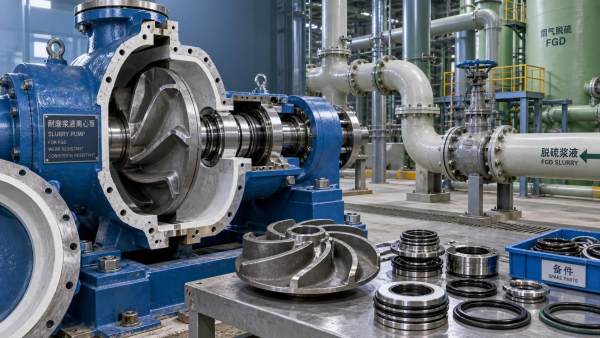
The purchase specification should identify the material for each critical wetted component: casing or casing liner, impeller, throatbush, frame plate liner, cover plate liner, expeller components, and any wear rings or suction liners. If a proprietary alloy grade is proposed, ask for its recognized material basis, chemical composition range where contractually relevant, and hardness requirement. Material naming alone does not prove the supplied casting will have the required properties.
For corrosive-abrasive duties, a supplier may recommend stainless steel, duplex stainless steel, nickel-based alloy, polyurethane, natural rubber, synthetic elastomer, or another engineered combination. The key question is not which material has the best general reputation. It is whether the proposed material has a defensible basis for the exact chemistry, temperature, and solids profile.
Also verify whether the quoted wear life is an expectation, an estimate, or a contractual guarantee. Wear life is heavily dependent on operating conditions and cannot be meaningfully compared without a common duty basis. A low initial pump price can be uneconomic if liners, impellers, or seal parts require unusually frequent replacement.
What does “custom” include in the mechanical design?
Custom slurry pumps may differ in hydraulic configuration, materials, drive arrangement, seal system, baseplate, flange standard, instrumentation, guard design, or dimensional interface. Those differences must appear on approved drawings and in the order specification. Verbal agreement on “customized design” is not enough.
Verify the pump orientation, inlet and discharge flange size and drilling, nozzle direction, mounting footprint, coupling arrangement, motor position, lifting points, and maintenance clearance. A pump can be technically suitable but still create installation problems if its suction flange does not align with existing pipework, its motor cannot be removed in place, or the site baseplate differs from the vendor drawing.
The seal arrangement should be selected from the actual operating conditions, not from price preference alone. Depending on the pump type and duty, choices may include packed gland seals, expeller-assisted arrangements, mechanical seals, or other configurations. Clarify whether seal-water or flush-water is required; its pressure, flow, cleanliness, and availability; and what happens during temporary loss of auxiliary water. If the site cannot reliably provide clean seal water, a seal arrangement dependent on it may create a predictable operating weakness.
Bearings, shaft design, lubrication method, coupling, belt drive where used, motor enclosure, and local electrical supply should also be compatible with the installation. Specify voltage, frequency, phase, required insulation or protection class where applicable, and whether the motor will run through a VFD. A pump assembly is only as reliable as the interfaces between its hydraulic, mechanical, and electrical components.
How can manufacturing capability be assessed without relying on a factory tour?
A factory visit can be useful, but it is not a substitute for technical evidence. For a custom slurry pump, assess whether the supplier controls the processes that determine dimensional accuracy, material integrity, assembly consistency, and testability.
Request information that is specific to the offered pump rather than general corporate presentations. Useful evidence includes drawings of comparable pump configurations, machining capability for large or complex components, balancing arrangements for impellers, material traceability practices, pressure-test procedures, performance-test capacity, and examples of inspection records with commercially sensitive details removed.
It is important to distinguish a manufacturer from a trading company or an assembler using externally sourced components. Neither commercial model is automatically unacceptable, but the buyer needs to know who is responsible for engineering changes, casting quality, machining tolerances, final assembly, warranty response, and spare-parts continuity. If different parties supply the wet end, bearing assembly, motor, and baseplate, the responsibility boundary should be explicit.
Ask whether the quoted model is a current production design and whether replacement parts will remain available for the expected service period. Interchangeability matters. If the pump is presented as compatible with an established design family, confirm exactly which parts are interchangeable and which dimensions or materials differ. Do not assume compatibility from a similar model name or external appearance.
What quality documents should be included in the order?
The inspection and test plan should be agreed before production begins. It should define hold points or witness points where needed, acceptance criteria, documentation, and the party authorized to approve deviations. An inspection plan that is added after the pump is complete has limited value.
Typical documentation may include:
- Approved general arrangement drawing and sectional drawing;
- Final datasheet and certified performance curve;
- Material certificates for specified critical components;
- Dimensional inspection records for contract-critical interfaces;
- Hardness results where wear material hardness is specified;
- Casing hydrostatic test record where required;
- Dynamic balancing record for the impeller when specified;
- Mechanical run test or performance test report, as applicable;
- Motor certificates and electrical documentation where included in supply;
- Preservation, packing, and shipping release records.
Performance testing requires particular care. Confirm whether the test is conducted with water, what measurements will be recorded, what tolerances apply, and whether the test arrangement represents the final pump configuration. If acceptance is referenced to a standard such as ISO 9906, the edition, grade, test conditions, and contractual applicability should be stated clearly. A generic statement that a pump is “tested to ISO standard” is too vague to resolve a later performance dispute.
For large orders or critical duties, independent third-party inspection may be appropriate. Its value depends on a clear scope: witnessing a pressure test, checking material documentation, reviewing dimensions, witnessing a performance test, or verifying packing are different activities. A third-party attendance report does not automatically validate every aspect of the design.
What should be checked in the commercial terms?
The technical scope and commercial scope must match. Confirm whether the price includes motor, baseplate, coupling, coupling guard, seal system, instruments, control accessories, commissioning spares, special tools, and recommended start-up spares. Slurry pump quotations can appear comparable while excluding materially different items.
Spare-parts lists should identify part numbers, quantities, materials, unit prices, lead times, and recommended stocking level. For a critical pump, a spare impeller alone may not be sufficient; the practical spares package depends on the expected wear pattern, shutdown consequences, and local maintenance capability. Ensure that serial numbers, drawing revisions, and part numbers are controlled so future orders do not depend on informal descriptions.
Delivery terms should define the manufacturing lead time from approval of drawings and receipt of agreed payment, not simply from purchase-order date. Include requirements for export packing, corrosion protection, crate marking, shipping documents, and preservation duration. For sea transport, inadequate preservation can create corrosion or moisture damage before the equipment reaches site.
Warranty language should identify the warranty start point, covered defects, exclusions for wear components, reporting process, remedy, and responsibility for replacement freight. Wear parts should not be treated as warranty items by default, but premature failure caused by a material or manufacturing defect should not be obscured by broad “abrasion” exclusions.
Which warning signs justify pausing the order?
Pause when the supplier will not provide a pump curve tied to the quoted impeller and speed; cannot explain the basis for slurry correction; substitutes materials with broad descriptions; avoids confirming maximum particle size; or offers an unusually low power rating without a maximum-duty calculation. These are not minor documentation gaps. They indicate that the design may have been selected from a catalogue rather than engineered for the duty.
Other warning signs include conflicting drawings and quotations, no defined test method, unclear responsibility for the motor and seal system, reluctance to share component-level material information, and a spare-parts list that lacks drawings or identifiable part numbers. Communication quality matters because custom equipment inevitably involves clarification and revision. Slow or imprecise replies during the quotation stage often become more costly once manufacturing has started.
A reliable order is built on a traceable chain: process data leads to hydraulic selection; hydraulic selection leads to material and mechanical design; design leads to approved drawings and acceptance tests; and those documents lead to an identifiable spare-parts and warranty scope. When that chain is complete, sourcing custom slurry pumps from China becomes a manageable engineering procurement task rather than a price-led gamble.
Related Information
 Oct 02, 2026
How abrasive slurry handling reduces premature impeller wear
Abrasive Slurry Handling reduces premature impeller wear through optimized velocity, material selection, suction control, and inspection strategies. Discover practical maintenance tips.- Oct 01, 2026
How mining slurry pumps affect downtime in high-wear circuits
Mining Slurry Pumps can make or break uptime in high-wear circuits. Learn how smarter selection, wear materials, and maintenance reduce failures and lifecycle costs. - Sep 30, 2026
Selecting coal washing pumps for fine coal recovery circuits
Coal Washing Pumps for fine coal recovery: learn how to select reliable slurry pumps for stable pressure, longer wear life, efficient dewatering, and lower downtime. - Sep 29, 2026
What causes slurry pump failures in flue gas desulfurization systems
Flue Gas Desulfurization Systems: discover the main causes of slurry pump failures, from cavitation and abrasion to seal leaks, corrosion, and unstable operation.


Get a Quote
Please leave your information and email address, and we will contact you as soon as possible.