
How to Order Replacement Slurry Pump Parts from Delin
When a slurry pump needs replacement parts, the quickest route to an accurate order is to give Delin the pump identification, the part numbers or measurements, and the operating conditions before requesting a quotation. A worn impeller may look easy to identify, but similar-looking components can differ in fit, material, or hydraulic design. Ordering by appearance alone can leave a maintenance team with parts that do not fit or do not perform as expected.
Start with the pump nameplate and any previous parts records, then document the components required and ask Delin to confirm compatibility in writing. Where identification is incomplete, provide clear measurements and photographs rather than guessing a model. Keep the pump isolated and follow site procedures before removing guards or opening the casing for inspection.
Start with the pump, not just the damaged component
The pump model is the strongest starting point because a part description such as “liner” or “impeller” rarely identifies a unique item. Record the full model designation exactly as it appears on the nameplate, including letters, numbers, suffixes, and any serial or equipment number. A suffix can distinguish a configuration that affects the parts needed.
Send a photograph of the complete nameplate as well as a typed transcription. If the plate is damaged, check the maintenance register, installation documents, previous purchase records, and any drawings held on site. Identify the source of each detail so Delin can distinguish confirmed information from an assumption.
Also state whether the pump is in its original configuration or has been modified. A replacement bearing assembly, altered shaft arrangement, or previous wet-end conversion may mean that the nameplate alone no longer describes every installed component. Include the identification of those assemblies where available, and flag any uncertainty rather than treating the original records as definitive.
Identify exactly which parts are needed
Use an assembly drawing or parts list to name each item and record its part number, quantity, and material designation. A request for “one complete pump set” can be interpreted in different ways: one party may expect only wear components, while another may include seals, fasteners, and bearing items. List the contents instead of relying on an informal set name.
Replacement requirements often fall into these groups:
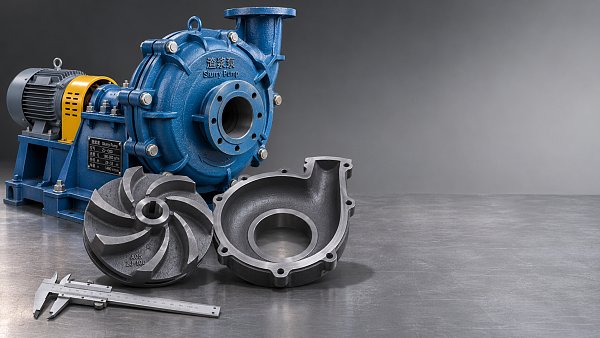
- Wet-end wear parts: impeller, casing liners, throatbush, frame plate liner insert, and other components that contact the slurry, where fitted.
- Shaft sealing parts: packing, lantern ring, expeller, expeller ring, or mechanical seal components, depending on the installed arrangement.
- Rotating and support parts: shaft, bearings, sleeves, seals, and associated hardware, where inspection shows they are required.
- Assembly items: gaskets, O-rings, fasteners, and other small items needed to reassemble the particular pump.
Not every pump uses every item in this list. Refer to the installed configuration and ask Delin to identify any additional components normally required for the planned work. Confirm whether those items are included in the quotation or priced separately.
When the part number is missing
Photograph the component from several angles, including any cast markings, machined faces, attachment points, and areas of wear. Record the markings exactly; a casting number may help identification but is not necessarily the finished part number. Place a scale in the photographs and provide measurements separately with units.
For an impeller, useful details can include the outside diameter, inlet diameter, overall width, number of vanes, and shaft attachment or thread details. For liners, measure mounting and sealing features as well as major diameters. Explain which dimensions are affected by wear: the remaining diameter of a badly eroded impeller, for example, may not represent its original size.
Measurements of used parts are supporting evidence, not proof of interchangeability. Ask Delin which dimensions and views are needed for the specific component, and whether a drawing or physical sample is required before an order can be confirmed. Do not ship a sample until packaging, handling, and return arrangements have been agreed.
Describe the duty before choosing a material
A correctly sized part can still be the wrong replacement if its material is unsuitable for the slurry. Provide the liquid and solids handled, approximate solids concentration and particle size, operating temperature, and any known corrosive conditions. Include the normal flow and discharge pressure or head if available, along with pump speed and operating pattern.
State whether the issue is abrasion, corrosion, impact, leakage, or a combination. Uneven wear around a liner or rapid damage at an impeller inlet may be useful information, but it does not by itself establish the cause. Photographs and maintenance observations help Delin understand the duty; they do not replace an inspection of operating conditions.
Metal and elastomer wear parts have different application limits. Particle size and shape, chemical compatibility, temperature, and the pump design can all affect the choice. Do not assume that a harder material is automatically better or that an elastomer can be substituted for a metal component in the same assembly. Request the proposed material designation and confirmation that it is compatible with the pump configuration and stated duty.
If the existing parts lasted acceptably, include their known material specification and service history. If they did not, describe the failure without prescribing a material change prematurely. The supplier can then quote the existing specification, a proposed alternative, or both, with any differences clearly identified.
Prepare a request that can be quoted accurately
Send the identification and duty information together with a line-by-line parts list. This reduces the chance that the quotation is based on a different interpretation of the equipment or the scope of supply. A practical request should contain:
- The full pump model and serial number, or an explanation of which identification details are unavailable.
- Each required part name, number, material, and quantity, with drawings or photographs where identification is uncertain.
- The installed seal arrangement and any known modifications or previous substitutions.
- The slurry duty and the reason for replacement, particularly if a different material is being considered.
- The required delivery destination and the date by which the parts are needed, distinguishing a firm shutdown date from a preferred date.
- A request for written confirmation of compatibility, quoted scope, lead time, packing, shipping terms, payment terms, and any applicable warranty conditions.
Use the supplier’s confirmed contact channel to send the request, and retain a copy of the information submitted. If several pumps are involved, identify each one separately. Two pumps with similar model names may have different seal arrangements or fitted materials, so a combined list should show which line belongs to which pump.
Review the quotation against the installed equipment
Check the part numbers and descriptions line by line rather than approving the total price alone. A quotation should make clear whether each item matches the number requested, replaces it with an alternative, or remains subject to identification. Ask Delin to explain any substitution and provide the relevant drawing or specification for review before placing the order.
Pay particular attention to interfaces. An impeller must match the shaft connection and surrounding wet-end components; a liner must fit the casing and its sealing arrangement. Seal parts must correspond to the actual seal type, not merely the pump model. Where components are quoted as a set, confirm exactly what the set contains and whether existing parts can be reused.
Review the material designation for every wetted component, especially where the quotation offers an alternative to the installed material. Confirm the quantities and units as well: one “set” of seals may not mean the same thing as one individual ring. Ask for clarification if a description does not identify which interpretation applies.
Delivery terms also need a specific reference point. Ask whether the stated lead time runs from order acceptance, payment, drawing approval, or another agreed event, and whether it covers production only or delivery to the destination. Confirm freight responsibility, packaging, and any documentation required for receipt. These details affect maintenance planning even when the parts themselves are correctly specified.
Assess the supplier using the proposed order
A search such as “Ltd. a reliable metallurgical slurry pump supplier?” points to a reasonable purchasing concern, but reliability cannot be established from a company name or a quotation alone. Evaluate Delin’s response to the actual request: does it identify missing information, explain any proposed substitutions, and state what it can and cannot confirm?
Useful evidence includes a traceable written quotation, clear part and material descriptions, an agreed method for resolving uncertain dimensions, and defined commercial terms. Where quality documentation, inspection records, or material certificates are important to the purchase, specify them before ordering and confirm what can be supplied. Avoid assuming that a document is included simply because it is customary for a different order.
For a critical shutdown, clarify how changes will be communicated if availability or the delivery schedule changes. Compare the response with the requirements of the job rather than treating the shortest stated lead time as sufficient evidence of reliability.
Confirm the order and inspect the delivery
Once the technical and commercial details are settled, issue the purchase order against the agreed quotation and revision. Repeat the pump identification, part numbers, quantities, material requirements, delivery details, and required documentation. Refer explicitly to any approved substitution or drawing so that an earlier version is not used by mistake.
When the shipment arrives, compare the labels and documents with the purchase order before the planned maintenance window. Check quantities, visible damage, identification markings, and any requested records. Where practical, compare critical interfaces with the approved drawing and existing assembly without damaging protective packaging or machined surfaces.
Do not modify a replacement part to make it fit without resolving the discrepancy. Record the affected part number, dimensions, and photographs, then contact Delin before installation. A mismatch may come from incomplete pump identification, a previous modification, an incorrect part, or an unapproved substitution; identifying which one applies is more useful than forcing assembly and risking damage to adjacent components.
Related Information
 Nov 16, 2026
How Much Do Delin Cement Slurry Pumps Cost?
Hebei Delin Machinery Co. cement slurry pump costs depend on duty and configuration. Explore key price factors and learn how to request a reliable quote.- Nov 16, 2026
Is Delin a Reliable Metallurgical Slurry Pump Supplier?
Comparing Ltd. cement slurry pump prices? Discover how to assess Delin’s pump selection, durability, spare parts, and support before you buy. - Nov 15, 2026
What Is Delin's Lead Time for a Custom Knife Gate Valve?
Is Hebei Delin Machinery Co. able to meet your custom knife gate valve deadline? Discover what affects lead time and how to request a reliable quote. - Nov 15, 2026
How to Order Replacement Slurry Pump Parts from Delin
Is Delin Ltd. a reliable metallurgical slurry pump supplier? Learn how to identify replacement parts, request a quote, and check compatibility before ordering.

{item.title}
Get a Quote
Please leave your information and email address, and we will contact you as soon as possible.