
What Is Delin's Lead Time for a Custom Knife Gate Valve?
Is Hebei Delin Machinery Co. able to deliver a custom knife gate valve within your project timeline? Lead times can vary depending on valve size, materials, design specifications, production schedules, and testing requirements. Understanding these factors early can help you plan procurement and avoid delays. This article explains what influences Delin’s custom valve delivery schedule, what information to provide when requesting a quote, and how to obtain a lead-time estimate for your application.
What is Delin’s lead time for a custom knife gate valve?
There is no verified standard lead time available here for a custom knife gate valve from Hebei Delin Machinery Co. The practical answer is to obtain a project-specific quotation and confirm both the duration and the event that starts the clock. An estimate based on an incomplete specification should be treated as provisional, not as a committed delivery date.
That distinction matters because “lead time” can describe several different intervals. One supplier may quote the time from receipt of a purchase order to completion at the factory. Another may count from drawing approval, receipt of an advance payment, or confirmation of all technical details. Freight and customs clearance may be outside either estimate.
For a shutdown or equipment installation, ask for a dated schedule rather than relying on a number of weeks alone. It should identify when the valve is expected to be ready for inspection, when it can leave the factory, and whether delivery to the project site is included. Delin would need to confirm the applicable dates and conditions for the actual order.
Why custom knife gate valve schedules vary
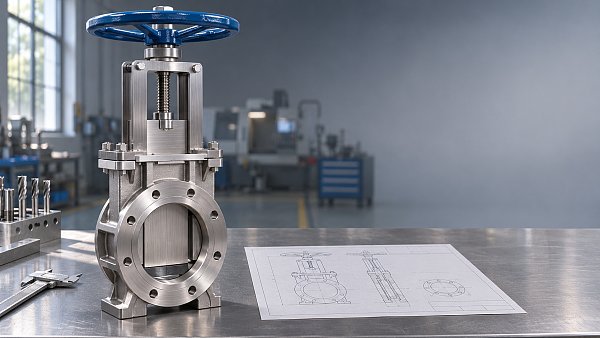
A knife gate valve is often selected to isolate a process stream containing solids, slurry, pulp, or other difficult media. The name alone, however, does not define the valve. Two units with the same nominal pipe size can require different bodies, gates, seats, actuators, and inspection procedures. Those differences affect both engineering and procurement.
Size, pressure, and mechanical design
Valve size influences more than the amount of material required. Larger components may need different machining capacity, lifting arrangements, and assembly procedures. The pressure and shutoff requirements also affect the design: a valve specified for isolation under a particular differential pressure may need a different construction from one used where pressure is equalized before operation.
Installation details can be just as consequential. Flange drilling, face-to-face dimensions, flow direction, and the available space around the actuator should be established before a drawing is released. If a replacement valve must fit existing pipework without modification, provide measured dimensions and any reliable drawings of the installed unit. Assuming that an old valve follows a current dimensional standard can create a late design change.
Wetted materials and components
Material availability is a common source of uncertainty. Body and gate materials must suit the process, while seat and packing materials need to be compatible with the media, temperature, and operating conditions. Abrasive solids, corrosive chemicals, and elevated temperatures can lead to different choices; one material should not be assumed suitable for all three.
The schedule may depend on whether the required material or component is already available, needs to be sourced, or requires additional documentation. If a particular grade is mandatory, say so in the request. If alternatives are acceptable, identify who can approve them and what evidence is needed. An unapproved substitution can solve a sourcing problem while creating a compliance or maintenance problem later.
Actuation and controls
A hand-operated valve and an automated assembly do not have the same scope. Pneumatic or electric actuation can add work involving mounting, torque or thrust selection, limit switches, solenoid valves, controls, and functional testing. Compatibility between the actuator and valve matters as much as the availability of either item on its own.
Where an actuator is supplied separately, agree on the interfaces and responsibilities early. The valve manufacturer may need the actuator dimensions and output data before completing the mounting design. The buyer should also clarify who assembles the package and who is responsible for testing it as a complete unit.
The timeline is more than factory production
A useful delivery plan follows the order from technical review through arrival, not just through machining. Depending on the project, some activities can run in parallel; others cannot begin until a preceding decision is complete.
- Technical clarification: The supplier reviews the application, dimensions, materials, operating conditions, and required documentation.
- Drawing and approval: The parties confirm interfaces and design details. Any customer approval period should be visible in the schedule.
- Material and component procurement: The manufacturer obtains the specified materials, actuator, and other items not available for immediate use.
- Manufacture and assembly: Components are produced, fitted, and assembled according to the agreed design.
- Inspection and testing: The agreed checks are completed, with any witness or document review arranged in advance.
- Packing and dispatch: The valve is prepared for the agreed handover point. Transport and import formalities may follow separately.
The order of these activities is not universal. For example, a manufacturer might reserve some materials before final drawing approval, but a buyer should not assume that it will. Ask which activities Delin plans to start before approval and which depend on a signed drawing or other formal release.
Approval delays deserve particular attention. If the quotation assumes prompt drawing review but the project requires several internal reviewers, the quoted manufacturing period may no longer align with the installation date. Establish a named approver and a realistic review window before placing the order.
Testing and documentation can change the handover date
A valve can be physically assembled but not yet ready for contractual handover. The purchase specification may call for pressure or seat leakage testing, material traceability, dimensional checks, coating records, or inspection by a customer representative. The applicable test method and acceptance criteria should be agreed in the order rather than assumed from the valve type.
If the project references a particular valve standard, edition, or inspection requirement, provide the exact reference and the relevant clauses where possible. Applicability depends on the valve design and contract. Likewise, request certificates or material documents only as needed, but identify them before production starts; documentation that cannot be reconstructed later may affect acceptance.
Witness testing introduces another scheduling dependency: the valve, test equipment, inspector, and approved procedure must all be available at the same time. Clarify how much notice is required, whether remote witnessing is acceptable, and what happens if the inspector cannot attend. These details can prevent a finished valve from waiting unnecessarily for release.
What to include in a request for quotation
A complete request gives Delin a better basis for assessing the design and identifying long-lead items. If some values are not yet known, mark them as open rather than allowing an assumption to become part of the order unnoticed.
- Application: Process medium, solids content or particle characteristics where relevant, and whether the valve is for isolation or another duty.
- Operating conditions: Normal and maximum pressure and temperature, expected differential pressure during operation, and required shutoff performance.
- Connections and space: Nominal size, flange or connection details, face-to-face requirements, orientation, and dimensional restrictions.
- Materials: Required body, gate, seat, and packing materials, including any material documentation requirements.
- Operation: Manual, pneumatic, electric, or another arrangement; available utilities; control accessories; and fail position if applicable.
- Verification: Required tests, inspection access, documentation, and any applicable project standards.
- Delivery: Quantity, required destination, preferred handover terms, and the date by which the valve must be available for installation.
Also describe the reason for the deadline. A valve needed for a planned outage may have a narrow installation window, while a valve for a new line may be constrained by piping completion or commissioning. Knowing the actual constraint helps distinguish an essential date from a preferred one.
How to judge whether an estimate is usable
A credible quotation should connect its lead time to a defined scope. Check that the quoted valve, actuator, testing, documents, and delivery point match the request. A shorter estimate may simply omit a requirement that another offer includes. Comparing durations without comparing scope can produce the wrong purchasing decision.
Ask Delin to state whether the schedule is an estimate or a contractual commitment, what starts it, and which assumptions could change it. If a special material or actuator is involved, ask whether availability has been checked. If the project requires a fixed date, discuss how changes, delayed approvals, and unforeseen supply issues will be handled in the purchase agreement.
Do not overlook transport. “Ready for dispatch” is not the same as “delivered to site.” The chosen delivery terms determine which party arranges and pays for particular parts of transport and customs handling; they do not, by themselves, guarantee arrival on a certain date. Confirm packing requirements, shipment dimensions when available, the destination, and responsibility for unloading.
Can the schedule be shortened?
Sometimes, but the workable options depend on the design and current capacity. A compatible standard connection, an available material grade, or an actuator already accepted for the application may reduce sourcing or engineering work. None should be substituted merely to gain time without checking pressure capability, corrosion resistance, shutoff needs, and installation fit.
The buyer can often remove avoidable delays without changing the design: submit a coordinated specification, resolve conflicting requirements, make reviewers available, and agree on inspection arrangements early. For multiple valves, ask whether partial shipment is possible and whether it would actually help the installation sequence. A partial delivery is useful only if the receiving team can install or commission those units independently.
Before committing to the project schedule, request a written, dated estimate for the exact configuration and trace it backward from the required site date. Include time for approvals, inspection, dispatch, transport, and receiving. If the resulting dates leave no allowance for unresolved technical questions, address those questions before treating the valve as a dependable milestone.
Related Information
 Nov 16, 2026
How Much Do Delin Cement Slurry Pumps Cost?
Hebei Delin Machinery Co. cement slurry pump costs depend on duty and configuration. Explore key price factors and learn how to request a reliable quote.- Nov 16, 2026
Is Delin a Reliable Metallurgical Slurry Pump Supplier?
Comparing Ltd. cement slurry pump prices? Discover how to assess Delin’s pump selection, durability, spare parts, and support before you buy. - Nov 15, 2026
What Is Delin's Lead Time for a Custom Knife Gate Valve?
Is Hebei Delin Machinery Co. able to meet your custom knife gate valve deadline? Discover what affects lead time and how to request a reliable quote. - Nov 15, 2026
How to Order Replacement Slurry Pump Parts from Delin
Is Delin Ltd. a reliable metallurgical slurry pump supplier? Learn how to identify replacement parts, request a quote, and check compatibility before ordering.

{item.title}
Get a Quote
Please leave your information and email address, and we will contact you as soon as possible.