
Can a Slurry Pump Handle High Solids Concentrations?
Can a slurry pump handle high solids concentration? Yes—but only when the pump is selected and operated for the actual slurry, not simply for the required flow rate. A slurry with a high percentage of solids behaves very differently from clean water. It may be heavier, more abrasive, more viscous, less stable in the pipeline, and more difficult to keep moving at a safe velocity.
In mining, mineral processing, dredging, tailings management, sand and gravel production, power generation, and industrial waste handling, this question is rarely theoretical. When solids concentration rises beyond what a pump and piping system can tolerate, the consequences are familiar: rapid liner wear, blocked suction lines, overloaded motors, reduced throughput, poor efficiency, seal failures, and unplanned shutdowns.
The practical answer is not “yes” or “no” based on solids percentage alone. A properly designed slurry pump can move dense and abrasive mixtures reliably. The key is matching the hydraulic design, wet-end materials, drive power, pipe system, and operating point to the slurry’s real characteristics.
What “high solids concentration” really means
High solids concentration is often expressed as a percentage by weight or by volume, but those measurements do not tell the whole story. Two slurries with the same solids concentration may place very different demands on a pump.
For example, a slurry containing fine clay particles can become thick and paste-like, increasing viscosity and reducing the ease with which particles settle or flow. A slurry made of coarse angular mineral particles may remain less viscous but cause severe abrasion. A mixture of large gravel, sharp particles, and water may create impact damage even if its overall solids concentration is lower than that of a fine-particle slurry.
Before deciding whether a slurry pump can handle the duty, engineers normally need to understand:
- Solids concentration by weight and by volume
- Particle size distribution, including the largest particle expected
- Particle shape: rounded, angular, flaky, fibrous, or irregular
- Solid density and the resulting slurry specific gravity
- Abrasiveness and hardness of the material
- Slurry viscosity, yield stress, and settling behavior
- Required flow rate, discharge pressure, and pipeline length
- Changes in feed conditions during normal operation
This is why a pump that performs well on a moderate-density sand slurry may struggle with thickened tailings, flotation concentrate, or a variable feed from a crusher sump.
The pump must be built for solids—not adapted from a water pump
A conventional centrifugal water pump is designed around relatively clear liquid. Its internal passages, impeller geometry, seals, and materials are not generally intended for frequent contact with coarse or abrasive solids. Using one in a dense slurry application can lead to rapid performance loss, even when the initial flow and head appear acceptable.
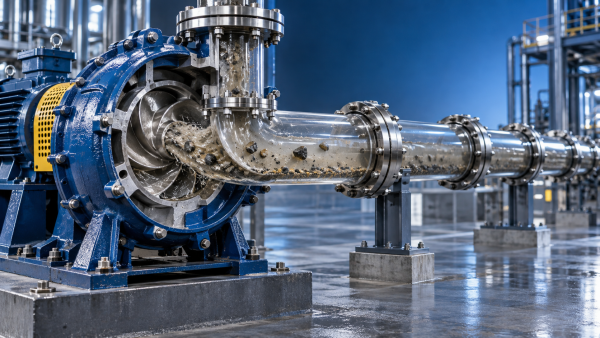
A purpose-designed centrifugal slurry pump has features intended to manage solids-laden flow. These may include wider impeller passages, larger clearances, heavier shafts and bearings, replaceable wear components, robust casing construction, and an impeller profile chosen for slurry transport. The design should allow particles to pass through the pump without repeated recirculation, excessive impact, or bridging in narrow areas.
For very high solids concentrations, the question becomes more specific: can the pump maintain enough flow and energy to keep the mixture moving while avoiding excessive internal wear and unacceptable power consumption? The answer depends heavily on the pump type.
Common pump approaches for dense slurries
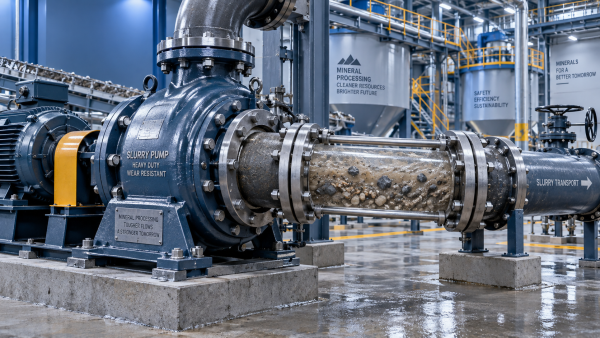
Heavy-duty centrifugal slurry pumps are widely used when the slurry remains pumpable and a continuous flow is required. They are common in mineral processing circuits, cyclone feed, mill discharge, tailings transport, and aggregate wash plants. Large wet-end passages and suitable impeller selection are especially important when particles are coarse.
High-head slurry pumps are used where a dense slurry must travel long distances or overcome substantial elevation. Their operating conditions require close attention because increasing head demand can raise power draw and accelerate wear.
Submersible slurry pumps can be useful in pits, sumps, ponds, and dredging environments. Their suitability for high solids depends on the impeller design, agitation arrangement, depth, and the physical character of the solids.
Positive displacement pumps, including certain piston, diaphragm, screw, or hose pump designs, may be considered when slurry becomes too viscous or too dense for efficient centrifugal pumping. These systems can handle challenging materials, but they bring different considerations, such as pulsation, valve wear, pressure limits, and maintenance requirements.
There is no universal “best” pump for high-solids service. The right choice follows the material and the duty point.
Particle size can be as important as concentration
A dense slurry of fine particles may pass through a pump more smoothly than a lower-concentration slurry containing oversized stones. The maximum particle size must be compared with the pump’s available passage size. If particles are too large relative to the impeller eye, vane channels, or throatbush area, they may lodge, circulate repeatedly, or damage the wet end.
Coarse particles also require adequate flow velocity. If velocity falls below the level needed to keep solids suspended, particles can settle in suction lines, horizontal discharge pipes, elbows, and low points. A settled pipeline is not simply an inconvenience; restarting it may require considerable intervention and can expose the pump to extreme load.
Operators sometimes respond to wear concerns by slowing the pump too far. Lower speed can reduce abrasion in some cases, but it can also reduce pipeline velocity and encourage settling. The goal is not the lowest possible speed. It is a stable operating condition that delivers the required head and keeps solids in motion without driving the pump into an inefficient or damaging range.
Material selection determines how long the wet end survives
High solids concentration often means higher wear rates, particularly where particles are hard, sharp, and fast-moving. The casing, impeller, throatbush, liners, expeller components, and other wetted parts must be chosen with abrasion and corrosion in mind.
High-chrome white iron is frequently used for highly abrasive mineral slurries because of its wear resistance. Elastomer-lined components can be effective for some fine, non-sharp abrasive slurries and may absorb impact well. However, rubber is not suitable for every application; high temperature, oils, chemical exposure, large sharp particles, or certain operating conditions can limit its use.
In corrosive duties, alloy selection becomes more complex. A material that resists abrasion may not offer adequate chemical resistance, while a corrosion-resistant alloy may wear faster under coarse solids. This trade-off should be evaluated using the actual slurry chemistry, pH, temperature, chloride content, and expected particle characteristics.
Material selection is not a minor purchasing detail. It directly affects maintenance intervals, spare-parts planning, pump availability, and total operating cost.
Why dense slurry changes pump performance
When a centrifugal pump handles water, much of the input energy is converted into liquid flow and pressure. In a slurry, energy is also needed to accelerate and transport solid particles. This introduces hydraulic losses and can reduce the pump’s effective head and efficiency compared with its water-based performance curve.
As slurry density rises, the pump may require more input power. If the motor, gearbox, belt drive, or variable-speed drive has not been sized with sufficient margin, overload trips can occur. In more serious cases, persistent overload can damage drive components or lead to premature bearing failure.
High viscosity creates another challenge. A thick slurry may not enter the impeller as easily as a lower-viscosity mixture. The pump’s capacity and head can decline, while energy consumption rises. Fine-particle slurries, thickened tailings, and process residues can be particularly deceptive because they may look fluid at rest but behave differently under shear and pressure.
This is why slurry pump selection should be based on corrected slurry performance rather than a clean-water curve alone. The pump vendor or engineering team should evaluate the slurry derating, efficiency reduction, required shaft power, and net positive suction head conditions for the intended duty.
Suction conditions are often where high-solids problems begin
A pump cannot perform well if the suction side is poorly designed. Dense slurry needs a short, adequately sized, and well-supported suction line wherever possible. Unnecessary bends, restrictions, air leaks, and poorly shaped transitions increase losses before the slurry even reaches the impeller.
Air entrainment deserves particular attention. Entrained air can reduce pumping stability, promote surging, lower delivered flow, and make performance difficult to predict. In a sump application, vortexing may pull air into the suction. In process systems, poor tank design or turbulent feed conditions can produce the same result.
Settling in the suction line is another common issue. If the pump must pull heavy solids over a long distance, it may experience unstable inlet conditions, intermittent blockages, or abrasive wear concentrated near the suction entry. In many installations, placing the pump closer to the slurry source or using a flooded suction arrangement is more reliable than asking the pump to lift a dense mixture through a long suction pipe.
Operating near the right duty point matters
Even a well-selected slurry pump can suffer if it is operated too far away from its best efficiency region. Running too far to the left of the curve—at low flow and high recirculation—can increase internal turbulence, heat, vibration, and localized wear. Running too far to the right may overload the motor, reduce discharge pressure, and increase erosion in high-velocity areas.
High-solids applications are rarely static. Feed density can rise after a change in process conditions, particle size may shift with ore characteristics, or operators may add water to recover flow. A variable-speed drive can provide useful flexibility, but it is not a cure for an incorrectly sized pump. Speed adjustments should remain within the pump’s allowable operating range and should account for the effects on head, power, wear, and pipeline transport velocity.
Instrumentation helps turn uncertainty into usable operating information. Flow, pressure, motor load, pump speed, vibration, bearing temperature, and slurry density measurements can reveal developing problems before the pump fails. A gradual increase in power draw or a drop in discharge pressure may indicate wear, blockage, density change, or a shifting system resistance curve.
A practical checklist before selecting a high-solids slurry pump
When reviewing whether a slurry pump can handle a high solids concentration, avoid relying on a single percentage value. A useful selection discussion should include the following questions:
- What is the normal solids concentration, and what is the maximum expected during upset conditions?
- Is concentration measured by weight or volume?
- What are the particle size distribution and maximum particle size?
- Do particles settle quickly, or does the slurry behave more like a viscous paste?
- What flow rate and total dynamic head are required at normal and worst-case conditions?
- What pipeline velocity is needed to avoid deposition?
- Is the slurry abrasive, corrosive, hot, aerated, or chemically reactive?
- Will the pump operate continuously, intermittently, or with frequent starts and stops?
- What maintenance access and spare-parts strategy are realistic for the site?
These details make the difference between a pump that merely moves material on a test day and one that remains dependable through changing production conditions.
Common mistakes that shorten pump life
One frequent mistake is selecting by flow rate and head alone. Those values are essential, but they do not account for particle size, slurry density, viscosity, or wear behavior. Another is assuming that a larger pump will automatically solve a difficult duty. Oversizing can create low-flow operation, recirculation, poor efficiency, and unstable control.
Ignoring the pipeline is equally risky. The pump and pipe system function as one unit. An undersized line may produce excessive friction loss and high energy demand; an oversized line may allow solids to settle at lower flow rates. Long-distance slurry transport requires a full system review, including bends, valves, elevation changes, solids deposition risk, and transient conditions during startup or shutdown.
Finally, maintenance should not wait until performance collapses. Wear is expected in abrasive slurry service. Regular inspection of liners, impellers, clearances, seals, bearings, and drive components allows planned replacement before a worn part damages more expensive assemblies or interrupts production.
So, can a slurry pump handle high solids concentration?
Yes, a slurry pump can handle high solids concentration when its design matches the material, the hydraulic duty, and the complete piping system. Heavy-duty slurry pumps are specifically engineered for many dense, abrasive, and coarse-particle applications, but their success depends on more than a nameplate or a standard performance curve.
The most reliable approach is to define the slurry honestly—including its worst operating condition—then evaluate pump type, passage size, wear materials, power requirement, suction arrangement, and pipeline velocity as a connected system. For high-solids service, the right pump is not simply the one that starts and moves slurry. It is the one that can keep doing so with stable performance, manageable wear, and fewer unwelcome surprises on the plant floor.
Related Information
 Sep 29, 2026
What causes slurry pump failures in flue gas desulfurization systems
Flue Gas Desulfurization Systems: discover the main causes of slurry pump failures, from cavitation and abrasion to seal leaks, corrosion, and unstable operation.- Sep 29, 2026
What Causes a Slurry Pump to Clog During Operation?
What causes a slurry pump to clog during operation? Explore key causes, warning signs, and proven solutions to prevent downtime, wear, and costly flow disruptions. - Sep 29, 2026
Can a Slurry Pump Handle High Solids Concentrations?
Can a slurry pump handle high solids concentration? Discover how pump design, particle size, materials, and pipeline conditions ensure reliable, efficient slurry handling. - Sep 22, 2026
How Does an OEM Slurry Pump Custom Order Process Work?
Delin OEM slurry pump custom order process: learn how duty analysis, material selection, seal options, testing, and commissioning create reliable pumps for demanding slurry applications.

Get a Quote
Please leave your information and email address, and we will contact you as soon as possible.