
Are High-Chrome Alloy Slurry Pumps Worth the Extra Cost?
High-chrome alloy slurry pumps are worth the extra cost when abrasive wear is the main cause of pump failure and when lost production time costs more than the material upgrade. They are not automatically the best choice for every slurry duty. Their value depends on particle hardness, particle size, slurry velocity, solids concentration, corrosion level, operating hours, and the cost of rebuilding or stopping the process.
A pump with high-chrome wet-end parts usually costs more than one built with standard cast iron, ductile iron, or lower-alloy materials. The purchase-price comparison can look unfavorable if it ignores impeller replacement frequency, casing wear, seal failures caused by hydraulic instability, labor, spare-part inventory, and unplanned shutdowns. In a severe abrasive service, a longer-lasting impeller or liner can change the economics quickly. In a mild slurry service, the same upgrade may simply add capital cost without producing a meaningful operating benefit.
What high-chrome alloy changes inside a slurry pump
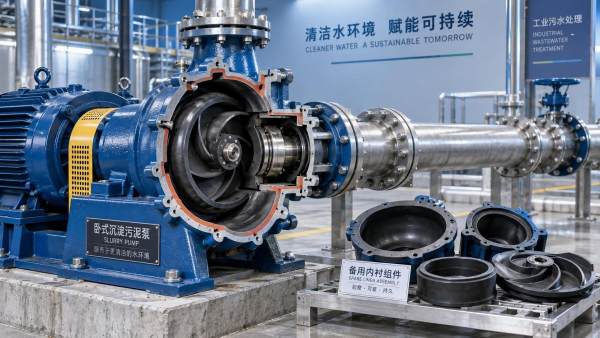
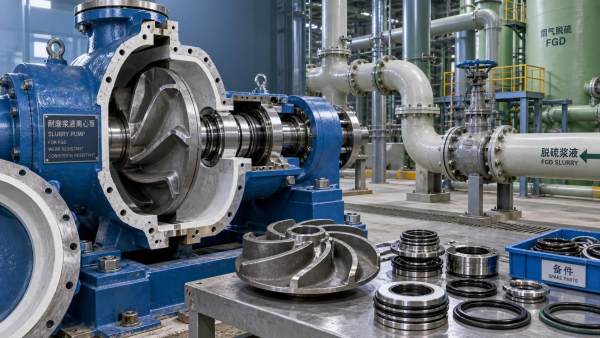
High-chrome white iron is commonly used for slurry pump wet-end components such as impellers, throatbushes, volute liners, frame-plate liners, and suction liners. Its chromium content promotes hard carbide structures within the metal. Those carbides resist cutting and grinding by abrasive particles better than conventional iron materials.
That resistance matters because slurry pumps do not fail from one uniform wear mechanism. A hard mineral slurry can erode the impeller vane leading edges, enlarge clearances between the impeller and liner, thin the volute wall, and damage the throatbush near the high-velocity discharge region. As clearances grow, internal recirculation increases. The pump then loses hydraulic efficiency, draws more power for the delivered flow, and may no longer meet the required head.
High-chrome alloy slows this type of material loss when the particles are hard enough and the operating duty creates significant abrasion. It does not make a pump immune to wear. It also does not correct an oversized pump, a poorly selected impeller diameter, chronic operation far from the best efficiency region, air entrainment, or inadequate suction conditions. Material selection and hydraulic selection need to agree with each other.
When the additional cost usually has a strong case
The strongest case appears where solids are hard, angular, and continuously present. Mineral processing slurries, sand-bearing process streams, ash mixtures, tailings, ore concentrates, scale-laden water, and abrasive chemical-process residues often create the kind of sliding and impact wear that high-chrome components are designed to resist.
Particle size changes the wear pattern. Fine particles often produce sliding abrasion across broad surfaces, while larger particles can cause localized impact, turbulence, and damage at vane inlets, the impeller eye, and directional changes in the casing. High-chrome materials perform well in many abrasive duties, but severe coarse-particle impact can require attention to component geometry and operating speed, not merely alloy grade. A hard material can resist abrasion yet remain less tolerant of certain impact conditions than a more ductile alternative.
Operating hours also matter. A pump that runs intermittently for short periods may consume little wear life over a year, even with an abrasive slurry. A continuously operating transfer pump accumulates erosion much faster. In the latter situation, longer intervals between wet-end rebuilds can reduce disruption to the process and make the initial price difference less significant.
The value rises further when access is difficult. A pump installed below equipment, in a congested plant area, or in a location requiring lifting equipment can make each rebuild expensive and time-consuming. The alloy decision then affects more than component cost. It affects the frequency of isolation, draining, disassembly, alignment checks, and restart work.
Where high-chrome alloy may not be the right answer
High-chrome alloy is principally selected for abrasion resistance. It should not be treated as a universal corrosion-resistant material. A slurry that is acidic, strongly alkaline, chloride-rich, or chemically reactive can attack the binder phase around the carbides or otherwise degrade the alloy in ways that are not apparent from an abrasion-only evaluation. A corrosion-resistant elastomer, stainless alloy, duplex alloy, nickel-based material, or another specialized construction may be more appropriate where chemical attack governs service life.
Abrasive and corrosive wear often occur together. This combination is easy to misjudge because a worn component can look like it has suffered simple erosion. If corrosion has softened or undercut the surface first, abrasive particles can remove material faster than expected. Increasing chromium alone may not solve the underlying problem. The slurry pH, oxidizing conditions, dissolved salts, temperature, and chemical additions need to be reviewed alongside solids characteristics.
Low-solids slurry can also weaken the economic case. Water carrying occasional fines is different from a dense, abrasive suspension. If the wet-end parts already reach an acceptable service interval in a less expensive material, high-chrome alloy may offer no practical payback. The relevant comparison is not whether high chrome lasts longer in theory; it is whether the longer life changes maintenance frequency, output stability, or total operating cost enough to matter.
Elastic materials deserve consideration for fine-particle duties where chemical compatibility and particle behavior favor them. Rubber-lined configurations can perform very well in suitable fine-abrasive applications, yet they are vulnerable to temperatures, hydrocarbons, sharp coarse particles, and mechanical damage beyond their design range. The choice should follow the duty rather than a simple ranking of “harder” versus “softer” materials.
Purchase price is only one part of the cost calculation
A useful comparison starts with the components that actually wear. In many slurry pumps, the impeller and liners determine wet-end maintenance cost, while bearings, shaft, baseplate, drive arrangement, and motor may remain unchanged between material options. Comparing complete pump prices without separating these items can obscure the decision.
The calculation should use the real interval between interventions, not a catalog comparison of nominal material properties. Record the date of installation, operating hours, process conditions, delivered flow and head where available, power draw, clearances measured at rebuild, and the location of visible wear. Over several maintenance cycles, this information shows whether high-chrome parts are extending life or merely shifting wear to a different component.
Downtime deserves careful treatment. Planned replacement during a scheduled outage has a different cost from an unexpected failure during production. A pump that remains operational but loses head can be equally disruptive if downstream classification, transport, dewatering, or process feed becomes unstable. The relevant question is whether the material upgrade preserves required duty for longer, not only whether it delays a physical leak.
Do not judge alloy performance from one damaged part
Wear shape is diagnostic. Uniform thinning across an impeller vane points toward broad abrasive exposure. Deep damage at the impeller eye can indicate inlet recirculation, excessive inlet velocity, poor suction conditions, or an unfavorable feed arrangement. Wear concentrated near the throatbush and volute cutwater often reflects high local velocity or a hydraulic mismatch. One alloy cannot compensate for a pump operating far from its intended range.
Cavitation can be mistaken for slurry abrasion because both can produce rough, pitted surfaces. Cavitation damage is often concentrated where pressure drops and vapor bubbles collapse, while abrasion tends to follow particle-laden flow paths. A pump suffering both mechanisms can deteriorate quickly. Before specifying more expensive wet-end material, verify suction piping losses, liquid level, available suction head, air leaks, vortex formation, and operating flow.
Excessive speed is another common source of disappointment. Higher speed increases slurry velocity and can accelerate wear sharply, particularly at the impeller periphery and in narrow passages. Reducing speed, choosing a larger pump at lower rotational speed, changing impeller diameter, or selecting a different hydraulic configuration may extend life more effectively than moving directly to a harder alloy. The best answer sometimes combines a high-chrome wet end with a lower-speed pump selection.
Material selection has to match the full slurry description
“Abrasive slurry” is not a sufficiently detailed specification. The solids concentration by weight or volume, particle-size distribution, maximum particle size, mineral hardness, particle shape, liquid chemistry, temperature, density, viscosity, flow rate, and required head all influence the result. A sample described as fine may still contain occasional oversize particles capable of blocking passages or striking the impeller. A slurry described as neutral may become chemically different after reagent addition, wash-water changes, or extended residence time.
Solids concentration alone can be misleading. A dense slurry of rounded, relatively soft particles may wear a pump differently from a lower-density slurry containing sharp, hard grit. Likewise, two streams with the same nominal particle size can behave differently when one has a broad size distribution that allows fines to fill spaces between coarse solids. That changes viscosity, settling behavior, and particle interaction with the wet-end surfaces.
Component construction also matters. A high-chrome impeller paired with an unsuitable liner material can move the wear problem rather than resolve it. Replaceable liners make it easier to restore clearances, but liner fit, sealing faces, fastening, and backing support must be correct. A loose liner can suffer fretting or allow slurry to reach areas not intended for exposure. During rebuilding, mating surfaces should be cleaned and inspected rather than relying on new wear parts alone.
How to compare options before committing to a full change
Where operating information is incomplete, a controlled comparison is more reliable than a broad assumption. Use pumps with the same hydraulic size and comparable duty, then keep a record of impeller clearance, throughput, slurry source, speed, operating hours, and the condition of each removed component. The comparison loses value if one pump receives a different feed, runs at a different speed, or is rebuilt with different clearances.
- Inspect removed components before cleaning away all evidence of the wear pattern. Photographs of vane edges, liner surfaces, the throatbush, and the impeller eye are useful when later reviewing the failure mode.
- Measure clearances and wall thickness at repeatable locations. Visual judgment alone often misses gradual hydraulic deterioration.
- Review changes in process feed, grinding conditions, screen performance, or chemical treatment that occurred during the service interval. A material comparison is unreliable when the slurry itself changed substantially.
- Confirm that the selected pump duty remains close to the expected flow range. Wear data from a hydraulically unsuitable installation should not become the basis for a material decision.
Lead time should be included in the decision, but it should not be confused with wear performance. A readily available lower-cost component can be preferable in a low-severity duty with easy maintenance access. In a critical abrasive service, holding a matched set of high-chrome spares may be justified because the purpose is to restore the intended hydraulic condition quickly rather than wait for a visibly failed part.
When the extra cost pays for itself
The additional cost is justified when abrasion is confirmed, wet-end wear is causing repeated intervention or loss of duty, and the selected alloy is compatible with the slurry chemistry and impact conditions. The return comes from preserving pump performance and extending the interval between rebuilds, not from the alloy name alone.
When wear is driven by cavitation, poor suction conditions, excessive speed, corrosion, coarse-particle impact, or incorrect hydraulic sizing, a high-chrome upgrade may give only partial improvement. Correcting those conditions first produces a clearer material decision and avoids paying for an alloy that is being asked to solve the wrong problem.
Related Information
 Oct 04, 2026
When custom slurry pumps make sense for nonstandard process duty
Custom Slurry Pumps reduce wear, blockage, downtime, and lifecycle costs in demanding nonstandard process duties. Learn when tailored pump engineering delivers measurable value.- Oct 03, 2026
Selecting pumps for flue gas desulfurization systems with gypsum slurry
Flue Gas Desulfurization Systems pump selection guide: optimize gypsum slurry handling with wear-resistant materials, reliable sealing, and lower lifecycle costs. - Oct 02, 2026
How abrasive slurry handling reduces premature impeller wear
Abrasive Slurry Handling reduces premature impeller wear through optimized velocity, material selection, suction control, and inspection strategies. Discover practical maintenance tips. - Oct 01, 2026
How mining slurry pumps affect downtime in high-wear circuits
Mining Slurry Pumps can make or break uptime in high-wear circuits. Learn how smarter selection, wear materials, and maintenance reduce failures and lifecycle costs.

Get a Quote
Please leave your information and email address, and we will contact you as soon as possible.