
Which Pump Is Best for Fly Ash Slurry?
Which pump is best for fly ash slurry? For most applications, an abrasion-resistant centrifugal slurry pump is a practical starting point. It can handle continuous flows and suspended solids while offering replaceable wear components. But “best” depends on more than the material being pumped: solids concentration, particle size, flow rate, delivery distance, and the way the system starts and stops all matter.
A pump that works well on a short transfer line may struggle with a long pipeline or a thickened slurry. The comparison below explains where common pump types fit, what information to gather before requesting a quotation, and how to avoid choices that create unnecessary wear or downtime.
Why fly ash slurry needs careful pump selection
Fly ash particles are often fine, but that does not mean the mixture is gentle on equipment. The ash may contain hard mineral constituents, and the properties of the slurry depend on the source, water chemistry, solids loading, and any other material mixed into it. Over time, contact between particles and pump surfaces can wear impellers, casings, liners, and seals.
The slurry can also change character during operation. A mixture that flows readily when diluted may settle in a tank or pipeline during a shutdown. Some ash-water mixtures may harden or form deposits, particularly when left stagnant; the tendency depends on the ash chemistry and conditions. These behaviors affect not only pump selection but also flushing arrangements, standby procedures, and maintenance access.
For the person responsible for the system, the real question is rarely just “Can this pump move the ash?” It is whether the pump can move the actual mixture at the required duty, without frequent blockages or an unmanageable maintenance burden.
Centrifugal vs. positive displacement pumps for fly ash slurry
Horizontal centrifugal slurry pumps: the usual starting point
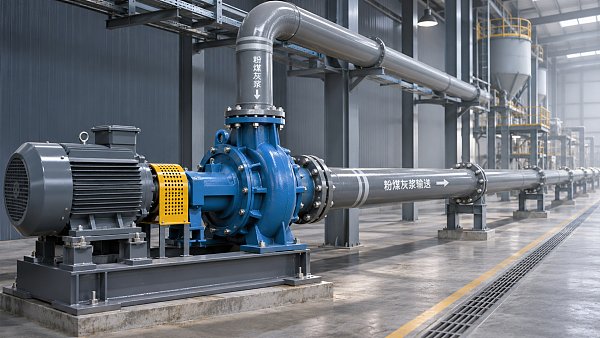
A horizontal centrifugal slurry pump is often the first option to evaluate for continuous fly ash slurry transfer. Its rotating impeller adds energy to the mixture, making it suitable for many plant transfer duties where the required flow is relatively steady. Slurry-specific designs typically provide thicker wear sections and replaceable components than general-purpose clean-water pumps.
This does not mean that every centrifugal pump is suitable for every ash mixture. As solids concentration and resistance increase, the pump’s actual performance can differ from its clean-water curve. Wear rates, available suction conditions, and the minimum velocity needed to keep solids moving must also be checked. A supplier should select the pump using the expected slurry properties and the full system duty, not pipe size alone.
Vertical sump pumps: useful when the slurry collects below floor level
If fly ash slurry accumulates in a pit or sump, a vertical slurry pump may simplify collection. The wet end sits below the mounting point, reducing the need for a long suction line. This arrangement is common where washdown water and ash gather intermittently or where a transfer pump must draw from a recessed tank.
The sump still needs to be designed as part of the system. Inadequate mixing can allow solids to accumulate away from the pump inlet, while excessive air entrainment can affect performance. Check the required immersion, liquid-level range, shaft length, and available space for removal. Some vertical designs can tolerate brief operation with a low liquid level, but this should be confirmed for the specific pump rather than assumed.
Positive displacement pumps: worth considering for demanding duties
Positive displacement pumps move a defined volume through each cycle or rotation. They can be attractive where the slurry is thick, where controlled flow is important, or where the required discharge pressure makes a centrifugal arrangement less practical. Suitability still depends on the pump design and the abrasiveness of the ash.
Diaphragm pumps can be useful for intermittent service or smaller transfers, while progressive cavity pumps may provide a relatively steady flow for compatible slurries. Piston-diaphragm and other high-pressure designs are sometimes used for demanding transport duties. These options require careful review of wear parts and operating limits. They also need appropriate pressure protection: unlike a centrifugal pump, a positive displacement pump can continue to develop pressure against a blocked discharge until a component fails or a protective device operates.
Match the pump to the slurry and the pipeline
Choosing between pump categories is only the beginning. A reliable selection depends on a realistic description of the duty, including normal operation and the conditions that occur during startup, shutdown, and upset events.
Solids concentration and particle characteristics
Ask whether concentration is reported by weight or by volume; the two values are not interchangeable. Provide the normal operating range and the highest concentration the pump may encounter, rather than a single average. The supplier also needs representative particle-size information, solids density, and, where available, an indication of abrasiveness.
Fine fly ash may remain suspended under some conditions, but behavior varies with the mixture. Coarser contaminants, agglomerates, or ash from other parts of the process can change the wear and settling profile. If the feed varies, samples taken across operating conditions are more useful than one unusually dilute sample.
Flow rate, elevation, and friction losses
The required flow rate should reflect the actual process demand, including any recirculation or intermittent peaks. Total dynamic head includes the elevation difference and pressure requirements, plus friction losses through the pipeline, bends, valves, and fittings. Slurry friction losses may differ from those calculated for water, particularly as concentration changes.
Long lines deserve special attention. The pump must provide enough head at the required flow, while the pipeline must be operated at a velocity appropriate for the slurry. Too little velocity can encourage deposition; unnecessarily high velocity can increase friction and wear. The acceptable range depends on the material and system, so it should be established through suitable calculations and operating experience.
Suction conditions and available space
A pump may be correctly sized for discharge pressure and still perform poorly if the inlet is restrictive. Review tank level, suction-pipe length and layout, liquid temperature, and any potential for air ingress. For centrifugal pumps, check the available net positive suction head against the pump’s requirements, with a suitable margin agreed for the application.
Also consider the physical work of maintaining the pump. Can an impeller or liner be removed without dismantling nearby pipework? Is there room for lifting equipment? A compact installation is less attractive if every wear-part change becomes a difficult shutdown.
Which wear materials and seals make sense?
Hard-metal wear parts are commonly considered for abrasive slurry service. Elastomer liners can also be effective in appropriate conditions, but compatibility depends on particle characteristics, temperature, chemicals, and operating duty. Neither material is automatically superior for every fly ash slurry. Discuss the expected wear mechanism with the supplier and verify that the proposed liner and impeller materials suit the actual mixture.
Seal selection deserves the same attention. Depending on the pump and duty, options may include gland packing, an expeller arrangement, or a mechanical seal. Each has practical implications for leakage, service water, maintenance, and operating pressure. If clean flush water is required, include its availability, quality, and effect on process water balance in the decision. Do not assume a seal can run dry or handle a particular solids concentration without confirmation.
For any selected design, ask which parts are expected to wear, how they are adjusted or replaced, and whether inspection can be performed without removing the entire pump. A slightly lower purchase price can lose its appeal when wear parts are difficult to access or routinely unavailable.
Two operating scenarios, two different answers
Continuous transfer from an ash mixing tank: If the slurry is kept reasonably uniform and must be moved continuously to a nearby treatment process, a horizontal centrifugal slurry pump is a sensible comparison point. The selection should be based on the expected concentration range, pipeline losses, and required flow. A standby pump, isolation arrangements, and flushing provisions may be important where interruptions are costly.
Thickened slurry sent through a demanding line: If the mixture is significantly thickened or the pipeline requires high pressure, a positive displacement pump may be more appropriate to investigate. The evaluation should include the slurry’s flow behavior, abrasive wear, pressure relief, pulsation control, and the consequences of a blocked line. The correct choice cannot be determined from concentration or distance alone.
Common selection and operating mistakes
- Using a clean-water pump curve as the final answer. Slurry can affect head, efficiency, and wear. Request a selection that accounts for the expected mixture.
- Sizing only for the maximum duty. A pump that spends most of its time far from its suitable operating range may be inefficient or experience avoidable problems. Review normal and minimum conditions too.
- Ignoring shutdown behavior. Provide a practical method to flush or otherwise manage the line when settling or hardening is possible. Confirm where flushing water will go.
- Focusing on pump material alone. Poor suction, unsuitable velocity, air entrainment, and changing concentration can undermine even a robust pump.
- Leaving instrumentation out of the discussion. Pressure, flow, motor load, and vibration trends can help operators recognize changing conditions before a minor issue becomes a longer stoppage.
What to give a pump supplier
A useful request includes the normal and maximum flow, required discharge conditions, elevation changes, pipe size and length, and a description of bends and valves. Add the slurry temperature, solids concentration range, particle-size information, solids density, pH or relevant chemistry, and expected hours of operation. Explain whether the pump will run continuously, cycle frequently, or remain idle with slurry in the system.
If some of that information is unavailable, say so. A supplier can identify which gaps are critical and whether representative sampling or further testing is needed. For many installations, an abrasion-resistant centrifugal slurry pump remains the most practical place to start. For high-pressure, thickened, or intermittent duties, a different pump may be the better fit. The sound decision is the one based on the complete operating system—not simply on the words “fly ash” in the process description.
Related Information
 Nov 19, 2026
Can a Water Test Accurately Predict Slurry Pump Performance?
Can a water test predict slurry pump performance accurately? Discover its limits, key correction factors, and how to select the right pump for your duty.- Nov 19, 2026
Should You Request a Factory Test Before Buying a Slurry Pump?
Should I request a factory performance test before buying a slurry pump? Discover when testing pays off, what to measure, and how to reduce costly procurement risks. - Nov 18, 2026
Which Pump Can Handle Abrasive Mill Scale Slurry?
Which pump can handle abrasive mill scale slurry? Compare centrifugal, vortex, submersible and positive displacement pumps to find the right fit for your operation. - Nov 18, 2026
Which Pump Is Best for Fly Ash Slurry?
Which pump is best for fly ash slurry? Compare centrifugal and positive displacement pumps, wear materials, and key selection factors to find the right fit.


{item.title}
Get a Quote
Please leave your information and email address, and we will contact you as soon as possible.