
Can a Water Test Accurately Predict Slurry Pump Performance?
A water test can establish how a slurry pump performs with clean water, but it cannot by itself accurately predict performance on every slurry. It provides a baseline for flow, head, power and efficiency; the reliability of a slurry prediction depends on how closely the pumped mixture behaves like water and whether suitable correction methods are available.
The distinction matters most when a water-test result is treated as a guarantee of duty with solids. Particle size, concentration, density and rheology can change the pump curve, the system resistance or both. A pump that meets its rated head on water may therefore operate at a different flow, draw a different amount of power or fail to maintain the required slurry duty.
What a water test actually proves
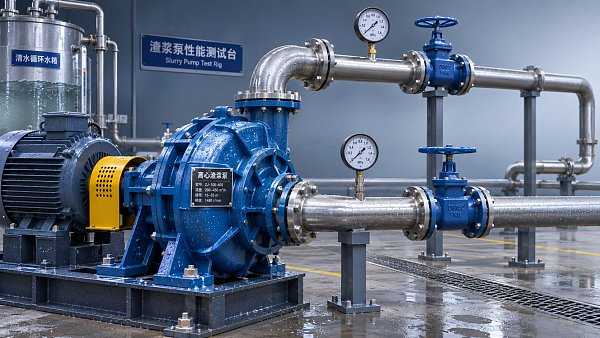
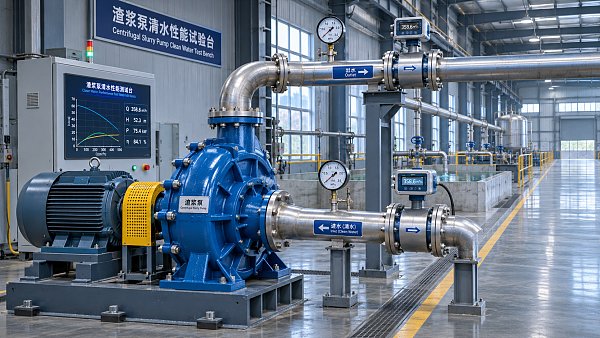
In a controlled water test, the pump is run at a specified speed while flow, pressure and power are measured at selected operating points. The results can be compared with the manufacturer’s water-performance curve and with the agreed test acceptance criteria. Depending on the test arrangement, they can also reveal issues such as unexpected vibration, leakage or unstable operation during the test.
This is valuable evidence. It helps establish that the assembled pump and impeller perform as expected with the test liquid. It also provides a consistent reference from which slurry performance can be estimated.
But the measured head is not automatically the head available when solids are introduced. Nor does a successful water test demonstrate resistance to abrasive wear, solids settling, passage of oversized particles or stable operation over a changing feed. Those questions require information about the slurry and the installation that is absent from a clean-water test.
Why the same pump can deliver a different duty
A centrifugal pump’s operating point is where its performance curve intersects the system curve. Introducing slurry can change both sides of that intersection. The pump may develop less head at a given flow than it does on water, while the pipeline may require more head to move the mixture. The resulting operating flow can be lower than a water-only calculation suggests.
Concentration is a starting point, not a complete description. A concentration expressed by weight does not mean the same thing as concentration by volume. The conversion depends on the densities of the solids and carrier liquid. Using the wrong basis can materially change the estimated mixture density and undermine subsequent power or performance calculations.
Particle size and distribution also matter. Coarse particles can behave differently from fine solids that remain dispersed in the carrier liquid. A broad size distribution may contain a coarse fraction that influences settling and passage through the pump even when the reported average size appears modest. Particle shape and density can also affect how solids move and interact with the pump and piping.
At higher concentrations, some fine-particle mixtures exhibit viscosity or yield-stress effects that cannot be represented adequately by density alone. A slurry may not behave like a Newtonian liquid, meaning that its apparent viscosity changes with shear conditions. In such cases, a single viscosity value without a specified measurement condition can be misleading.
Not every solids-containing liquid requires a large correction. A dilute suspension of very fine particles in a low-viscosity carrier may behave sufficiently like water for an initial estimate. The important qualification is that “sufficiently” depends on the accuracy needed and on evidence for the particular slurry, not simply on whether the mixture looks thin.
Head, pressure and power are not interchangeable
Water curves usually express pump head as a height of liquid. Pressure rise and head are related through fluid density: for a given head, a denser mixture produces a larger pressure rise. This does not mean the pump has gained hydraulic capability merely because a pressure gauge shows a higher reading.
Conversely, multiplying water-test pressure by a density ratio is not a complete slurry-performance prediction. The actual head developed on slurry may differ from the water head, and pressure measurements must account for the conditions and elevations at the measurement points.
Power deserves separate attention. Hydraulic power depends on flow, head and mixture density; shaft power also depends on efficiency. If a denser slurry is pumped at a comparable flow and head, the required power generally increases. Changes in efficiency and operating point can alter the result further. A motor selected only from water-test power can therefore lack adequate margin for the specified slurry duty.
This is also why a single percentage correction applied to every parameter is unreliable. A head adjustment, an efficiency adjustment and a power calculation serve different purposes. They must be applied consistently at the intended speed and flow, using a method suited to the slurry and pump.
How useful are slurry correction factors?
Correction factors connect a water curve to an estimated slurry curve. In simplified form, a head ratio relates head on slurry to head on water at a comparable flow and speed. An efficiency ratio can be used in a similar way. These factors may come from manufacturer methods, published correlations or test data, but their usefulness depends on the conditions for which they were developed.
A correction based on coarse settling solids should not automatically be applied to a fine, viscous slurry. Likewise, a method developed for one range of concentration or particle size may be unreliable outside that range. Pump design and impeller geometry also influence how well a correlation transfers.
When reviewing a corrected curve, the assumptions are as important as the curve itself:
- What solids concentration was used, and is it expressed by mass or volume?
- What particle-size distribution, solids density and carrier-liquid properties were assumed?
- Does the method address settling solids, viscous behavior or both, as relevant?
- Are head and efficiency corrected separately, and how was shaft power calculated?
- What evidence supports the method for the proposed operating range?
If the available description is only “slurry at a specified density,” the resulting curve should be treated as an estimate with potentially significant uncertainty. Two mixtures with similar density can have different particle sizes, rheology and wear behavior.
The pipeline can change the answer as much as the pump
Applying a correction to the pump curve is not enough if the system curve still assumes clean water. Slurry pipeline losses depend on mixture properties, pipe diameter, velocity and flow regime. Settling solids introduce a further constraint: velocity must be sufficient for the intended transport conditions, while excessive velocity can increase friction losses and wear.
Consider a pump chosen from a water curve at a flow that appears to meet production requirements. When slurry losses are included, the system may demand more head at that flow. At the same time, the pump’s available head may be lower than its water curve indicates. The intersection moves, and the resulting flow may fall below the required value or below the velocity needed to keep solids moving in parts of the line.
Static elevation should also be considered using the actual system configuration and mixture. It should not be confused with friction loss: changing pipe diameter can alter friction and transport velocity, but it does not remove the elevation difference between the relevant liquid levels.
Suction conditions need a separate check. A satisfactory water test does not establish that the installed pump will have adequate suction performance with the process mixture. Suction-line losses, liquid level, entrained air, temperature and the behavior of solids near the inlet can all affect operation. Where applicable, the available net positive suction head should be assessed against the pump’s requirements with suitable allowance for uncertainty and the intended duty.
When a water-based estimate is enough—and when it is not
A water test combined with an appropriate correction can be a practical basis for selection when the slurry is well characterized, the operating range is known and the correction method is supported for comparable conditions. Confidence improves when the predicted duty is not close to a limiting condition and there is sufficient margin in power, suction and flow requirements.
Confidence is weaker when the feed varies substantially, the coarse fraction is poorly defined, rheology changes with concentration, or the duty is close to the pump’s limits. In these cases, the uncertainty should be made visible rather than hidden inside a single nominal curve. Calculations for the expected range of concentration and particle size can show whether the selection remains workable as the feed changes.
A representative slurry test may be justified when the consequence of missing the duty is high or when the correction method is poorly supported. Its value depends on representativeness: the sample must reflect relevant solids properties and concentration, and the test should reproduce the operating conditions closely enough for the results to be useful. A short test at one condition will not, by itself, establish long-term wear life or performance across every feed variation.
What to specify before accepting the result
A meaningful performance commitment distinguishes the clean-water acceptance test from the intended slurry duty. The documentation should identify the pump configuration, impeller diameter, speed, test liquid and measurement conditions, as well as the acceptance tolerance agreed for the water test. A passed water test confirms performance against that defined water-test criterion; it is not automatically proof of slurry performance.
For the slurry prediction, the basis should include the required flow and total dynamic head, solids properties, concentration range, mixture density, rheological information where relevant, and the system conditions used to calculate losses. The predicted operating point, shaft power and correction method should be traceable to those inputs.
The most useful conclusion is therefore conditional: a water test is a reliable reference for water performance, while slurry performance is an engineering prediction whose accuracy depends on the quality of the slurry data and the validity of the correction. Where that prediction carries too much uncertainty for the duty, representative testing or additional characterization is more informative than treating the water curve as a direct guarantee.
Related Information
 Nov 19, 2026
Can a Water Test Accurately Predict Slurry Pump Performance?
Can a water test predict slurry pump performance accurately? Discover its limits, key correction factors, and how to select the right pump for your duty.- Nov 19, 2026
Should You Request a Factory Test Before Buying a Slurry Pump?
Should I request a factory performance test before buying a slurry pump? Discover when testing pays off, what to measure, and how to reduce costly procurement risks. - Nov 18, 2026
Which Pump Can Handle Abrasive Mill Scale Slurry?
Which pump can handle abrasive mill scale slurry? Compare centrifugal, vortex, submersible and positive displacement pumps to find the right fit for your operation. - Nov 18, 2026
Which Pump Is Best for Fly Ash Slurry?
Which pump is best for fly ash slurry? Compare centrifugal and positive displacement pumps, wear materials, and key selection factors to find the right fit.


{item.title}
Get a Quote
Please leave your information and email address, and we will contact you as soon as possible.