
What operating conditions determine the right slurry pump design?
The right slurry pump design is determined by the interaction between the slurry and the duty point, not by flow rate or discharge pressure in isolation. A pump can meet its nominal hydraulic duty and still fail prematurely if particle impact, corrosion, settling, air entrainment, seal conditions, or operating variability were not included in the specification.
The critical question is not simply “What capacity is required?” It is: “What material is moving, in what concentration, through what system, and how will that condition change during normal and abnormal operation?” Those answers drive the choice of pump type, wet-end geometry, speed, materials, shaft seal, bearing arrangement, drive rating, and maintenance philosophy.
Start with the slurry, not the pump curve
A slurry is a two-phase mixture. The carrier liquid determines much of the hydraulic behavior, while the solids determine wear, settling risk, density, and often corrosion. Treating the mixture as water with a higher specific gravity is one of the most consequential errors in slurry pump selection.
The specification should define solids concentration in both weight and volume terms where possible. Weight concentration is useful for mass balance and throughput calculations, but volume concentration has a stronger influence on slurry rheology and hydraulic performance. Two slurries with the same mass fraction can behave very differently when their solids have different densities.
As solids concentration rises, several design consequences follow:
- Mixture density increases, raising absorbed power at a given flow and head.
- Hydraulic losses increase, reducing the head available from a given impeller diameter and speed.
- Viscosity or non-Newtonian behavior may alter the pump curve substantially.
- Particle-to-particle interaction can increase wear in the impeller, throatbush, volute, and discharge passages.
- Settling becomes more likely if velocity falls in pipes, pump passages, or standby equipment.
For moderately concentrated, free-flowing slurries, corrected pump performance may be estimated using established slurry derating methods. For highly viscous, paste-like, or yield-stress mixtures, conventional centrifugal pump corrections may not be sufficient. In those duties, laboratory rheology data and application-specific testing can be more valuable than a detailed water-based pump curve.
Particle size distribution matters more than a single “maximum size”
Maximum particle size is necessary information, but it is not enough to define the wet end. The complete particle size distribution affects passage sizing, wear pattern, solids handling capability, and the risk of blockage. A slurry containing occasional coarse oversize particles calls for a different margin than one with a stable, narrow particle distribution.
Coarse particles tend to cause impact wear, especially at the impeller inlet, vane leading edges, throatbush, and points where the flow changes direction. Fine particles may produce a more uniform abrasive action and can enter narrow clearances that coarse particles cannot. Angular mineral particles generally cut and gouge surfaces more aggressively than rounded particles of similar size and hardness.
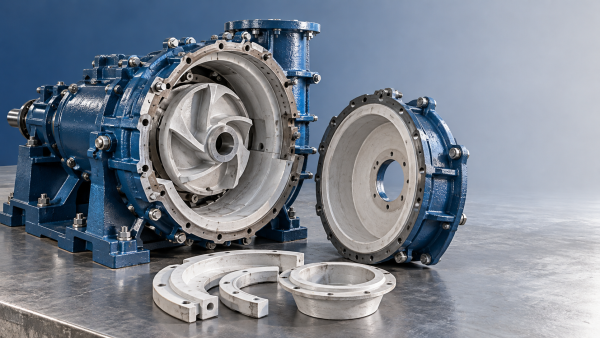
Pump geometry should therefore be matched to particle behavior. Large-passage impellers and wider flow channels reduce blockage risk and can improve solids handling, but they may sacrifice some hydraulic efficiency. Closed impellers can provide strong hydraulic performance in controlled fine-slurry duties, while open or semi-open designs may tolerate larger solids or variable feed conditions better. The correct choice depends on the penalty of plugging, expected wear rate, and required operating stability rather than on a universal preference for one impeller style.
A common specification weakness is using the nominal top particle size while ignoring tramp material. If the upstream process can introduce bolts, liner fragments, fibrous debris, scale, or agglomerates, the pump selection must account for that exposure or the system must include screening, crushing, dilution, or other protective measures. No wet-end material selection compensates for a passage that is physically too small for occasional solids.
Abrasion and corrosion are separate mechanisms that may occur together
Wear material selection begins with determining whether the duty is primarily abrasive, corrosive, erosive-corrosive, or chemically aggressive at elevated temperature. These mechanisms are related but should not be collapsed into one general requirement for a “wear-resistant” pump.
High-chrome white iron is widely used in abrasive mineral slurry service because it offers strong resistance to particle-driven wear under suitable conditions. Its suitability declines where corrosion, thermal shock, impact loading, or chemical compatibility exceeds its limits. Elastomer-lined wet ends can perform well with fine, non-sharp particles and appropriate temperatures, particularly where resilience reduces damage from particle impact. They are not a universal answer for coarse, sharp, hot, oil-contaminated, or solvent-exposed slurries.
Rubber, polyurethane, high-chrome alloys, stainless steels, duplex materials, nickel alloys, and other materials each solve different parts of the problem. Selection should consider pH, chloride content, oxidizing or reducing chemistry, dissolved gases, temperature, solids hardness, particle shape, and expected velocity at wear surfaces. A pH value alone does not establish corrosion compatibility. For example, the same apparent pH can represent materially different chemical environments depending on salts, oxidation potential, temperature, and dissolved constituents.
Where abrasion and corrosion act simultaneously, material behavior can be less predictable than either mechanism alone. Abrasion may remove a protective corrosion film; corrosion may weaken the surface and accelerate erosion. In such conditions, expected component life should be validated against compatible service history, testing, or conservative inspection intervals rather than inferred from hardness alone.
Hydraulic duty must include the full operating envelope
Flow rate, total dynamic head, and suction conditions remain fundamental, but the design point should represent the real operating envelope rather than a single ideal number. Slurry systems often see changing density, cyclone feed fluctuations, sump level variation, line wear, valve position changes, and changes in solids production. A pump selected too close to a limiting condition can lose useful operating range quickly.
The system curve should be calculated using slurry properties, pipe internal diameter, fittings, elevation, and anticipated friction changes. Pipe wear can alter both friction loss and internal diameter over time. Where solids settle, the minimum acceptable line velocity becomes a process constraint. It may be necessary to maintain a higher flow than the nominal process demand simply to prevent deposition in the pipeline.
The preferred operating region of the selected pump deserves as much attention as its best efficiency point. Sustained operation far to the left of the curve can lead to recirculation, vibration, radial loading, heat generation, and accelerated seal or bearing problems. Operation too far to the right can cause excessive power draw, reduced head margin, unstable duty, and poor control response. These risks are amplified with abrasive slurry because hydraulic instability becomes mechanical wear.
Variable-speed control can expand operating flexibility, but it does not remove the need for a sound hydraulic selection. A variable-frequency drive must be evaluated against minimum and maximum pump speed, minimum line velocity, motor torque, available NPSH, resonance zones, and the changed wear rate at higher speed. Speed reduction may reduce wear, but it may also allow solids to settle in the suction line or process pipeline.
Suction conditions and NPSH cannot be assessed as if the liquid were clean water
Insufficient suction margin can produce cavitation, loss of capacity, noise, vibration, and rapid damage to the impeller inlet. In slurry service, cavitation erosion can combine with abrasive wear and make root-cause identification difficult after the fact.
Available net positive suction head should be calculated at the most severe credible operating condition: lowest sump level, highest fluid temperature, highest slurry density where relevant, highest flow, worst suction line loss, and any expected degradation from strainers or piping. The calculation must also recognize that entrained air, froth, vortexing, and poor sump geometry may impair pump suction behavior even when the numerical NPSH margin appears acceptable.
Froth-bearing slurry requires particular caution. Air changes the mixture density and can disrupt impeller filling, reduce head, and destabilize pumping. A conventional horizontal centrifugal slurry pump may not be the right configuration where air content is persistent and significant. Vertical tank pumps, froth pumps, altered inlet arrangements, or upstream deaeration may be more appropriate depending on the process.
Suction piping should be short, adequately sized, and arranged to avoid pockets where air or settled solids can accumulate. The pump inlet should receive a stable flow pattern. A generously sized suction pipe is not automatically beneficial if the lower velocity encourages solids deposition. The design must balance suction loss against settling behavior.
Settling behavior determines layout, standby strategy, and restart risk
Some slurries remain suspended with modest agitation; others settle quickly when velocity or turbulence declines. This distinction changes more than pipeline sizing. It affects whether a horizontal pump can remain filled during a stop, whether a standby unit needs flushing, whether a sump requires agitation, and how the system should be restarted after an outage.
A slurry that forms a compact sediment bed can lock an impeller, obstruct a suction branch, or create a high-torque startup condition. If frequent stoppages are expected, the design should examine flush-water connections, drain points, clean-out access, line slope, isolation arrangements, and the sequence for returning equipment to service. These provisions are often inexpensive at the design stage and difficult to retrofit after deposits begin accumulating inside a live system.
Vertical cantilever sump pumps can avoid some shaft-seal concerns and may suit sumps with variable liquid levels, but they are not inherently immune to settling or wear. Their immersed length, inlet submergence, structural stiffness, and solids circulation in the sump still require evaluation. Horizontal pumps may offer easier access to wet-end components and greater flexibility in severe-duty configurations, provided suction conditions are adequately controlled.
Seal selection follows pressure, solids, leakage tolerance, and support utilities
The shaft seal is not an accessory selected after the pump has been chosen. It is part of the operating design. Packing glands, expellers, mechanical seals, and seal-water arrangements have distinct requirements and failure modes.
Packed glands can be robust in abrasive duties when supplied and adjusted correctly, but they require controlled leakage and reliable flush water where the duty calls for it. A gland-water system needs specified pressure, flow, filtration quality, and monitoring; simply stating “seal water available” is not an engineering definition. Loss of flush can quickly damage packing, sleeves, and adjacent components.
Expeller or dynamic seal arrangements can reduce or eliminate external seal-water demand in suitable services, but their effectiveness depends on pump speed, suction conditions, and discharge pressure. They may not provide the required containment during stopped conditions or in duties with high static head. Mechanical seals can be appropriate where leakage control is critical, but abrasive solids, pressure fluctuations, dry running, and poor flush plans can make them a high-maintenance choice if the seal environment is not controlled.
The relevant decision is not which seal is most sophisticated. It is whether the seal arrangement remains stable through normal operation, transient conditions, standby periods, and utility interruptions.
Operating hours change the economic meaning of efficiency and wear life
A pump operating intermittently for a few hours per week can tolerate a different maintenance approach from one running continuously in a critical process line. Required availability, permitted downtime, access restrictions, and maintenance windows should influence the selected frame size, liner arrangement, bearing capacity, instrumentation, and spare-parts strategy.
For high-duty applications, a slightly larger pump operating at lower speed may offer a more favorable wear-life trade-off than a smaller unit driven near its speed limit, even if the initial purchase cost is higher. This is not a universal rule: oversizing can move the pump into inefficient or unstable low-flow operation. The evaluation must compare the actual operating point, speed, wear exposure, power consumption, and expected maintenance interval.
Wear parts should also be assessed as a system. A low-cost impeller is not necessarily economical if it forces simultaneous replacement of adjacent components or requires a long shutdown. Design features such as replaceable liners, accessible throatbushes, cartridge bearing assemblies, condition monitoring points, and realistic lifting access affect the total maintenance burden.
Specify the uncertainties, not only the nominal conditions
The most reliable slurry pump specifications state what is known and identify what remains variable. Feed density range, particle size distribution, maximum solids size, pH range, temperature range, flow turndown, upset conditions, available seal water, suction level range, and expected operating hours should be documented. If a property has not been measured, it should be identified as an assumption with an appropriate design margin.
Vendor pump curves are indispensable, but they should be reviewed alongside the assumed slurry correction method, absorbed power basis, NPSH basis, wet-end material, impeller diameter, speed, seal arrangement, and allowable operating range. A curve alone does not confirm suitability for an abrasive or chemically complex duty.
This discipline is especially important in systems where ash, solids-laden wastewater, flue-gas treatment by-products, or other abrasive process streams are handled continuously. In such services, the pumping requirement should be evaluated as part of the wider process and maintenance configuration, as illustrated by solutions for the Power Generation Industry. The dependable design is the one that remains workable when slurry properties, suction conditions, and operating hours depart from the nominal case—not merely the one that reaches the calculated duty point on day one.
Related Information
 Oct 26, 2026
Why Slurry Pump Bearing Assemblies Overheat After Replacement
Slurry Pump Bearing Assemblies overheating after replacement? Discover how lubrication, preload, and alignment affect heat—and learn practical checks to prevent costly downtime.- Oct 26, 2026
Pump CFD Analysis: Identifying Recirculation and Erosion-Prone Zones
Pump CFD Analysis reveals recirculation and erosion-prone zones. Learn how to validate hotspots, guide design improvements, and support more reliable pump operation.  Oct 25, 2026
Are Double-Casing Slurry Pumps Cheaper to Maintain Than Single-Casing?
Is a double-casing slurry pump cheaper to maintain than a single-casing pump? Compare wear life, parts, labor, and downtime to find the best value for your operation.- Oct 25, 2026
How Do You Free a Slurry Knife Gate Valve Stuck Partly Open?
How do I free a slurry knife gate valve stuck partly open? Discover safe isolation steps, approved flushing methods, and repair checks to restore reliable operation and reduce downtime.


{item.title}
Get a Quote
Please leave your information and email address, and we will contact you as soon as possible.