
What Should Buyers Expect From a Custom Slurry Pump Manufacturer?
What Should Buyers Expect From a Custom Slurry Pump Manufacturer?
Choosing a slurry pump is rarely just a matter of matching flow rate and head on a datasheet. In abrasive, corrosive, high-density, or variable-solids services, the pump becomes part of the process risk. A poor selection may still move material on day one, yet consume impellers, overload motors, clog seal systems, or force unplanned shutdowns long before anyone expected.
That is why buyers working in mining, mineral processing, dredging, tailings handling, power plant ash systems, sand washing, and heavy industrial processing should expect more from a custom slurry pump manufacturer than a catalogue model with a different flange or paint color. The manufacturer should be able to translate real operating conditions into a pump configuration that can be maintained, monitored, and supplied over its working life.
“Custom” does not always mean designing every component from zero. In many practical projects, the best answer is a proven pump platform with a tailored wet end, material selection, drive arrangement, seal package, liner design, or mounting layout. What matters is whether those changes are based on the slurry and duty—not on assumptions.
Expect Questions Before You Receive a Proposal
A capable supplier does not begin by asking only for inlet size, discharge size, and motor power. Those details matter, but they do not define the pumping problem. The first technical discussion should dig into what is actually flowing through the line.
At a minimum, the manufacturer should want to understand the required flow range, total dynamic head, expected operating hours, solids concentration, particle size distribution, particle hardness, slurry density, temperature, pH, viscosity behavior, and whether the material settles during stoppages. The pump’s suction conditions also deserve attention. A duty point that looks reasonable on paper can become troublesome when the suction tank level drops, the pipeline is extended, or the feed changes after an upstream process adjustment.
Buyers should be prepared for some uncertainty, particularly in new plants or changing ore bodies. A good manufacturer will not pretend uncertain inputs are precise. Instead, it should identify the variables that most affect selection and explain what margin, speed range, or wear allowance may be appropriate. That is a more useful conversation than receiving a very exact-looking pump curve built on incomplete slurry data.
It is also worth discussing abnormal conditions. Does the line run dry during startup? Can oversized particles enter during dredging? Is the pump expected to clear a partially settled line? Will operators throttle the discharge valve, or is variable-speed control available? These are not minor operating details. They often determine whether a robust heavy-duty pump, a recessed-impeller arrangement, a different seal arrangement, or changes to the piping should be considered.
The Hydraulic Design Should Match the Actual Duty Range
A slurry pump should not be selected solely because its published best-efficiency point happens to sit near one stated duty point. Process plants seldom operate at one unchanging condition. Feed density shifts, pipelines wear, cyclone circuits are adjusted, and production targets change. Buyers should ask where the pump will operate most of the time, not merely where it may operate during a design calculation.
The manufacturer should be able to provide a pump performance curve and explain its relevance to the proposed configuration. That discussion normally includes flow, head, efficiency, absorbed power, speed, and the expected operating window. For slurry service, the relationship between water-based test performance and field performance also needs to be handled carefully. Actual slurry behavior can affect head, efficiency, wear rate, and power demand. A responsible supplier will describe the assumptions used rather than implying that a water test curve guarantees identical results in every slurry.
Oversizing is another common trap. A pump that is too large may require frequent throttling or low-speed operation. It can create poor control, wasted energy, recirculation concerns, and excessive wear in certain conditions. Undersizing has an obvious cost as well: missed production targets, overload risk, and limited room for process changes. The right selection is usually the one that has enough operating flexibility without treating “bigger” as a substitute for engineering.
Materials Need to Be Chosen for the Wear Mechanism, Not by Habit
In slurry pumping, material selection is not a simple choice between “metal” and “rubber.” Different parts of a wet end may face different damage mechanisms: sliding abrasion, impact abrasion, corrosion, erosion-corrosion, chemical attack, or heat-related degradation. An impeller handling sharp mineral particles does not necessarily need the same material strategy as a casing liner exposed to fine, corrosive slurry.
High-chrome white iron is widely used in abrasive duties because of its wear resistance, while elastomer liners can be effective in some fine-particle applications where impact is limited. Various alloys, natural rubber, synthetic elastomers, polyurethane, and other engineered materials may be considered depending on the slurry. None is universally “best.” Coarse, sharp solids that strike the wet end at high velocity can quickly change the answer compared with a fine, relatively smooth slurry.
A manufacturer should explain the reasoning behind its proposed materials, including any trade-offs. For example, a material selected primarily for abrasion resistance may have limitations in corrosive chemistry; a lined construction may simplify replacement in one service but be unsuitable in another. Buyers should be cautious when a supplier recommends the same wet-end material for every process without asking about particle characteristics or chemical conditions.
Mechanical Design Matters as Much as the Wet End
The wet end gets most of the attention because it sees the slurry directly. But bearing life, shaft stiffness, sealing, frame strength, and drive alignment often decide whether the pump is straightforward to run or a constant maintenance burden.
For demanding service, buyers should expect discussion of the shaft and bearing arrangement, lubrication method, allowable drive loads, baseplate design, and coupling or belt-drive configuration. If the pump will be installed outdoors, on a floating dredge, in a confined plant floor, or on a mobile skid, access for inspection and replacement becomes part of the custom scope. A pump that is technically sound but cannot be lifted, aligned, or serviced safely in its installed position is not a finished solution.
Seal selection deserves the same level of care. Depending on the duty, options can include expeller-based arrangements, packed gland seals, mechanical seals, or combinations with flush or barrier systems. Each arrangement has operating requirements. Mechanical seals are not automatically the premium answer if the service lacks reliable flush water or if dry running is likely. Packing may be more forgiving in some field conditions, but it requires adjustment and can allow controlled leakage. The manufacturer should explain what utilities, operator attention, and maintenance practices the proposed seal system assumes.
Customization Should Be Visible in the Drawing Package
A buyer should be able to see what is being supplied. Before production, the documentation should make the scope clear enough for engineering, operations, maintenance, and procurement teams to review. Depending on the project, this may include a general arrangement drawing, sectional drawing, performance curve, materials list, motor and drive details, connection information, weights, dimensions, and recommended spare parts.
For a custom build, it is especially important to identify what is standard and what has been modified. Has the suction geometry changed? Is the baseplate nonstandard? Are special flush connections required? Is the impeller diameter trimmed, or is a different hydraulic family being used? Ambiguity here creates trouble later, particularly when a replacement part is ordered years after the original pump was installed.
There should also be a clear boundary between pump supply and system responsibility. Pump manufacturers can advise on suction piping, discharge routing, valve selection, instrumentation, and control philosophy, but the purchaser should know exactly what has been reviewed and what remains the responsibility of plant or EPC engineering. A pump cannot compensate for a badly designed suction line, inadequate venting, or a system that routinely creates severe pressure transients.
Quality Assurance Should Be Practical, Not Just a Promise
Quality assurance in slurry pump manufacturing is not only about a final paint inspection. Buyers should ask how critical components are controlled through casting, machining, assembly, and testing. The appropriate level of documentation depends on the project and its risk, but the manufacturer should be able to state what checks are standard and what additional inspections are available.
Useful questions include whether material traceability can be supplied when required, how dimensional checks are handled, whether hydraulic or pressure testing is performed where applicable, and what performance testing is available for the selected pump size and configuration. If testing is based on water, that should be stated plainly. Buyers should also confirm whether third-party inspection, hold points, witness testing, or project-specific documentation must be agreed before the order is released.
The goal is not to burden a routine purchase with unnecessary paperwork. It is to ensure the level of verification matches the consequences of failure. A standby sump pump and a critical tailings transfer pump do not deserve the same procurement approach.
Spare Parts and Service Are Part of the Pump Decision
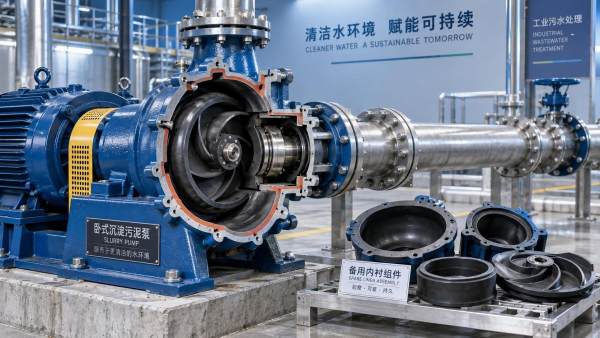
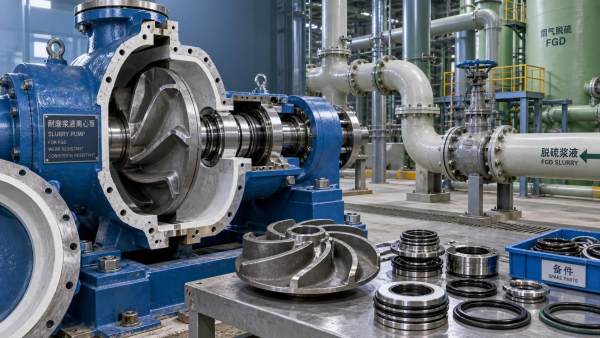
A slurry pump is a wear item by nature. Even an excellent selection will eventually need liners, impellers, throatbushes, packing, seals, bearings, or other replacement components. Buyers should ask early how parts are identified, whether wear components are interchangeable across supplied units, what lead times may apply, and which spares should be held on site.
There is no universal spare-parts list because site conditions differ. A remote mine with limited transport options may carry more insurance stock than a plant near a service center. A process that cannot stop may justify a cartridge assembly, a standby pump, or a rotating spare. The manufacturer should help distinguish between commissioning spares, normal operating spares, and capital spares rather than supplying a generic list with no link to maintenance strategy.
Technical support after commissioning is equally revealing. Ask who can assist with vibration, overheating, premature wear, seal leakage, loss of head, or unexpected power draw. The most valuable support is diagnostic: reviewing operating data, checking the duty against the curve, inspecting failed parts, and identifying whether the root cause is hydraulic, mechanical, material-related, or system-related.
Frequently Asked Questions
Is a custom slurry pump always more expensive?
Not necessarily. A custom configuration may cost more than a stock unit if it requires special materials, nonstandard dimensions, a dedicated skid, or unusual testing. However, a catalog pump that is poorly matched to the duty can cost more over time through wear parts, lost availability, energy use, and maintenance labor. The useful comparison is lifecycle fit, not only purchase price.
What information should be sent in an initial inquiry?
Provide the process duty, slurry description, solids information if known, temperature, chemistry, piping details, suction conditions, preferred drive, installation constraints, operating schedule, and any existing pump history. Photos of worn components from a current installation can also be informative, although they should not replace process data. If values are estimated, identify them as estimates.
Can a manufacturer guarantee wear life?
Wear life is difficult to guarantee without stable, well-characterized operating conditions. Changes in particle size, density, chemistry, speed, and operating point can materially alter component life. A credible manufacturer can discuss likely wear drivers and recommend inspection intervals, but absolute promises should be examined closely unless they are backed by clearly defined duty conditions.
When is a custom design justified?
Customization is justified when a standard configuration cannot meet the process, maintenance, layout, material, sealing, or reliability requirement without compromise. It is also useful where existing equipment repeatedly fails for identifiable reasons. The best starting point is not “we need a custom pump,” but “here is where the current pumping arrangement is failing.”
The right custom slurry pump manufacturer should make the buying process more transparent, not more complicated. Expect detailed questions, documented assumptions, clear technical trade-offs, and honest limits around what the pump can handle. If a supplier can explain why a particular configuration suits the slurry, the site, and the maintenance reality, that is usually a stronger signal than an attractive curve or a low initial quotation alone.
Related Information
 Oct 04, 2026
When custom slurry pumps make sense for nonstandard process duty
Custom Slurry Pumps reduce wear, blockage, downtime, and lifecycle costs in demanding nonstandard process duties. Learn when tailored pump engineering delivers measurable value.- Oct 03, 2026
Selecting pumps for flue gas desulfurization systems with gypsum slurry
Flue Gas Desulfurization Systems pump selection guide: optimize gypsum slurry handling with wear-resistant materials, reliable sealing, and lower lifecycle costs. - Oct 02, 2026
How abrasive slurry handling reduces premature impeller wear
Abrasive Slurry Handling reduces premature impeller wear through optimized velocity, material selection, suction control, and inspection strategies. Discover practical maintenance tips. - Oct 01, 2026
How mining slurry pumps affect downtime in high-wear circuits
Mining Slurry Pumps can make or break uptime in high-wear circuits. Learn how smarter selection, wear materials, and maintenance reduce failures and lifecycle costs.


Get a Quote
Please leave your information and email address, and we will contact you as soon as possible.