
What Service Life Can You Expect from a Corrosion-Resistant Slurry Pump?
When a slurry line begins losing flow, drawing more power, or requiring repeated seal and impeller work, the immediate question is often whether the pump has reached the end of its life. The practical answer is that a corrosion-resistant slurry pump can remain in service for years, but its wet-end parts may need replacement much sooner depending on the slurry, chemistry, and operating conditions.
So, what is the expected service life of a corrosion resistant slurry pump? There is no single hour or year figure that applies to every installation. A correctly selected pump operating near its intended duty point may provide long-term service, while an identical model can suffer rapid wear when exposed to highly abrasive solids, aggressive chemicals, dry running, excessive velocity, or poor maintenance. The useful way to assess service life is to separate the life of the pump structure and drive system from the replacement interval of wear components.
The pump does not wear as one single unit
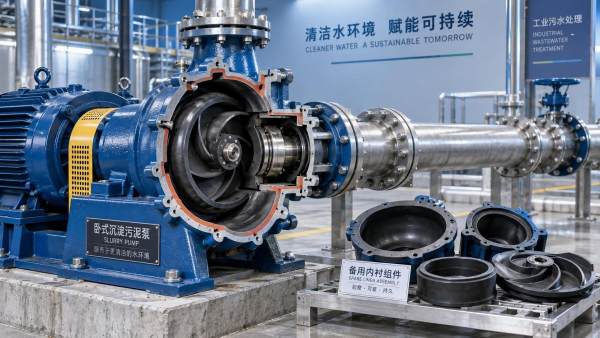
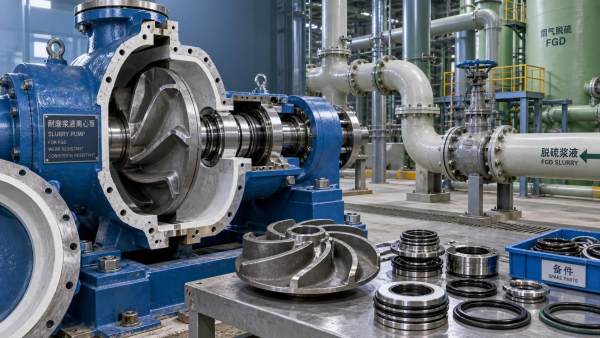
A slurry pump is often described as having “failed” when its performance falls below process requirements. In reality, different parts usually age at different rates. The casing, bearing frame, shaft, motor, baseplate, and piping connections can often remain usable for a long time if they are protected from corrosion, vibration, and misalignment. The wet end is exposed directly to the slurry and normally determines maintenance intervals.
Components that commonly require inspection and replacement include:
- Impeller and throatbush
- Volute or casing liners
- Side liners, frame plates, and cover plates where applicable
- Shaft sleeves and gland packing or mechanical seal faces
- Expeller components in dynamic sealing arrangements
- Bearings, couplings, and belts when vibration or alignment problems develop
This distinction matters during purchasing and maintenance planning. A durable pump is not necessarily one that never needs parts; it is one whose materials, hydraulic design, access for maintenance, and operating range allow wear parts to be replaced before damage reaches the major mechanical assembly.
Why corrosion resistance alone does not determine longevity
Corrosion-resistant construction protects the pump from chemical attack, but slurry duty usually combines several damaging mechanisms. A liquid may be acidic, alkaline, chloride-bearing, oxidizing, or otherwise corrosive while also carrying hard particles that erode surfaces. The combined effect can be much more severe than either corrosion or abrasion alone.
For example, a chemically compatible alloy can still wear quickly if sharp, hard particles strike the impeller and liner surfaces at high velocity. Conversely, a highly abrasion-resistant material may perform poorly when the chemical environment attacks its binder, matrix, or protective surface. Material selection must therefore account for the complete slurry, not just its pH or its percentage of solids.
Conditions that usually shorten pump life
Abrasive particles at excessive velocity
Wear rises sharply when a pump is forced to run faster than necessary. Higher rotational speed can solve a short-term head or flow problem, but it also increases the velocity at which solids hit wetted surfaces. The result may be thinning at the impeller vane tips, volute cutwater, throatbush, and high-turbulence zones.
A pump should not be oversized in speed simply to create operating margin. Where the process permits it, a larger pump running at a lower speed may provide a better wear outcome than a smaller unit driven near its upper limit. This is not a universal rule, because size, efficiency, solids passage, and available space also matter, but speed should always be considered during selection.
Operating too far from the best efficiency region
Slurry pumps have a preferred operating range. When actual flow is much lower than intended, internal recirculation can develop near the impeller eye and discharge area. When flow is much higher, velocity, inlet conditions, and power demand may become problematic. Either condition can create uneven wear, vibration, noise, and reduced sealing reliability.
A common operating situation is a pump selected for a future process capacity that never arrives. The system then uses a throttled discharge valve to control flow. This may keep production moving, but it can leave the pump operating in a poor hydraulic zone for extended periods. Reviewing the actual duty point against the pump curve is often more valuable than replacing parts repeatedly without addressing the cause.
Unstable or incomplete slurry data
Average solids concentration is not enough to predict wear. A process can appear stable on paper while occasional coarse particles, density spikes, reagent changes, temperature changes, or entrained air cause the real damage. Start-up, shutdown, tank cleaning, upset conditions, and intermittent feed changes may expose the pump to its harshest duty.
For a meaningful life estimate, document the normal condition and the credible worst condition. Record particle size distribution where available, particle hardness or mineral content, slurry density, liquid chemistry, temperature, flow rate, static lift, pipe layout, and expected variation. A pump material that is suitable for normal production may not withstand a short but recurring upset condition.
Cavitation, air entrainment, and suction restrictions
Cavitation occurs when local pressure falls low enough for vapor bubbles to form and collapse inside the pump. It may appear as crackling noise, fluctuating discharge pressure, vibration, pitting, or a loss of capacity. Air entering through a leaking suction line, vortexing in a sump, poor submergence, blocked strainers, or insufficient suction head can create similar symptoms.
These problems are sometimes mistaken for ordinary abrasion. However, a replacement impeller will not last as expected if the suction condition remains unresolved. Check the suction pipe for unnecessary restrictions and air leaks, confirm sump level behavior, inspect for solids buildup, and compare available suction head with the pump’s requirements under the actual slurry condition rather than clean-water assumptions.
Material selection should follow the wear mechanism
There is no universally best corrosion-resistant material. High-chrome white iron is widely used where abrasion is dominant and the chemical environment permits it. Natural rubber or synthetic elastomer liners can be effective for certain fine-particle slurries and moderate chemical conditions, especially where resilience helps resist particle impact. Stainless steels, duplex alloys, nickel-based alloys, and other corrosion-resistant metals may be selected when chemical attack is the principal threat.
The right choice depends on whether the slurry causes cutting abrasion, sliding abrasion, impact damage, corrosion, erosion-corrosion, or a combination of these. Particle size is especially important. Coarse, sharp particles may damage elastomeric materials by cutting or tearing, while very fine particles may be handled effectively by a suitable elastomer. A metal alloy that resists abrasion well can still be a poor match for strongly reducing acids, chloride-rich liquids, or high-temperature chemical service.
Before changing materials after a short component life, inspect the failed part rather than relying only on operating impressions. Smooth, directional thinning suggests erosion. Localized pits may indicate corrosion or cavitation. Cracks, broken vane sections, and torn liners can point to oversize solids, impact, mechanical interference, or unsuitable material toughness. The appearance and location of wear often reveal more than a general statement that the slurry is “aggressive.”
Use wear patterns to decide whether replacement is routine or premature
Regular inspection should establish a baseline. A new or rebuilt wet end can be measured at known reference points, such as liner thickness, impeller vane thickness, throatbush clearance, and clearances between rotating and stationary parts. Repeat measurements at planned intervals show the actual wear rate in that application.
Routine wear tends to be reasonably predictable and concentrated in expected high-velocity areas. Premature wear often shows one or more warning signs:
- A sudden drop in flow or head without a process explanation
- Rapid increase in power draw or inability to maintain required pressure
- Uneven wear on one side of an impeller or liner
- Repeated seal leakage soon after adjustment or replacement
- New vibration, bearing temperature increase, or coupling damage
- Frequent need to close impeller clearance to restore performance
- Corrosion concentrated around joints, crevices, or stagnant zones
When these signs occur, replacing only the visibly damaged part may restore production briefly but does not answer why the damage accelerated. Review operating records around the time performance changed. A different ore source, altered reagent dosage, blocked pipeline, changed sump level, worn control valve, or revised pump speed can be the missing factor.
Maintenance practices that protect the major assembly
Maintenance cannot eliminate wet-end wear, but it can prevent ordinary wear from turning into shaft, bearing, or casing damage. Keep packing correctly adjusted: it should control leakage without being overtightened. Excessive packing compression creates sleeve wear, heat, and unnecessary shaft load. Mechanical seals require their specified flush, barrier, or cooling conditions; running a seal dry or with contaminated support fluid can quickly damage seal faces.
Alignment is equally important. Misalignment between motor and pump, a soft baseplate, pipe strain, worn couplings, or an unbalanced impeller can load bearings and shafts beyond their intended condition. Inspect vibration trends, bearing temperature, lubricant condition, and fastener tightness as part of scheduled work. These checks are not substitutes for hydraulic troubleshooting, but they help identify mechanical consequences before a failure becomes extensive.
Clearance adjustment deserves attention on pumps designed with adjustable wear components. Restoring the correct impeller-to-liner or impeller-to-throatbush clearance can recover hydraulic performance as parts wear. Adjustment must follow the pump manufacturer’s procedure and should not be used to compensate indefinitely for severely thinned parts. Closing the clearance too far can cause rubbing, heat, or seizure.
A practical way to estimate service life before and after installation
Before purchase, request a duty assessment based on the full slurry and system information, not merely nominal flow and head. The resulting expectation should describe likely wear parts, material options, probable risks, and conditions that could shorten the interval. Treat any service-life estimate as an application-specific planning value, not as a guarantee detached from operating conditions.
After installation, replace assumptions with operating evidence. Track flow, pressure, speed, density where measured, power, vibration, seal leakage, and component measurements. The first wear cycle is especially informative. If the pump reaches its planned maintenance point with predictable wear and stable performance, future spares planning becomes more reliable. If it does not, investigate the mismatch before ordering the same configuration again.
A corrosion-resistant slurry pump delivers its longest useful life when the material is compatible with the liquid, the hydraulic size matches the actual duty, the suction condition is stable, and wear components are inspected before clearances and vibration become excessive. In severe service, the goal is not to promise a fixed lifetime; it is to make wear predictable, protect the mechanical assembly, and prevent avoidable downtime.
Questions often raised during pump life planning
Should a corrosion-resistant slurry pump be replaced when the impeller wears out?
Usually not. Impellers, liners, throatbushes, seals, and sleeves are commonly serviceable parts. Replacement of the complete pump is more likely to be considered when the main casing, bearing frame, shaft, or structural components are damaged, obsolete, or uneconomical to repair.
Can changing to a more corrosion-resistant alloy solve rapid wear?
Only when corrosion is a meaningful cause of the damage. If wear is driven mainly by large, hard, angular solids or excessive speed, a more corrosion-resistant alloy may provide little improvement. Examine the failed component, slurry chemistry, and particle characteristics before changing material.
Does a slower pump always last longer?
Lower speed often reduces abrasive wear because particle impact velocity is lower, but the pump must still meet flow and head requirements and operate within an acceptable hydraulic range. Reducing speed too far can create another off-duty operating problem. Selection should balance speed, pump size, efficiency, solids handling, and system demand.
What is the first item to check when wear life suddenly decreases?
Compare current process conditions with the conditions under which the previous components operated. Changes in solids size, density, chemistry, temperature, pump speed, suction level, or pipeline resistance are often more revealing than the wear part alone. Then inspect where the damage is concentrated to distinguish abrasion, corrosion, cavitation, and mechanical contact.
Related Information
 Oct 04, 2026
When custom slurry pumps make sense for nonstandard process duty
Custom Slurry Pumps reduce wear, blockage, downtime, and lifecycle costs in demanding nonstandard process duties. Learn when tailored pump engineering delivers measurable value.- Oct 03, 2026
Selecting pumps for flue gas desulfurization systems with gypsum slurry
Flue Gas Desulfurization Systems pump selection guide: optimize gypsum slurry handling with wear-resistant materials, reliable sealing, and lower lifecycle costs. - Oct 02, 2026
How abrasive slurry handling reduces premature impeller wear
Abrasive Slurry Handling reduces premature impeller wear through optimized velocity, material selection, suction control, and inspection strategies. Discover practical maintenance tips. - Oct 01, 2026
How mining slurry pumps affect downtime in high-wear circuits
Mining Slurry Pumps can make or break uptime in high-wear circuits. Learn how smarter selection, wear materials, and maintenance reduce failures and lifecycle costs.

Get a Quote
Please leave your information and email address, and we will contact you as soon as possible.