
Double-Housing vs. Single-Housing Slurry Pumps: Which Fits Your Duty?
The housing arrangement is not a minor construction detail in a slurry pump. It determines how the pump contains pressure, how quickly worn parts can be changed, whether external leakage becomes a maintenance issue, and how much structural margin is available when the duty becomes harsher than expected.
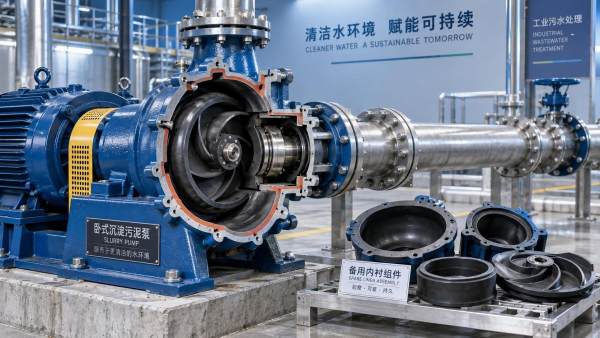
A double-housing slurry pump uses an outer casing and a separate internal wear liner. A single-housing pump relies on one pressure-containing casing, whose internal surfaces are directly exposed to the slurry. Neither layout is universally better. Double housing is generally the stronger choice for severe abrasive duties, higher pressures, and applications where liner replacement is expected. Single housing can be more practical where pressure is moderate, maintenance access is limited, or the slurry calls for a solid corrosion-resistant alloy casing rather than a separate liner system.
What is the structural difference?
In a double-housing design, the outer casing is the structural pressure vessel. It is commonly made from ductile iron, cast steel, or another material selected primarily for mechanical strength. Inside it sits a replaceable wet-end liner, often in high-chrome white iron for abrasion resistance or elastomer for selected fine-particle and chemically compatible duties. The slurry contacts the liner, impeller, throatbush, and related wet-end components rather than the outer casing.
The external casing and the internal liner do different jobs. The outer casing resists operating pressure and provides structural rigidity. The liner is sacrificial: it is intended to wear and be replaced before the supporting casing is damaged. In many designs, the space between the liner and casing is sealed from the slurry and may be filled with water or left as a controlled cavity, depending on the manufacturer’s construction.
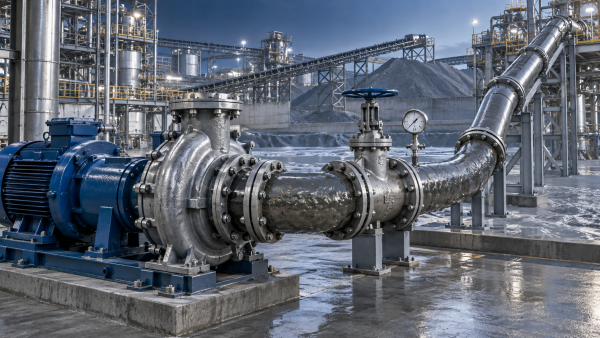
A single-housing slurry pump has no separate outer pressure casing around a replaceable liner. The casing itself is both the pressure boundary and the wetted wear component. It may be cast from high-chrome alloy, duplex stainless steel, rubber-lined metal, polyurethane, or another material chosen to handle the actual slurry. When the casing reaches its wear limit, it is repaired, refurbished, or replaced as a complete component.
This distinction explains the central answer to the question, how does double housing slurry pump compare to single housing: double housing separates structural containment from wear resistance, while single housing combines them in one casing. The practical consequences extend well beyond initial purchase price.
Why double housing is often used in severe slurry service
Abrasive slurry does not wear every pump component evenly. The highest local velocities, particle impact angles, turbulence zones, and recirculation paths usually determine component life. Volute cutwaters, throatbushes, liner inlets, impeller shrouds, and clearance-sensitive areas can deteriorate long before the rest of the pump appears heavily worn.
With a double-housing pump, a worn internal liner can be replaced without discarding the outer casing. This is particularly valuable when coarse particles, hard mineral solids, or high solids concentrations create predictable but substantial wet-end wear. The casing remains in service as long as it retains structural integrity, while the lining system becomes part of the planned maintenance cycle.
The secondary casing also provides an additional containment layer. This should not be confused with a guarantee against leakage: failed seals, damaged liner joints, incorrect assembly, or prolonged operation after a liner failure can still lead to problems. However, an outer casing can reduce the immediate consequence of liner perforation and may provide more time to identify an internal wear failure before slurry escapes externally.
Double-housing construction is often associated with heavy-duty centrifugal slurry pumps used in mineral processing, tailings transport, mill discharge, ash handling, dredging, and other applications where abrasion and pressure are both material considerations. The correct decision still depends on the actual duty point. A pump selected only because it has a double casing can be poorly matched if its impeller speed, wetted material, clearance control, or hydraulic range is unsuitable.
Where a single-housing pump can be the better fit
Single-housing does not mean light-duty by definition. A robust single casing in an appropriate alloy can be highly effective, especially when corrosion resistance is more important than the replaceability of a liner. In chemically aggressive slurry service, the material decision may dominate the housing decision.
For example, a slurry containing chlorides, acids, or process chemicals may require duplex stainless steel, super duplex, nickel alloys, or carefully selected non-metallic materials. A replaceable high-chrome liner is excellent against many abrasive slurries but is not automatically suitable for corrosive service. If the corrosion mechanism attacks the liner material quickly, the economic advantage of a replaceable wear part disappears.
Single-housing pumps can also offer a simpler configuration. Fewer structural interfaces may reduce assembly complexity, and a compact casing can be useful where space, weight, or piping layout is constrained. In lower-pressure transfer duties, wastewater slurries, fine solids, chemical slurries, and process streams with manageable wear rates, replacing a complete casing at longer intervals may be entirely rational.
The key question is not whether the casing is replaceable. It is whether the expected wear life, replacement scope, and downtime consequences are acceptable for the process. A complete casing replacement may be inexpensive relative to a production interruption in one plant, yet unacceptable in another where the pump is a critical bottleneck.
Pressure duty changes the decision
Pressure is one of the clearest reasons to consider double housing. The outer casing in a double-housing pump is designed to take the structural load, allowing the internal liner to focus on erosion resistance. This arrangement can provide a useful design margin in high-head or multi-stage slurry duties.
However, terms such as “high pressure” should be treated carefully. Pump pressure capability depends on the specific model, casing design, flange rating, shaft arrangement, sealing system, temperature, and permissible operating envelope. A double-housing pump is not automatically suitable for every high-pressure duty, and a single-housing pump is not automatically limited to low pressure.
The required calculation starts with total dynamic head, but selection cannot stop there. Static lift, pipeline friction, fittings, elevation changes, slurry density, solids concentration, and transient conditions all affect the pressure seen by the pump. Start-up conditions, blocked discharge scenarios, valve operation, and changes in solids loading can impose loads different from steady-state operation. The selected casing must suit the maximum credible operating condition, not merely the nominal point on a process flow diagram.
Wear behavior matters more than the word “abrasive”
Many slurry specifications state that a fluid is abrasive without identifying the characteristics that govern pump wear. Particle size distribution, particle hardness, shape, concentration, density, settling tendency, and transport velocity are more useful than a general abrasion label.
Coarse, angular, hard particles tend to create impact and gouging wear. Fine particles may produce sliding abrasion, especially at high velocity. A low-solids slurry can still be destructive if the particles are hard and the pump runs fast. Conversely, a denser slurry of soft particles may be less damaging than expected. Corrosion can accelerate erosion by weakening the material surface, creating a combined erosion-corrosion mechanism that a simple abrasion rating will not capture.
Double housing is attractive when the slurry’s wear pattern makes planned liner replacement economically sensible. Yet the liner material must match the mechanism. High-chrome alloy liners are commonly chosen for hard, abrasive particles where chemical attack is limited. Elastomer liners can perform well with fine particles and certain non-sharp solids, but they may be unsuitable for large, sharp particles, excessive temperature, or incompatible chemicals. A single alloy casing may be preferable when corrosion resistance, temperature capability, or mechanical durability rules out the available liner options.
Maintenance economics are not just about part price
The apparent advantage of a replaceable liner is straightforward: replace the worn internal component rather than the complete casing. The real comparison is more complicated because maintenance cost includes labor, outage duration, lifting requirements, inventory, alignment work, sealing parts, and the risk of an unplanned failure.
A double-housing pump may reduce the cost of each major wet-end renewal, but it can require careful liner installation. Improper seating, damaged sealing faces, incorrect tightening sequence, or incompatible elastomer seals can create leakage paths or distort liner components. A maintenance plan should specify inspection points, torque procedures where applicable, clearance settings, and criteria for changing associated parts such as impellers, throatbushes, expellers, and gland components.
A single-housing pump can simplify some maintenance tasks because there are fewer casing-and-liner interfaces. But once the casing itself is worn beyond allowable limits, the replacement event may be more extensive. If the casing also supports connected pipework or requires significant dismantling, the planned outage may be longer than the price of the casing alone suggests.
For a realistic lifecycle comparison, estimate the expected replacement interval for wet-end parts, the labor hours for each intervention, the cost of lost production or standby operation, and the availability of spares. A pump with a higher initial cost may be justified when it turns an emergency casing failure into a scheduled liner change. It may not be justified where a standby pump is available and the slurry is mild enough that complete casing life is long.
Sealing and leakage should be evaluated separately from casing type
Housing construction influences containment, but it does not replace a suitable shaft-sealing arrangement. Slurry pumps may use packed glands, centrifugal expeller arrangements, mechanical seals, or combinations selected according to suction conditions, process pressure, flush-water availability, environmental requirements, and allowable leakage.
A common mistake is to treat a double casing as a solution to all leakage concerns. The most visible leakage in a slurry pump installation may originate at the shaft seal, flange joints, drain points, or auxiliary piping rather than from a worn casing liner. If the process cannot tolerate dilution from gland water, that constraint can affect the seal selection and pump configuration more strongly than the choice between single and double housing.
Housing decisions should therefore be made alongside, not before, the seal strategy. A pump that survives abrasion well but requires an impractical sealing arrangement is not a successful selection.
Selection errors that create avoidable cost
One frequent error is selecting a double-housing pump solely because the slurry contains solids. Solids alone do not establish severe wear duty. The pumping system may operate at low head with fine, non-aggressive particles, where a simpler single-housing construction provides adequate service life.
The opposite error is choosing a single-housing pump because the process appears chemically demanding, without calculating expected erosion. A corrosion-resistant material can still lose section rapidly under high-velocity particle impact. Where erosion and corrosion coexist, material selection may require specialist review rather than a choice based on chemical compatibility tables alone.
Another problem is using clean-water hydraulic assumptions. Slurry density changes power demand, while solids can alter hydraulic efficiency, head performance, and suction behavior. A housing selected for a nominal flow rate may face unexpected stress and wear if the pump is operated far from its best efficiency region, at excessive speed, or under recurrent dead-head and low-flow conditions.
Interchangeability also deserves scrutiny. Two pumps may appear similar externally but use different liner geometry, casing thickness, fastening arrangements, shaft seals, or material specifications. For replacement and cross-border sourcing, verify drawings, part numbers, material grades, dimensional tolerances, and the supplier’s stated pressure and temperature limits. “Fits” is not the same as “performs safely at the required duty.”
A practical basis for choosing the housing arrangement
Double housing is usually the stronger candidate when the pump must handle sustained abrasive wear, substantial differential pressure, expensive process downtime, or a duty where predictable liner replacement can be built into maintenance planning. It is especially relevant when the outer casing’s retained structural life has clear value after the wetted liner has reached its wear limit.
Single housing deserves serious consideration when operating pressure is moderate, the slurry is chemically aggressive, the appropriate liner material is unavailable or unsuitable, the equipment must remain compact, or complete casing replacement is acceptable within the site’s maintenance strategy. It can also be the more logical configuration where process conditions do not justify the complexity of a separate casing-and-liner system.
The final choice should be based on a duty sheet that includes flow range, total head, slurry density, solids concentration, particle size and hardness, temperature, chemical composition, suction conditions, allowable leakage, expected operating hours, and maintenance constraints. Without those details, the housing decision is largely a guess.
Double housing offers a disciplined way to manage wear by separating containment from consumable wet-end protection. Single housing offers a direct, potentially simpler solution when its casing material and pressure capability match the duty. The better pump is the one whose housing, wetted materials, hydraulics, seal arrangement, and maintenance plan all fit the same operating reality.
Related Information
 Oct 04, 2026
When custom slurry pumps make sense for nonstandard process duty
Custom Slurry Pumps reduce wear, blockage, downtime, and lifecycle costs in demanding nonstandard process duties. Learn when tailored pump engineering delivers measurable value.- Oct 03, 2026
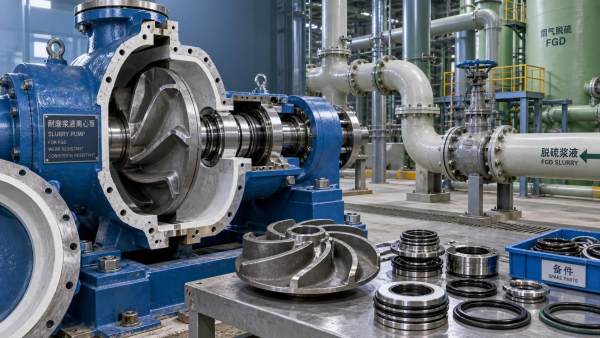
Selecting pumps for flue gas desulfurization systems with gypsum slurry
Flue Gas Desulfurization Systems pump selection guide: optimize gypsum slurry handling with wear-resistant materials, reliable sealing, and lower lifecycle costs. - Oct 02, 2026
How abrasive slurry handling reduces premature impeller wear
Abrasive Slurry Handling reduces premature impeller wear through optimized velocity, material selection, suction control, and inspection strategies. Discover practical maintenance tips. - Oct 01, 2026
How mining slurry pumps affect downtime in high-wear circuits
Mining Slurry Pumps can make or break uptime in high-wear circuits. Learn how smarter selection, wear materials, and maintenance reduce failures and lifecycle costs.

Get a Quote
Please leave your information and email address, and we will contact you as soon as possible.