
Are Chinese-Made Slurry Pumps Reliable for Overseas Mining Projects?
Chinese-made slurry pumps can be reliable enough for overseas mining projects, but the answer depends far more on the pump specification, manufacturing discipline, and support model than on the country of manufacture alone. A well-engineered Chinese pump from a supplier that controls materials, machining, assembly, testing, and parts supply can perform effectively in abrasive-duty service. A low-cost pump selected only by appearance or nominal duty point can create expensive downtime regardless of where it was built.
For overseas mine operators, the practical question is not whether a pump carries a Chinese label. It is whether the proposed unit will survive the slurry, fit the existing system, and remain serviceable when it is hundreds or thousands of kilometres from the supplier. Those are separate tests, and each should be evaluated before a purchase order is placed.
What makes a slurry pump reliable in mining service?
Slurry pumps fail for identifiable reasons: excessive wear, seal failure, bearing damage, hydraulic instability, cavitation, shaft deflection, blocked passages, or unsuitable operating conditions. The country of origin does not prevent or cause these problems by itself. Reliability comes from how the pump is designed around those failure modes.
In a mining application, the operating fluid is rarely just water with solids. Particle size, hardness, concentration, density, shape, and corrosiveness all affect the pump. A unit moving fine flotation tailings at moderate density faces a different duty from one feeding cyclone clusters with hard, angular ore particles. The same model family may be suitable for both only when the wet-end materials, impeller design, speed, lining arrangement, and drive configuration have been selected correctly.
A buyer assessing Chinese slurry pumps should therefore separate the supplier's manufacturing origin from the actual technical proposition. A reliable offer should identify the slurry duty clearly rather than merely state a flow rate and head. It should show the intended operating point, pump speed, impeller diameter, material grades, shaft seal arrangement, power requirement, and expected wear-part configuration. If those details are vague, the risk is not “Chinese manufacturing”; it is incomplete engineering.
Can Chinese pumps match international mining pump designs?
Many Chinese manufacturers produce centrifugal slurry pumps based on well-established mining pump architectures. Some offer interchangeable wear parts or dimensions compatible with widely used pump families. This can be useful where a mine already operates a recognized design and wants additional supply options for pumps or consumables.
Compatibility, however, should not be assumed from a product image, a similar model code, or a statement that parts are interchangeable. The details matter: casing thickness, impeller geometry, liner fit, shaft diameter, bearing assembly, seal chamber dimensions, fastener grade, and material chemistry can all affect field performance and maintenance. A nominally compatible part that fits physically may still have a different wear life, balance condition, or hydraulic effect.
Chinese suppliers range from specialized manufacturers with engineering and test capability to traders sourcing from multiple factories. That variation is why broad claims about reliability are unhelpful. A buyer should assess the individual manufacturer, its controls, and its willingness to document what it is supplying.
For a critical pump position, especially a mill discharge, cyclone feed, thickener underflow, tailings transfer, or high-pressure concentrate duty, the decision should rest on verified configuration and support capability. A standard water-duty pump adapted with hard-metal parts is not automatically a mining-grade slurry pump. Conversely, a properly built heavy-duty slurry pump made in China may be a sound option when the duty has been reviewed carefully.
Where overseas projects face the greatest risk
Remote mining projects place unusual pressure on the supply chain. A pump can be technically adequate at commissioning yet still become an operational problem when the first wet-end overhaul is due and replacement components are unavailable. Freight time, customs clearance, site access, and limited maintenance windows can turn a minor parts issue into prolonged lost production.
The main risk areas tend to be practical rather than theoretical:
- Unclear slurry data. If solids concentration, particle-size distribution, hardness, or pH are estimates, the selected material and pump speed may be wrong from the start. The supplier should identify assumptions and explain how changes in slurry conditions affect the selection.
- Selection at the edge of the curve. A pump that operates far from its best efficiency region may experience recirculation, vibration, excessive wear, and unstable flow. Oversizing does not always create a safety margin; throttling an oversized slurry pump can introduce another set of problems.
- Material substitution. High-chrome white iron, natural rubber, synthetic elastomers, stainless alloys, and duplex materials serve different duties. A quotation that lists generic “wear-resistant alloy” without a defined grade leaves too much room for variation.
- Weak bearing and seal arrangements. The wet end gets attention because it visibly wears, but bearing assembly quality, lubrication practice, shaft stiffness, and seal-water conditions often determine whether the pump runs reliably between planned outages.
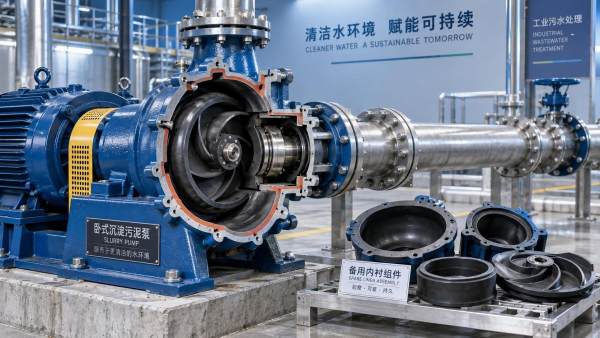
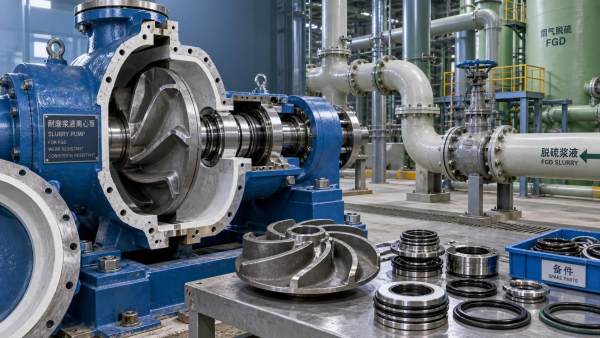
- No spare-parts strategy. A supplier may be able to produce a pump, yet have no established process for supplying matched liners, impellers, throatbushes, seals, bearings, and hardware to an overseas site on a predictable schedule.
- Limited commissioning support. Incorrect rotation, misalignment, unsuitable gland-water pressure, poor suction conditions, or a badly set variable-speed drive can damage a new pump quickly. Remote support procedures matter when on-site service is not readily available.
These risks apply to pumps from every supply region. They deserve particular attention when a project is qualifying a new overseas vendor, because assumptions that would be corrected through a long local relationship may not surface until the equipment reaches site.
Which duties are more suitable for a new Chinese supplier?
Not every pump position carries the same consequence of failure. The most sensible entry point is often a non-critical or parallel duty where the mine can compare performance and service life without exposing production to a single unproven asset. Transfer pumps, sump duties, auxiliary tailings service, and standby installations can provide a more manageable qualification path than an immediately critical feed position.
That does not mean secondary duties deserve weak engineering. They still need a proper hydraulic selection and materials review. It means the operational consequences of a learning curve are lower, and the site can establish whether documentation, dimensional consistency, parts quality, and supplier communication meet expectations.
For a critical duty, a buyer may still choose a Chinese-made pump, but the approval process should be more rigorous. It is reasonable to ask for the pump curve at the proposed speed and impeller diameter, power data, general arrangement drawings, sectional drawings, parts lists, material identification, and details of the proposed seal system. The operator should also review the suction arrangement and expected operating range rather than treating the pump as a stand-alone item.
A good supplier should be able to discuss trade-offs. For example, running more slowly with a larger pump may reduce wear velocity but increase initial cost and footprint. A rubber-lined design may suit fine, non-sharp particles well, while coarse and sharp particles may call for a hard-metal wet end. An expeller seal can reduce dependence on gland water in some conditions, but it is not suitable for every suction pressure or process requirement. Simple answers to these questions are usually less valuable than specific ones.
How should buyers evaluate manufacturing quality?
A mine does not need to audit every machine shop in person to make a disciplined purchasing decision, but it should request evidence that connects manufacturing controls to failure prevention. The emphasis should be on the components that carry the most wear and load.
For cast wet-end components, material control is central. Impellers, casings, liners, and throatbushes must have the intended chemistry and heat-treatment outcome to resist abrasion. The buyer can ask how castings are identified by heat, how material grades are controlled, and what inspection is applied before machining and assembly. The aim is not to demand paperwork for its own sake; it is to reduce the chance that a high-wear component has been substituted with a lower-grade material.
Dimensional control is equally important. A slurry pump depends on controlled clearances between the impeller and its surrounding wear parts. Excessive clearance reduces hydraulic performance; inadequate clearance can cause contact and rapid damage. The bearing frame, shaft, seal chamber, and baseplate alignment also need to be consistent, particularly where the pump will connect to existing pipework or use an established motor and coupling arrangement.
Factory testing should be interpreted carefully. A water performance test can confirm flow, head, power, and basic mechanical operation, but it cannot reproduce the full wear behavior of abrasive ore slurry. It is still valuable because it verifies that the assembled pump behaves as specified hydraulically. Buyers should ask what test results will be provided and whether the actual delivered pump, rather than a representative model, will be tested where practical.
Documentation is often an early indicator of engineering maturity. A supplier that can provide a coherent drawing package, serial or component identification, a defined bill of materials, and a clear inspection record is easier to work with after shipment. When a replacement liner or impeller is needed years later, accurate identification can be as important as the original purchase price.
Are lower prices a reliability warning?
Lower acquisition cost is not automatically a warning, but an unusually low quotation should prompt a technical comparison. Two slurry pumps with similar dimensions may differ materially in casting weight, wear material, bearing capacity, seal arrangement, motor rating, baseplate construction, included instrumentation, and supplied spares. A price comparison without a configuration comparison can make a robust package appear expensive and an incomplete one appear attractive.
The appropriate metric for a mine is usually cost over the operating cycle: purchase price, installation, power consumption, wear-part replacement, labor, downtime exposure, and inventory holding. A pump with a lower initial price can be the better choice if it meets the duty, produces acceptable wear life, and has a dependable parts route. It becomes costly when repeated unplanned intervention offsets the saving.
Buyers should also avoid expecting a universal service-life figure. Wear life is governed by the specific slurry and operating point. Claims that an impeller, liner, or seal will run for a fixed number of hours have little value without context. A more useful discussion identifies the wear mechanism, the materials selected to address it, and the parts that should be stocked for the planned maintenance interval.
What should be agreed before ordering?
The strongest safeguard is a purchase specification that turns assumptions into agreed requirements. It need not be excessively long, but it should define the duty and acceptance basis clearly enough that both sides are working from the same pump.
- Process flow, total head, solids concentration, density, particle-size information, temperature, pH, and any corrosive constituents.
- Normal, minimum, and maximum operating conditions, including whether variable-speed operation is expected.
- Required wet-end materials and elastomer types, with component-level identification where wear service is critical.
- Seal arrangement, flush or gland-water requirements, instrumentation, motor and drive details, and site electrical standards.
- Drawing approval requirements, factory test expectations, inspection points, packing requirements, and serial-number traceability.
- Recommended commissioning spares, two-year operating spares where appropriate, and the supplier's process for urgent replenishment.
- Clear technical contacts for installation, start-up, troubleshooting, and parts identification after delivery.
It is also prudent to clarify what happens when actual slurry conditions differ from the design basis. Mines change ore blends, plant throughput, grind size, and water balance. A pump supplier cannot guarantee results against an undefined or moving process, but it should be able to explain the operating limits and the adjustment options available, such as changing impeller diameter, pump speed, liner material, or pump size.
The practical answer for overseas buyers
Chinese slurry pumps are reliable enough for overseas mining projects when they are sourced as engineered equipment, not as interchangeable commodities. The better question is whether the manufacturer can demonstrate a suitable design, controlled materials, repeatable production, test evidence, and a parts-and-support arrangement that works at the mine's location.
For a first purchase from a new supplier, start with a fully defined duty and make technical compliance visible in the quotation. Compare pump curves, materials, seal systems, bearing arrangements, supplied spares, and logistics terms before comparing prices. Where uptime consequences are high, qualify the supplier through a controlled installation or require a more detailed review of the critical components and support plan.
That approach avoids both common mistakes: dismissing a capable Chinese manufacturer solely because of origin, and assuming that any lower-cost equivalent will perform like a proven mining pump. Reliability is earned through specification, manufacturing, installation, and support after the pump leaves the factory.
Related Information
 Oct 04, 2026
When custom slurry pumps make sense for nonstandard process duty
Custom Slurry Pumps reduce wear, blockage, downtime, and lifecycle costs in demanding nonstandard process duties. Learn when tailored pump engineering delivers measurable value.- Oct 03, 2026
Selecting pumps for flue gas desulfurization systems with gypsum slurry
Flue Gas Desulfurization Systems pump selection guide: optimize gypsum slurry handling with wear-resistant materials, reliable sealing, and lower lifecycle costs. - Oct 02, 2026
How abrasive slurry handling reduces premature impeller wear
Abrasive Slurry Handling reduces premature impeller wear through optimized velocity, material selection, suction control, and inspection strategies. Discover practical maintenance tips. - Oct 01, 2026
How mining slurry pumps affect downtime in high-wear circuits
Mining Slurry Pumps can make or break uptime in high-wear circuits. Learn how smarter selection, wear materials, and maintenance reduce failures and lifecycle costs.

Get a Quote
Please leave your information and email address, and we will contact you as soon as possible.