
Key Duty and Wear Criteria for Slurry Pumps in Iron Ore Mining
In iron ore mining, selecting a heavy duty slurry pump for iron ore mining requires more than matching nominal flow and head specifications.
Technical evaluators must examine actual duty conditions, particle behavior, materials, hydraulic efficiency, and wear life before approving equipment for abrasive service.
The central decision is whether a pump can maintain required throughput throughout its wear cycle while controlling downtime, energy consumption, and replacement costs.
Start with the Real Pumping Duty, Not the Design Point
Many slurry pump selections fail because they are based on a single design point rather than the full operating envelope encountered during production.
Iron ore processing circuits rarely operate at fixed conditions. Ore hardness, grind size, solids concentration, and plant throughput can change between shifts or campaigns.
Technical evaluators should define minimum, normal, and maximum flow conditions before comparing any heavy duty slurry pump for iron ore mining.
The duty definition should include static head, friction losses, pipeline length, elevation changes, valve losses, and the expected condition of pipework over time.
A pump that meets head requirements when pipelines are new may become undersized as roughness, scale accumulation, or routing changes increase system resistance.
Slurry density is equally important because it affects power demand, velocity, settling risk, and the force with which particles strike internal pump components.
Assess both in-situ slurry density and credible upset conditions. A temporary increase in solids can overload the drive or accelerate wear dramatically.
Particle size distribution must be specified beyond a simple maximum particle diameter. Fine particles, angular coarse material, and oversize fragments wear differently.
Iron ore slurries can contain sharp hematite, magnetite, silica, and gangue particles, each creating different abrasion mechanisms inside the wet end.
Duty calculations should identify whether the service is cyclone feed, mill discharge, tailings, concentrate transfer, underflow, or long-distance pipeline transport.
These applications may appear similar on a process flow diagram, yet they impose substantially different requirements for pressure capability, passage size, and wear resistance.
Use Hydraulic Selection to Protect Both Performance and Wear Life
Hydraulic performance should be evaluated using the pump curve together with the actual system curve, not through flow and head values considered separately.
The preferred operating region is generally near the pump’s best efficiency point, where recirculation, vibration, energy loss, and uneven wear are reduced.
Running far left of the best efficiency point can create internal recirculation, causing localized turbulence and severe erosion near the impeller eye.
Operating too far right can raise velocity and frictional losses while increasing the risk of cavitation, unstable operation, and shortened component life.
Evaluators should request efficiency curves, power curves, NPSH requirements, speed limits, and wear-adjusted performance data for the proposed pump configuration.
Efficiency should not be treated as an isolated energy metric. Higher efficiency often reduces heat, turbulence, and hydraulic stress within the wet end.
However, the highest initial efficiency is not always the lowest lifecycle-cost option if narrow passages or lightweight materials produce rapid performance degradation.
Impeller diameter and rotational speed require careful review. Higher speed can meet head demands with a smaller pump, but usually intensifies abrasive wear.
A larger pump operating at lower speed may offer better wear life and maintenance access, particularly where coarse particles dominate the slurry.
Confirm that the selected operating point allows future adjustment. Impeller trimming, speed control, or a planned diameter reserve can support changing plant conditions.
For variable throughput, a variable-frequency drive may improve control, but the pump and motor must remain within acceptable torque, speed, and cavitation limits.
Evaluate Abrasion by Mechanism, Not Only by Solids Percentage
Solids concentration matters, but it does not fully predict wear. Particle hardness, shape, size, velocity, and impact angle are often more influential.
Sliding abrasion occurs where particles scrape along liners, impeller vanes, and throatbush surfaces under sustained high-velocity flow.
Impact abrasion is more severe when coarse, angular particles strike surfaces directly, especially at direction changes, discharge zones, and impeller leading edges.
Fine abrasive particles can create widespread polishing and gradual wall loss, while coarse particles may cause localized gouging, cracking, or sudden failure.
Technical evaluators should obtain representative slurry data from process engineers, laboratory tests, historic inspections, and operating records rather than relying on assumptions.
Useful data includes percent solids by weight, slurry specific gravity, particle size distribution, top particle size, mineral hardness, particle morphology, and temperature.
Where ore bodies vary, selection should use the most damaging credible material condition rather than an annual average that masks difficult operating intervals.
Consider the impact of tramp material. Occasional oversize fragments may dictate inlet dimensions, impeller passage, liner thickness, and inspection frequency.
Wear rates should also be linked to slurry velocity. Low velocity risks settling, whereas excessive velocity can multiply erosion in pumps and pipelines.
The appropriate velocity range depends on particle size, density, pipe diameter, and rheology, so generalized rules should be verified against the actual circuit.
Match Wet-End Materials to the Duty and Maintenance Strategy
Material selection is a core technical decision because wet-end components determine wear life, repair intervals, spares demand, and total cost of ownership.
High-chrome white iron is widely used for severe abrasive duties because its hard carbide structure resists sliding abrasion effectively in many ore slurries.
Its limitations should also be understood. Brittle materials can be vulnerable to large-particle impact, thermal shock, poor installation practices, or severe corrosion.
Natural rubber liners can perform well with fine particles and certain moderate abrasive services, particularly where resilience helps absorb particle impact.
Rubber is generally less suitable for sharp coarse solids, high temperatures, or chemical conditions that cause swelling, degradation, or liner separation.
Elastomers, polyurethane, duplex alloys, and specialty materials may be appropriate for specific services, but they should be justified through duty-specific evidence.
Do not accept a material recommendation solely because it is familiar within a supplier’s standard range. Ask why it suits the stated slurry.
Component-by-component material choices may be valuable. The impeller, throatbush, frame plate liner, cover plate liner, and expeller can experience different mechanisms.
A suitable configuration may combine hard-metal wetted parts with a robust external casing, depending on pressure rating, serviceability, and site maintenance practices.
When reviewing alternatives, compare expected wear life in operating hours, acceptable wall-loss limits, component replacement cost, and repair labor requirements.
Inspect the Components That Usually Set the Wear Interval
The wet end does not wear uniformly. Identifying the components that control service interval helps evaluators establish realistic maintenance and spares plans.
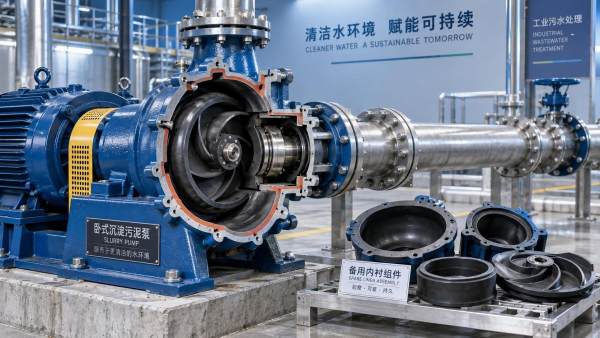
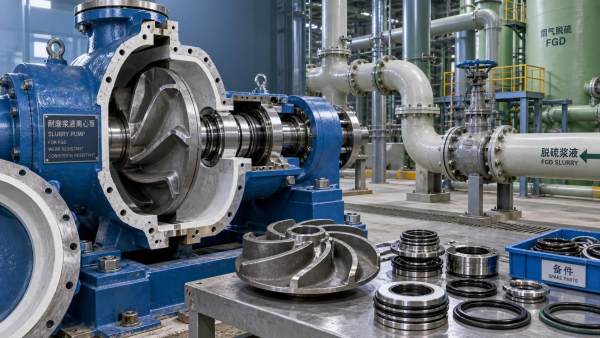
Impellers commonly experience wear on the leading edges, vane tips, shrouds, eye, and discharge areas where particles change direction at high velocity.
The throatbush is often a critical wear component because it experiences concentrated flow and can influence leakage, efficiency, and liner life.
Frame plate and cover plate liners should be monitored for localized thinning, particularly around the cutwater and other areas exposed to turbulent discharge flow.
Clearance between the impeller and throatbush affects hydraulic efficiency. As clearance grows, recirculation increases and pump head progressively declines.
Front or rear clearance adjustment systems can help recover performance, but operators need clear limits to avoid contact, excessive load, or damaged parts.
Shaft sleeves, gland packing, mechanical seals, expellers, and seal water systems deserve equal scrutiny because seal failures can interrupt an otherwise healthy pump.
For high-pressure applications, verify casing pressure capability, bolt loading, liner retention methods, and the supplier’s recommendations for safe wear limits.
Wear monitoring should use consistent measurements rather than visual impressions alone. Thickness readings, clearance checks, power trends, and flow data provide better evidence.
A documented inspection history allows sites to forecast replacement windows, order components early, and prevent unplanned outages during high-value production periods.
Compare Lifecycle Cost Instead of Purchase Price
For iron ore operations, initial pump price is rarely the dominant cost. Energy, downtime, labor, wet-end replacements, and lost production often exceed it.
Lifecycle evaluation should compare equivalent duties over a defined operating period, preferably using plant-specific production, maintenance, and electricity cost assumptions.
Calculate energy cost using expected absorbed power across the operating range, not motor nameplate power or a single point of advertised efficiency.
Estimate replacement expenditure by component, including impeller, liners, throatbush, seals, bearings, fasteners, and any special tools required for overhaul.
Downtime must be assigned a credible value. In constrained circuits, a slurry pump failure can reduce mill throughput or stop a downstream process entirely.
Maintenance duration matters as much as interval. Cartridge-style assemblies, accessible liner fasteners, lifting provisions, and standardized parts can reduce outage exposure.
Spare-parts availability should be examined early. Long lead times for critical wet-end parts can create inventory costs or operational vulnerability.
A technically sound proposal should state assumptions transparently and distinguish expected wear life from guaranteed life under documented operating conditions.
For evaluators seeking a robust baseline design, the Type DH(R) Slurry Pump can be assessed against the defined duty, materials, and maintenance criteria.
The correct comparison is not which pump appears least expensive initially, but which option delivers required tonnes with the lowest defensible total cost.
Verify Mechanical Reliability Beyond the Wet End
Wet-end wear receives most attention, yet mechanical reliability determines whether a pump can operate continuously between planned maintenance intervals.
Review bearing arrangement, bearing life calculations, lubrication method, shaft diameter, shaft deflection, and compatibility with expected radial and axial loads.
High slurry density and changing hydraulic conditions can increase mechanical loads, especially when the pump operates away from its preferred efficiency region.
The baseplate and drive train should be sufficiently rigid to control vibration. Misalignment accelerates bearing, seal, coupling, and shaft failures.
Motor selection requires a power margin based on maximum slurry density, maximum impeller diameter, drive losses, and credible operating excursions.
Undersized motors may trip during startup or density peaks. Excessive oversizing can reduce efficiency and complicate protection settings without solving hydraulic problems.
Check the seal arrangement against suction conditions, discharge pressure, solids content, available flush water, and the site’s ability to maintain auxiliary systems.
Expeller seals may reduce external water demand in suitable services, while gland or mechanical seals may be necessary for specific containment requirements.
Instrumentation should support condition-based decisions. Pressure, flow, motor power, vibration, bearing temperature, and seal water data reveal deterioration before failure occurs.
Ask suppliers for dimensional drawings, lifting weights, service clearances, and maintenance procedures. A reliable design still creates risk if site access is poor.
Use a Practical Technical Evaluation Checklist
A structured review prevents selection teams from focusing on headline performance while overlooking the conditions that drive wear and lifecycle cost.
First, validate the process data with operations personnel. Confirm flow range, head range, slurry density, particle distribution, temperature, and upset scenarios.
Second, plot the proposed pump against the system curve at minimum, normal, and maximum duty conditions, including anticipated future resistance increases.
Third, compare candidate materials against the dominant abrasion and corrosion mechanisms, supported by comparable operating references where available.
Fourth, assess wear-component access, expected service intervals, adjustment procedures, lifting needs, spare-part lead times, and site repair capabilities.
Fifth, compare lifecycle costs using consistent assumptions for energy, components, labor, inventory, downtime, and expected production consequences.
Sixth, review mechanical and sealing arrangements to ensure bearings, shafts, drives, casings, and auxiliary systems match the actual operating environment.
Finally, define acceptance criteria before procurement. These can include tested duty performance, pressure capability, materials certification, documentation, and support obligations.
References from similar iron ore applications are valuable when they include slurry characteristics, operating hours, maintenance records, and component wear observations.
Generic reference lists are less useful because similar pump models can produce very different results when slurry properties and operating points differ.
Conclusion: Select for Stable Tonnes, Controlled Wear, and Predictable Maintenance
A heavy duty slurry pump for iron ore mining should be selected as part of a complete operating system, not as a standalone flow-and-head device.
The strongest technical evaluations connect process duty, hydraulic operating range, particle characteristics, wet-end materials, mechanical design, and maintenance strategy.
Wear criteria should focus on actual failure mechanisms and measurable component condition rather than broad claims about abrasion resistance or nominal solids capability.
When evaluators compare lifecycle cost, serviceability, and performance retention, they can identify pumps that protect throughput through demanding iron ore operating cycles.
The final purchasing decision should favor the option that delivers stable duty, manageable wear intervals, and clear evidence supporting long-term operating reliability.
Related Information
 Oct 04, 2026
When custom slurry pumps make sense for nonstandard process duty
Custom Slurry Pumps reduce wear, blockage, downtime, and lifecycle costs in demanding nonstandard process duties. Learn when tailored pump engineering delivers measurable value.- Oct 03, 2026
Selecting pumps for flue gas desulfurization systems with gypsum slurry
Flue Gas Desulfurization Systems pump selection guide: optimize gypsum slurry handling with wear-resistant materials, reliable sealing, and lower lifecycle costs. - Oct 02, 2026
How abrasive slurry handling reduces premature impeller wear
Abrasive Slurry Handling reduces premature impeller wear through optimized velocity, material selection, suction control, and inspection strategies. Discover practical maintenance tips. - Oct 01, 2026
How mining slurry pumps affect downtime in high-wear circuits
Mining Slurry Pumps can make or break uptime in high-wear circuits. Learn how smarter selection, wear materials, and maintenance reduce failures and lifecycle costs.

Get a Quote
Please leave your information and email address, and we will contact you as soon as possible.