
How dredging pumps maintain output as solids concentration rises
As solids concentration rises, dredging operators need stable flow, predictable pressure, and fewer interruptions. Well-designed dredging pumps maintain output through hydraulic balance, wear control, and disciplined operating practices.
What Operators Need to Know First
The core question is not whether a pump can move slurry once. It is whether it can sustain production when density, particle size, and abrasion increase.
For operators, declining output usually appears as reduced discharge distance, unstable pressure, excessive vibration, rising power demand, or repeated pipeline blockages.
Dredging pumps maintain performance by converting engine or motor power into slurry velocity while minimizing internal losses caused by dense solids and component wear.
Higher solids concentration increases slurry density and viscosity. The pump must generate more energy to keep material moving at a velocity that prevents settlement.
When slurry velocity falls below the critical transport speed, coarse particles settle in pipelines. This raises resistance quickly and can lead to blockage.
A reliable pumping system therefore depends on more than pump size. It requires matching the pump, pipeline, impeller, power source, and slurry conditions.
Operators should focus on trends rather than isolated readings. A gradual pressure drop or power increase often signals a developing hydraulic or wear-related problem.
The most useful operating objective is stable production per hour, not simply the highest instantaneous solids concentration at the suction intake.
Why Higher Solids Concentration Challenges Pump Output
Water is comparatively easy to pump because it has low viscosity and does not cause significant internal abrasion. Dense slurry behaves very differently inside the pump.
As solids content rises, the mixture becomes heavier. More energy is needed to accelerate it through the impeller, volute, discharge pipe, and fittings.
Dense slurry also creates greater friction losses in pipelines. Long discharge lines, elevation changes, bends, and undersized pipes amplify this effect.
Particle size matters as much as concentration. Fine silt may increase viscosity, while gravel, sand, shell, and stones create stronger impact and wear loads.
Irregular particles can disturb smooth flow through the pump. They may recirculate near the impeller, strike liners, or accumulate in low-velocity sections.
Air entrainment is another common challenge. Excessive air at the suction side reduces pump efficiency, causes surging, and makes discharge flow difficult to control.
Operators should not assume that a higher solids percentage always improves productivity. Excessively dense slurry can reduce total delivered tonnage by slowing flow severely.
The practical target is the highest sustainable solids concentration that keeps velocity, pressure, power consumption, and mechanical condition within acceptable operating limits.
Impeller Design Keeps Slurry Moving
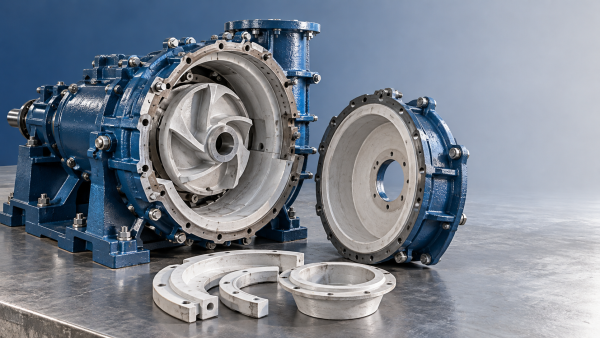
The impeller is the main component responsible for transferring energy to slurry. Its geometry strongly affects flow capacity, head generation, and solids handling ability.
Dredging pump impellers usually have wider passages than clean-water pump impellers. These passages allow larger solids to pass without frequent clogging.
Open or semi-open impellers are often used where large particles are expected. Their design can improve solids passage and simplify adjustments during wear.
Closed impellers may offer better hydraulic efficiency under controlled conditions. However, they are generally less forgiving when oversized solids enter the system.
Blade shape affects how smoothly slurry enters and exits the impeller. Well-designed blades reduce turbulence, internal recirculation, and unnecessary energy loss.
Impeller diameter also matters. A larger impeller can generate more head, but it must be matched to available power and the pump casing design.
As impellers wear, their hydraulic performance changes. Rounded blade edges and enlarged clearances reduce the pump's ability to develop pressure efficiently.
Regular inspection of impeller condition helps operators identify output loss before it becomes a production-stopping failure or causes damage elsewhere in the system.
Wear-Resistant Materials Protect Hydraulic Performance
Abrasion does not only shorten component life. It directly reduces pumping efficiency by changing the shape and clearance of critical hydraulic surfaces.
Dredging pumps commonly use high-chrome white iron, hardened alloys, elastomer liners, or specialized coatings depending on particle size and slurry characteristics.
Hard metal materials perform well against sharp, coarse, high-impact solids. They are frequently selected for sand, gravel, mineral slurry, and aggressive excavation conditions.
Rubber or elastomer liners can perform effectively with fine particles and corrosive mixtures. Their resilience helps absorb impact from smaller suspended solids.
Material selection should consider abrasion, corrosion, particle size, temperature, and expected operating hours. There is no single liner material suitable for every dredging application.
Replaceable liners protect the main pump casing from direct wear. This reduces repair cost and allows worn hydraulic surfaces to be restored efficiently.
Throatbushes, suction liners, side liners, and expeller components require routine attention. Their wear can increase recirculation and reduce developed head.
Tracking component wear alongside operating hours gives maintenance teams a better replacement schedule than waiting until output declines noticeably in the field.
Clearance Control Prevents Internal Recirculation
Internal clearances are essential to pump performance. As gaps increase between the impeller and liners, more slurry circulates inside the casing instead of moving downstream.
This recirculation reduces discharge pressure and wastes energy. Operators may respond by increasing speed, which can accelerate wear and overload the drive system.
Many dredging pumps include adjustable wear components or suction-side clearance systems. These allow the pump to recover efficiency as liners and impellers wear.
Clearance adjustment should follow manufacturer procedures and operating data. Over-adjustment can cause mechanical contact, excessive heat, and sudden component damage.
A practical sign of excessive clearance is declining pressure at the same pump speed and similar pipeline conditions. Power demand may also change unexpectedly.
Operators should compare readings against known baseline conditions. Pressure, flow, vacuum, speed, and power trends provide stronger evidence than visual inspection alone.
Maintaining proper clearance can extend the useful operating interval between major rebuilds. It also helps preserve output when solids concentration rises during a project.
Clearance checks are especially important after pumping abrasive material continuously. High solids content can wear critical surfaces faster than expected production schedules suggest.
Maintaining Suction Conditions Is Essential
A dredging pump cannot maintain output if the suction side is starved. Stable suction flow is the foundation for stable discharge performance.
Suction losses increase when hoses are too long, pipe diameter is too small, strainers are blocked, or suction lift exceeds practical limits.
Operators should keep suction lines as short and straight as site conditions allow. Sharp bends and unnecessary restrictions reduce available suction head.
Leaks on the suction side can admit air without releasing slurry externally. This makes them difficult to detect but highly disruptive to pump performance.
Air leaks often cause fluctuating vacuum readings, irregular discharge, vibration, and a distinctive change in pump sound. They should be investigated promptly.
When working with thick slurry, material should enter the suction intake consistently. Sudden changes between water, dense sand, and air create unstable pump loading.
Cutterhead operation, excavation depth, ladder position, and feed rate all influence suction conditions. Pump output reflects these upstream operating decisions.
Operators should coordinate dredging speed with pump capacity. Feeding solids faster than the system can transport them increases blockage and wear risk.
Speed, Power, and Pipeline Velocity Must Work Together
Pump speed is one of the most direct tools for maintaining output. Increasing speed can raise head and flow, but only within safe limits.
Higher speed increases impeller tip velocity and hydraulic energy. It also increases power consumption, wear rate, vibration risk, and stress on mechanical components.
Operators should never use speed alone to solve low output. The underlying cause may be worn parts, suction problems, pipeline resistance, or excessive slurry density.
Motor current, engine load, discharge pressure, and flow rate should be monitored together. A single indicator rarely explains the entire operating condition.
Pipeline velocity must stay high enough to keep solids suspended. This minimum value depends on particle size, density, concentration, and pipe diameter.
Longer pipelines require additional head to overcome friction. Booster pumps may be necessary when the main dredging pump cannot sustain transport velocity over distance.
Adding a booster pump should be based on hydraulic calculations, not guesswork. Incorrect booster placement or sizing can create surging and uneven loading.
Variable-speed drives can help operators respond to changing conditions. They allow more precise control than fixed-speed systems when feed consistency varies throughout a shift.
Practical Operating Checks During High-Solids Work
Before a high-solids run, inspect suction piping, discharge piping, clamps, liners, seals, bearings, lubrication points, and all visible wear components.
Start with a controlled feed rate and establish baseline readings. Record pump speed, vacuum, discharge pressure, motor current, and observed slurry behavior.
Increase solids feed gradually rather than making abrupt changes. This gives operators time to identify whether the pump and pipeline remain within stable limits.
Watch for pressure fluctuations rather than only average pressure. Rapid variation can indicate air intake, unstable suction feed, cavitation, or intermittent sediment buildup.
Monitor bearing temperature and vibration during dense slurry pumping. Increased mechanical loading can reveal misalignment, blockage, worn bearings, or impeller imbalance.
Flush the system with water when pausing operations, especially before extended shutdowns. Leaving dense solids in pipes can create difficult restart conditions.
Keep operational records for each material type and location. Over time, these records help crews predict suitable speed, feed rate, and maintenance intervals.
Clear communication between the dredge operator, excavation crew, and discharge-area personnel reduces sudden changes that can destabilize the pumping system.
When Output Falls, Diagnose the Cause Systematically
A drop in output should be investigated in a logical order. Avoid immediately increasing speed, because this can hide the cause and worsen wear.
First, compare current readings with the normal operating baseline. Check whether suction vacuum, discharge pressure, power demand, or flow behavior changed first.
High vacuum with low output can indicate suction restriction, blocked intake, excessive lift, or slurry that is too dense to enter smoothly.
Low pressure at normal speed may indicate worn impellers, enlarged clearances, internal recirculation, discharge leaks, or reduced pump rotational speed.
High power consumption with reduced flow often points to dense material, pipeline blockage, mechanical friction, or an impeller operating outside its efficient range.
Sudden vibration or noise requires immediate attention. Possible causes include cavitation, bearing failure, impeller damage, loose fasteners, or large solids impacting internal components.
Inspect discharge pipelines for partially blocked sections, damaged joints, and unexpected elevation changes. A restriction can create substantial resistance without a complete blockage.
Systematic diagnosis protects both production and equipment. It helps operators correct the actual limitation instead of relying on temporary, high-risk adjustments.
Conclusion: Stable Output Comes From System Control
Dredging pumps maintain output as solids concentration rises by combining suitable hydraulic design, durable wear materials, controlled clearances, stable suction, and adequate pipeline velocity.
For operators, the most important lesson is that pump performance depends on the entire slurry transport system, not only on the pump itself.
A wider-passage impeller, abrasion-resistant liners, and adjustable wear components help preserve hydraulic efficiency as harsh material passes through the pump.
However, these design features cannot compensate for poor suction conditions, excessive pipeline resistance, air leaks, or uncontrolled solids feed at the cutterhead.
Consistent monitoring of pressure, vacuum, power, speed, vibration, and component wear allows crews to identify performance loss before output falls significantly.
The best operating strategy is to maintain a stable, transportable slurry mixture rather than pushing concentration beyond the point where flow becomes unreliable.
When operators match dredging pumps to actual material conditions and respond to data early, they can reduce downtime, prevent blockages, and maintain more predictable production.
That approach turns high-solids pumping from a recurring disruption into a manageable operating condition with clear limits, practical controls, and measurable performance targets.
Related Information
 Oct 26, 2026
Why Slurry Pump Bearing Assemblies Overheat After Replacement
Slurry Pump Bearing Assemblies overheating after replacement? Discover how lubrication, preload, and alignment affect heat—and learn practical checks to prevent costly downtime.- Oct 26, 2026
Pump CFD Analysis: Identifying Recirculation and Erosion-Prone Zones
Pump CFD Analysis reveals recirculation and erosion-prone zones. Learn how to validate hotspots, guide design improvements, and support more reliable pump operation.  Oct 25, 2026
Are Double-Casing Slurry Pumps Cheaper to Maintain Than Single-Casing?
Is a double-casing slurry pump cheaper to maintain than a single-casing pump? Compare wear life, parts, labor, and downtime to find the best value for your operation.- Oct 25, 2026
How Do You Free a Slurry Knife Gate Valve Stuck Partly Open?
How do I free a slurry knife gate valve stuck partly open? Discover safe isolation steps, approved flushing methods, and repair checks to restore reliable operation and reduce downtime.


{item.title}
Get a Quote
Please leave your information and email address, and we will contact you as soon as possible.