
Choosing pumps for reliable flue gas desulfurization systems
Choosing Pumps for Reliable Flue Gas Desulfurization Systems
Selecting the right pumps is critical to the efficiency, uptime, and compliance of Flue Gas Desulfurization Systems. For project managers and engineering leaders, pump performance must withstand abrasive slurries, corrosive chemicals, and demanding operating conditions while supporting long-term maintenance goals. This guide outlines the key technical and operational factors to consider when choosing reliable pumps for FGD applications.
Pump selection in an FGD project is rarely a matter of matching flow and head from a datasheet. The pump may sit in a wet limestone circuit, a gypsum dewatering line, a reagent preparation system, or a wastewater treatment section. Each duty exposes equipment to a different combination of solids loading, chemistry, temperature, pressure variation, and availability expectations. A pump that appears adequate at the design point can become a persistent maintenance issue if those conditions are not understood early.
The practical goal is not simply to buy the most heavily built pump. It is to select a configuration whose hydraulic range, wetted materials, sealing arrangement, wear components, and serviceability match the actual operating envelope. That distinction matters when a project must balance environmental performance, construction schedules, operating cost, and future maintenance access.
Start with the Process Duty, Not the Pump Category
“Slurry pump” is too broad a description for most Flue Gas Desulfurization Systems. The engineering team should define what the pump will move, where it sits in the process, and what happens when performance changes over time. Recirculation duties in an absorber tower, for example, tend to be high-flow and high-energy services. They may require robust hydraulic design and careful consideration of erosion at the impeller, liner, casing, and discharge zones. A smaller reagent transfer pump may face a different risk profile, with chemical compatibility and dry-running exposure becoming more relevant than extreme hydraulic power.
The initial duty sheet should go beyond nominal capacity. It should identify expected minimum, normal, and maximum flow; total dynamic head at each condition; liquid density; solids concentration; particle size distribution where available; temperature; pH range; chloride content; viscosity; and anticipated operating hours. If these details are uncertain during early design, that uncertainty should be made visible rather than buried in a single assumed duty point.
FGD systems often operate under changing conditions. Coal quality, limestone quality, reagent utilization, load cycling, water balance, and byproduct handling can all alter slurry behavior. A pump selected only for one clean, steady-state calculation may run too far from its preferred hydraulic region after commissioning. That can increase vibration, recirculation within the pump, seal loading, and wear rates.
Questions that should be resolved before technical comparison
- Is the service continuous, intermittent, standby, or seasonal?
- Will solids settle in suction piping or in a standby pump during extended downtime?
- Does the duty involve abrasive limestone slurry, gypsum slurry, filtrate, wastewater, or a chemical reagent?
- What operating changes are expected during startup, low-load operation, washdown, or upset conditions?
- Can the pump be isolated and maintained without taking a critical process train offline?
- Are there restrictions on equipment footprint, lifting access, motor voltage, noise, or foundation loading?
These questions may look operational rather than mechanical, but they directly influence the suitable pump arrangement. A project team that answers them early is less likely to discover later that a selected unit cannot be maintained safely, cannot tolerate the real solids content, or needs an unavailable spare before a planned outage.
Abrasion and Corrosion Must Be Considered Together
Wet FGD duty is difficult because abrasion and corrosion frequently occur at the same time. Limestone and gypsum particles can erode wetted surfaces, while slurry chemistry can challenge metallic materials, elastomers, coatings, and mechanical seal components. It is tempting to treat material selection as a simple choice between metal and rubber-lined construction. In practice, the decision depends on particle characteristics, impact velocity, temperature, chemistry, and the geometry of the wetted passage.
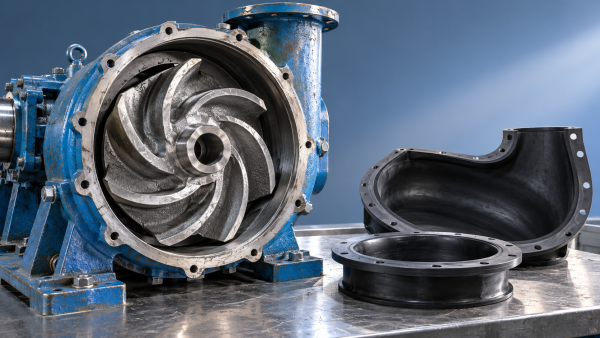
High-chrome white iron is commonly considered for abrasive slurry service because of its wear resistance. Elastomer linings can be appropriate where particle size, slurry velocity, temperature, and chemical environment suit the lining material. Stainless steels and higher-alloy materials may be considered in more corrosive liquid streams, but corrosion resistance alone does not guarantee acceptable erosion resistance. The selected material system should be assessed as a complete wetted package: casing, impeller, throatbush, liners, shaft sleeve, fasteners where exposed, and seal-related components.
Chlorides deserve particular attention in FGD applications. Their presence and concentration can affect the material decision, especially where temperature and oxygen conditions vary. There is no universal “FGD-grade” material choice that can be safely applied to every project. The relevant slurry chemistry, material compatibility information, and local operating history should be reviewed together.
Wear life also depends on pump speed. Higher speed can allow a smaller pump frame and lower initial equipment cost, but it may increase particle impact energy and shorten component life in abrasive service. Lower-speed operation can be attractive for demanding slurries, provided the pump remains hydraulically efficient and does not become oversized for the expected duty range. This is one reason that comparing only purchase price and nominal efficiency can lead to the wrong decision.
Read the Pump Curve as an Operating Risk Document
Pump curves are often reviewed quickly during procurement, yet they provide one of the clearest indications of future operating risk. The selected duty should generally sit in a stable portion of the curve and reasonably close to the pump’s best efficiency region, while allowing for credible process variation. Exact acceptance criteria vary by project and manufacturer, but the underlying principle is straightforward: avoid treating the rated point as the only condition that matters.
A pump operating too far left on its curve may experience internal recirculation, heat buildup, and unstable flow. Too far right, it may require more power than expected, have reduced suction margin, and experience higher velocity-related wear. In slurry service, the consequences can appear gradually: declining head, increased vibration, repeated seal attention, or a growing gap between the design flow and actual plant flow.
The motor selection should be checked against the full operating range, not just the stated design point. If the system curve can shift because of pipe scaling, valve positions, density changes, or parallel pump operation, the maximum absorbed power needs review. Variable-frequency drives can add useful flexibility, but they do not eliminate hydraulic limits. Operating at reduced speed may affect minimum flow, solids suspension, seal plans, and the ability to maintain the required spray or circulation conditions.
NPSH is not a paperwork item
Available net positive suction head should be evaluated under the least favorable credible operating condition, not merely at normal tank level and normal temperature. Slurry characteristics can complicate the calculation, and field conditions such as long suction runs, entrained air, partially blocked strainers, or unexpected elevation changes can reduce margin. Cavitation in abrasive slurry service is especially damaging because vapor collapse and solid-particle erosion can act on the same surfaces.
Where suction conditions are marginal, the better answer may be a change in layout, elevation, pipe diameter, pump speed, or pump type rather than accepting a narrow margin. This is easier to solve before civil works and piping are fixed than after the system is installed.
Choose Sealing and Shaft Arrangements for the Real Maintenance Environment
The best sealing arrangement depends on the service, plant utilities, leakage tolerance, and maintenance capability. Expeller or dynamic sealing arrangements may be used in some slurry applications, while mechanical seals may be necessary where leakage control or process configuration requires them. Neither approach is automatically superior. The decision should consider whether clean flush water is continuously reliable, whether seal support systems can be monitored, and what occurs during power loss, startup, or a blocked discharge event.
For mechanically sealed pumps, seal faces, elastomers, sleeves, gland components, flush compatibility, pressure conditions, and solids exclusion all require attention. A seal plan that depends on clean water may perform poorly if supply quality or pressure is inconsistent. Conversely, a seal-less or reduced-flush arrangement may introduce other restrictions that are not appropriate for every duty.
Shaft stiffness, bearing arrangement, lubrication method, and bearing isolation should not be overlooked. FGD pump failures are not always caused by the wet end. Misalignment, pipe strain, inadequate baseplate support, poor lubrication practice, and contamination can shorten bearing life even when the hydraulic selection is sound. The specification should clarify alignment expectations, allowable nozzle loads where relevant, and the responsibility for field commissioning checks.
Evaluate Maintainability Before Awarding the Package
In many operating plants, maintenance labor and outage exposure matter more than a small difference in initial pump cost. A reliable FGD pump package should be practical to inspect, isolate, lift, and rebuild within the available plant layout. If the pump is in a congested absorber area or below-grade sump, maintenance access needs to be assessed from the beginning.
Project teams should ask how the impeller is adjusted, whether wet-end parts can be changed without disturbing major piping, how much clearance is needed for shaft or cartridge removal, and whether lifting points are adequate for actual site practices. It is also worth confirming whether wear parts are common across pump sizes or duties. Standardization can simplify inventory, but forcing one frame size across incompatible duties can create its own problems.
Do Not Separate Pump Selection from the Piping System
A well-selected pump can still underperform in a poor piping arrangement. Short, direct suction piping with appropriate diameter and minimal air pockets is generally easier to manage than a complicated route with high points, abrupt reducers, and unnecessary restrictions. For slurry lines, designers also need to consider whether velocity is sufficient to limit settling without becoming unnecessarily erosive. The acceptable range depends on the slurry and layout; it should be determined from project-specific process and hydraulic information.
Parallel pumping requires particular care. Pumps with mismatched curves, poorly controlled sequencing, or insufficient minimum-flow protection can operate unstably when plant load changes. In critical circulation services, the control philosophy should address pump start-up, duty/standby rotation, failure response, and operation during reduced load. Mechanical selection and automation design should be reviewed together rather than handed off as separate disciplines.
A Better Basis for Comparing Supplier Proposals
Supplier quotations are easier to compare when the technical evaluation asks for more than a compliant flow and head. Request clear pump curves, power curves, NPSH information, material descriptions for every relevant wetted part, seal arrangement details, bearing and lubrication information, dimensional drawings, weight, nozzle orientation, and a defined list of exclusions. If a proposal relies on assumptions about solids, chemistry, temperature, or operating hours, those assumptions should be explicitly recorded.
It is useful to distinguish between guaranteed performance, design recommendations, and site-dependent outcomes. A manufacturer can provide pump performance information and material recommendations, but actual life in FGD duty still depends heavily on slurry properties, installation quality, operating discipline, and maintenance practices. Clear boundaries reduce disputes later and help project teams make decisions based on risk rather than optimistic interpretation.
Before finalizing the package, review the complete duty matrix with process, mechanical, electrical, piping, operations, and maintenance representatives. The review should focus on the difficult duties, not only the standard ones: high-solids transfer, absorber recirculation, intermittent sump service, corrosive wastewater, standby units, and pumps exposed to frequent starts. These are often the locations where a small design omission becomes an expensive operating problem.
Make Reliability a Design Decision
Reliable pumps for Flue Gas Desulfurization Systems are selected through disciplined matching, not through a single material grade, a larger motor, or a familiar brand name. The strongest decisions connect actual slurry behavior with hydraulic performance, suction conditions, materials, sealing, piping, maintenance access, and spare-parts planning.
For an engineering project, the most useful next step is often a structured duty review before purchase order release. Confirm the operating envelope, identify uncertain fluid properties, challenge narrow NPSH margins, verify maintenance constraints on the layout, and document assumptions that need validation during commissioning. That work may take time during design, but it is far less disruptive than correcting an unsuitable pump after an FGD system is expected to be online.
Related Information
 Oct 24, 2026
How Much Should a Froth Pump Be Oversized for Flotation Concentrate?
How much should a froth pump be oversized for flotation concentrate? Learn how inlet air, peak flow, and head affect sizing to avoid costly mistakes and select the right pump.- Oct 24, 2026
Is Higher Hardness Always Better for High-Chrome Pump Castings?
Is higher hardness always better for high chrome pump castings? Discover how toughness, carbide structure, and slurry conditions affect service life—and choose smarter to reduce downtime. - Oct 23, 2026
Which Leakage Test Should You Specify for a Zero-Leakage Knife Gate Valve?
Which leakage test should I specify when ordering a zero-leakage knife gate valve? Compare API 598 and ISO 5208, define seat leakage limits, and avoid costly purchasing mistakes. - Oct 23, 2026
Which Pump Material Lasts Longest in Limestone-Gypsum FGD Slurry?
Which pump material lasts longer in limestone-gypsum desulfurization slurry? Compare high-chrome iron, rubber and duplex steel to find the right fit, reduce downtime and extend service life.


{item.title}
Get a Quote
Please leave your information and email address, and we will contact you as soon as possible.