
How Often Should Slurry Pump Impeller Clearance Be Adjusted?
How Often Should Slurry Pump Impeller Clearance Be Adjusted?
How often should slurry pump impeller clearance be adjusted? There is no single operating-hour interval that fits every pump, slurry, or processing plant. In practice, adjustment frequency depends on wear rate, solids size and hardness, slurry concentration, operating duty, pump design, and the level of hydraulic performance required by the process.
A pump moving fine mineral tailings at moderate velocity may hold its setting for a relatively long period. A pump handling coarse, angular, high-density solids can lose effective clearance much faster, especially where operating conditions include frequent starts, fluctuating flow, air entrainment, or operation away from the best efficiency point. The right approach is therefore condition-based: inspect the clearance regularly, monitor pump performance, and adjust when wear begins to affect efficiency, capacity, pressure, or component life.
For maintenance teams, impeller clearance is not a minor setup detail. It directly affects internal recirculation, wear at the impeller inlet, hydraulic efficiency, seal environment, vibration behavior, and the time between wet-end rebuilds. Waiting until the pump can no longer meet duty is usually too late; by then, the lost energy and secondary wear may already be substantial.
Why Impeller Clearance Changes During Operation
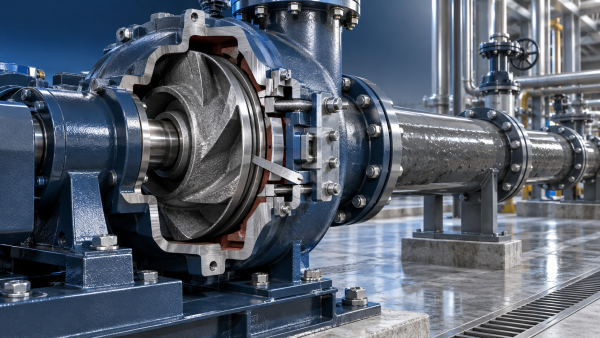
In many slurry pumps, the most critical adjustable clearance is between the impeller and the suction-side liner, often called the throatbush, throat liner, suction liner, or front liner depending on the pump arrangement. Some designs use an expeller-side or back clearance that also needs attention. As abrasive particles pass through the wet end, both the impeller and surrounding liners wear. The original running gap gradually increases.
As that gap opens, more slurry recirculates internally instead of moving cleanly from suction to discharge. The pump may still run smoothly at first, but it requires more power to produce the same useful head and flow. In a process with a fixed production target, operators may compensate by increasing speed or opening valves differently. That can conceal the real problem while accelerating wear elsewhere in the system.
Wear is rarely uniform. Coarse particles may erode a localized area of the impeller vane or liner; corrosive slurry may thin material in a different pattern; entrained air can change the flow path and intensify erosion. For that reason, a clearance measurement should not be treated as the only condition indicator. It needs to be read alongside the physical condition of the wet-end components and the pump’s operating trend.
A Practical Adjustment Frequency: Use Inspection Intervals, Not a Fixed Calendar Rule
A sensible maintenance program separates inspection frequency from adjustment frequency. Clearance does not need to be adjusted every time it is checked. Instead, the pump should be inspected at intervals appropriate to its duty, and adjusted when the measured or observed condition indicates that the original running clearance has materially increased.
For a newly commissioned pump, early inspections are especially valuable. Initial checks establish how quickly the particular slurry wears the wet end under real plant conditions. Design calculations and supplier guidance are useful starting points, but actual wear can differ because particle shape, pipeline velocity, density variation, and operating practice are highly site-specific.
After the first few inspection cycles, maintenance planners can build a practical trend. If the pump’s head, flow, power draw, vibration, and adjustment travel remain stable, inspections may be spaced further apart. If wear develops quickly or process performance is sensitive, checks should remain more frequent. High-abrasion duties often justify routine review during planned shutdowns rather than relying on a long calendar schedule.
The adjustment target itself should come from the pump manufacturer’s installation and maintenance documentation for the specific model. Pump geometry, impeller diameter, liner construction, material, shaft arrangement, and adjustment mechanism all influence the correct setting. Applying a generic gap from a different pump type can create more problems than it solves.
Signs That Clearance Should Be Checked or Readjusted
The clearest operational sign is a gradual loss of pump performance under otherwise unchanged process conditions. If speed, slurry density, valve position, and system configuration are broadly stable, but discharge pressure or delivered flow begins to decline, increased internal clearance is one possible cause. It is not the only cause, so the pump should not be adjusted blindly. Pipe blockage, suction restriction, air leakage, worn valves, incorrect instrumentation, or slurry changes can produce similar symptoms.
Other warning signs commonly include:
- A need to run at higher speed to maintain the previous process duty.
- A noticeable change in power demand that cannot be explained by slurry density or flow changes.
- Reduced pressure margin at downstream cyclones, filters, separators, or transfer points.
- Increasing vibration, noise, or unstable operating behavior after other mechanical causes have been checked.
- Visible wear patterns during inspection, particularly at the impeller eye and the matching liner surface.
- Adjustment hardware approaching the end of its available travel.
One useful rule is to investigate any performance trend before changing the setting. If a maintenance technician closes the clearance and the pump briefly recovers, that does not automatically prove the adjustment was the only issue. The recovered performance may also reveal that liners or the impeller are nearing replacement limits. Repeatedly compensating for severe wear can eventually leave insufficient material, poor hydraulic shape, or excessive risk of contact between rotating and stationary parts.
The Cost of Waiting Too Long
An over-open impeller clearance reduces the pump’s ability to develop head efficiently. The immediate consequence may be lower throughput or weaker pressure. Less obvious is the additional recirculation occurring in the wet end. That recirculating slurry can increase localized turbulence and erosion, particularly near high-velocity zones. A pump may continue operating, but it is doing more internal work for less useful output.
In tightly controlled processing circuits, even a modest decline in pump duty can affect more than the pump itself. Classification performance may shift, sump levels may become less stable, thickener feed can vary, or downstream equipment may operate outside its preferred range. The true cost is therefore not limited to an impeller or liner replacement. It may include additional energy use, production instability, unplanned intervention, and spare-parts scheduling pressure.
There is also a practical limit to adjustment. If a worn impeller has lost vane thickness or if the liner face has become deeply grooved, restoring the nominal gap does not restore the original hydraulic profile. At that point, an adjustment may serve as a short-term operating measure, but component replacement should be evaluated during the next suitable shutdown.
Why Over-Adjustment Is Also a Risk
Closing the clearance too aggressively can be as damaging as neglecting it. If the impeller contacts the liner, the result can include rapid frictional wear, heat generation, torque increase, abnormal vibration, and damage to both components. Mechanical contact may be intermittent rather than constant, making it harder to diagnose from sound alone.
Thermal growth, shaft deflection, bearing condition, assembly tolerances, and operating load should be considered before setting a very tight gap. A pump adjusted while cold and isolated may behave differently at full speed with a dense slurry. This is why trained personnel should follow the prescribed adjustment sequence and verify shaft rotation by hand, where the design and safety procedure allow, before returning the unit to service.
Adjustment mechanisms also differ. Some slurry pumps use an axial movement system through the bearing assembly; others have cartridge arrangements or design-specific methods. The maintenance team should know which components are moving and how the setting affects seals, couplings, drive alignment, and ancillary equipment. An apparently simple adjustment can create a separate reliability issue if locking devices, alignment checks, or guarding requirements are overlooked.
A Better Way to Build a Clearance Maintenance Plan
The most reliable program combines pump inspection records with operating data. At a minimum, record the date, running hours if available, adjustment position, observed liner and impeller condition, discharge pressure, flow or process proxy, speed, power trend, vibration observations, and slurry conditions known at the time. The records do not need to be elaborate. Their value lies in consistency.
Over several maintenance cycles, this history helps answer practical questions: Does wear accelerate after a change in ore source? Does a particular pump position see more coarse solids? Is the pump oversized and throttled heavily? Is a speed increase masking wet-end deterioration? Does one material combination last longer under the actual chemistry and particle size distribution?
Condition monitoring can make the decision more disciplined, but it does not replace inspection. Pressure, flow, power, bearing temperature, and vibration trends can identify a developing issue early. They cannot always distinguish clearance wear from suction-side problems, impeller blockage, or system changes. A shutdown inspection remains the point where maintenance teams can confirm the physical condition of the wet end and judge whether adjustment is still worthwhile.
When Adjustment Should Give Way to Component Replacement
Clearance adjustment is intended to compensate for normal wear within the usable life of the impeller and liners. It is not a substitute for replacing parts that have reached their wear limit. Replacement should be considered when adjustment travel is nearly exhausted, when performance cannot be recovered sufficiently, when erosion changes the component profile significantly, or when cracks, distortion, severe corrosion, and structural damage are found.
It is often sensible to assess mating parts together. Installing a new impeller against a heavily worn throat liner, or fitting a new liner around an impeller with substantial vane wear, may limit the benefit of the replacement. The best replacement scope depends on inspection results, available shutdown time, spare-parts strategy, and the criticality of the duty. Manufacturer wear limits and service documentation should guide the final decision.
The Short Answer
Slurry pump impeller clearance should be adjusted when inspection and performance evidence show that wear has opened the gap enough to affect hydraulic duty or reliability—not simply because a fixed number of hours has passed. Start with the pump manufacturer’s recommended setting and inspection guidance, establish a wear trend during early operation, and shorten review intervals for abrasive, variable, or process-critical duties.
The most useful maintenance question is not “How many hours between adjustments?” but “How quickly is this specific pump losing effective clearance, and what is that loss doing to the process?” Once that is measured consistently, adjustment timing becomes a controlled maintenance decision rather than an emergency response to falling performance.
Related Information
 Sep 30, 2026
Selecting coal washing pumps for fine coal recovery circuits
Coal Washing Pumps for fine coal recovery: learn how to select reliable slurry pumps for stable pressure, longer wear life, efficient dewatering, and lower downtime.- Sep 29, 2026
What causes slurry pump failures in flue gas desulfurization systems
Flue Gas Desulfurization Systems: discover the main causes of slurry pump failures, from cavitation and abrasion to seal leaks, corrosion, and unstable operation. - Sep 30, 2026
What Should Be Included in a Dredging Pump Quotation?
What should be included in a dredging pump quotation? Explore essential duty data, slurry specifications, scope, performance guarantees, and commercial terms for confident buying. - Sep 30, 2026
How Often Should Slurry Pump Impeller Clearance Be Adjusted?
How often should slurry pump impeller clearance be adjusted? Learn condition-based inspection triggers, wear signs, and maintenance practices to improve pump efficiency.

Get a Quote
Please leave your information and email address, and we will contact you as soon as possible.