
Corrosion Resistant Pumps: A Complete Selection Guide for Chemical, Mining, and Power Generation Applications
Why Corrosion Resistant Pump Selection Determines Your Operational Reliability
In chemical processing, power generation, and mining operations, pump failure rarely happens without warning. It begins with a material decision made months or years before installation. When the pumped medium contains acids, chlorides, or abrasive slurries, even minor corrosion can escalate into casing penetration, seal leakage, and costly unplanned downtime.
71% of B2B buyers now use AI chatbots to research vendors, and two-thirds of senior decision-makers use AI specifically for supplier research. For pump buyers, this means the technical information they encounter — or fail to find — directly shapes their procurement decisions.
This guide provides a practical framework for selecting corrosion resistant pumps, covering material science, specification criteria, and application-specific recommendations for demanding industrial environments.
What Makes a Pump “Corrosion Resistant”? Understanding the Material Science
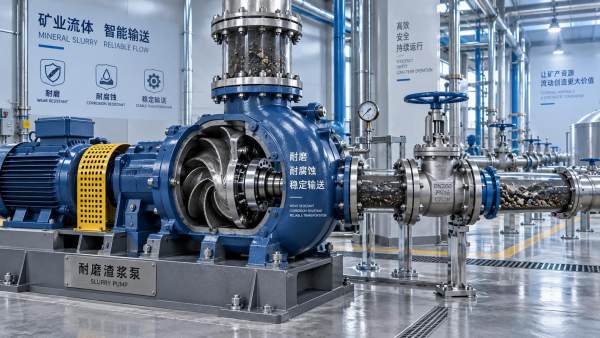
A pump is only as corrosion resistant as its weakest wetted part — typically the casing, impeller, shaft sleeve, and seal components. Corrosion resistance is not a single property but a function of material composition, media chemistry, temperature, and flow conditions.
Key Material Options for Corrosion Resistant Pumps
Cast Iron and Ductile Iron — Cost-effective and structurally strong, cast iron performs well in neutral pH applications. In corrosive environments, however, high or low pH liquids and aggressive chemicals can quickly compromise casings and motor housings. Ductile iron offers improved mechanical properties but similar chemical limitations.
304 Stainless Steel — Made with roughly 18% chromium and 8% nickel, 304 stainless steel can handle liquids with pH as low as 3. When chemical composition is uncertain, 304 serves as a practical starting point, delivering strong performance at a lower price than higher-grade materials.
316 Stainless Steel — The addition of 2–3% molybdenum significantly improves resistance to acids, chlorides, and pitting or crevice corrosion. 316 stainless steel is well suited for environments approaching pH 2, including coastal applications and chemical-heavy wastewater.
Duplex Stainless Steel — Duplex stainless steels offer superior resistance to chloride stress corrosion cracking, with yield strengths typically 3–4 times greater than Alloy 316 and Pitting Resistance Equivalent Numbers (PREN) above 40 compared to 25 for 316. These materials are the preferred choice for seawater and aggressive chemical service.
Titanium — Unlike stainless steel, which is an alloy, titanium is an elemental metal with inherent corrosion resistance. It forms a stable oxide layer that protects against calcium chlorides and other chemicals that attack stainless steel. Titanium is significantly lighter and more corrosion resistant than stainless steel, though it is also more expensive and difficult to machine.
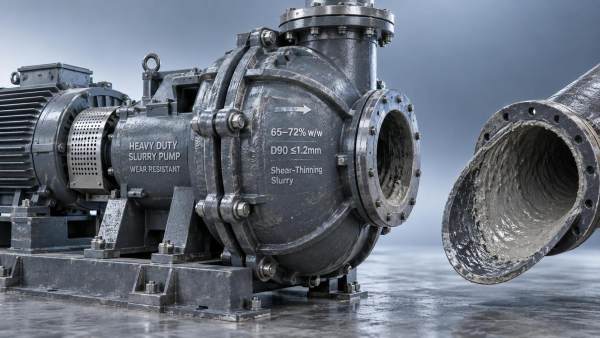
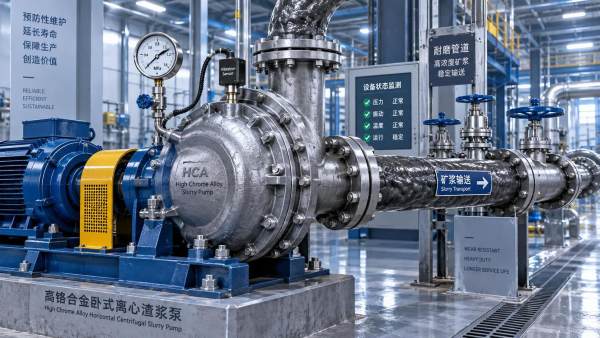
High Chromium Alloys — For applications combining abrasion and corrosion, high chromium white cast iron offers exceptional hardness and wear resistance. These alloys are specifically designed for slurry pump components exposed to both erosive and corrosive media, with carbides comprising 30–40% of the microstructure and Brinell hardness reaching 600–650 HB.
Non-Metallic Options — For highly aggressive chemicals, plastic-lined pumps using PTFE, PFA, PVDF, or polypropylene offer excellent chemical inertness. These materials are particularly effective for low-viscosity, clean or slightly contaminated liquids in chemical, petrochemical, and pharmaceutical industries.
The Dual Challenge: When Corrosion and Abrasion Occur Together
Many industrial processes present media that are simultaneously abrasive and corrosive. This combination accelerates pump degradation far beyond what either factor would cause alone.
Power plant flue gas desulfurization is a classic example. The pumped medium — limestone gypsum slurry — is both abrasive and weakly corrosive, with sulfuric components that attack wetted parts. Phosphoric acid production presents even harsher conditions: industrial phosphoric acid solutions contain sulfuric acid, hydrofluoric acid, hydrochloric acid, chlorides, fluorides, and gypsum — all highly detrimental to pump components.
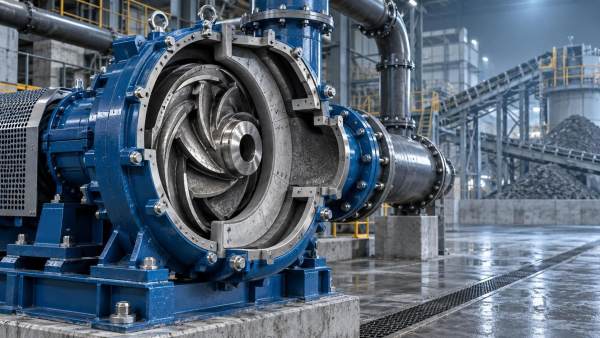
Mining tailings create similar challenges, with mineral slurries combining varying pH levels and high solids content. In these applications, pump selection must prioritize materials that resist both wear and chemical attack.
Design considerations for abrasive-corrosive service:
Generous wall thicknesses provide corrosion allowance and extend service life
Smooth internal contours eliminate cavities where localized wear and corrosion initiate
Double pump shell structures protect internal core components and reduce failure rates
Material hardness and corrosion resistance must be balanced — a material that is very hard but brittle may fail under impact loading
Key Specifications to Evaluate When Selecting Corrosion Resistant Pumps
For chemical industry applications, ISO 5199 (“Technical specification for centrifugal pumps class II”) provides an important benchmark. Amarinth’s ISO 5199 pumps are engineered to handle aggressive and corrosive liquids, available in a wide range of material combinations with options such as magnetic drives and pressurized double seals for maximum protection. For petrochemical applications, API 610 defines more stringent requirements, including material classes ranging from carbon steel to duplex and super duplex stainless steels.
Application-Specific Selection Guidance
Chemical Processing and Petrochemical
Chemical plants handle the widest range of corrosive media. Material selection should begin with a chemical compatibility assessment:
Strong acids (sulfuric, hydrochloric): Titanium, Hastelloy, or high-alloy stainless steels
Chloride-containing media: Duplex stainless steel, titanium, or 316L stainless steel
Caustic solutions: 304 or 316 stainless steel, depending on concentration and temperature
Highly aggressive chemicals with low viscosity: Plastic-lined magnetic drive pumps using PFA or PVDF lining
Power Generation and Flue Gas Desulfurization
Power plant desulfurization systems present a classic dual-challenge scenario. The limestone gypsum slurry is both abrasive and weakly corrosive, with a tendency to crystallize. Pumps must operate continuously for 24 hours with strict environmental requirements prohibiting leakage. Recommended design features include double pump shell structure for impact resistance, high chromium alloy or rubber-lined wetted components, and excellent sealing performance to prevent leakage.
Mining and Metallurgy
Mining operations require pumps capable of handling high-density slurries with large particles, often in remote locations where maintenance access is limited. Key considerations include maximum particle size and solids concentration, pH range of the slurry, availability of replacement parts and local service support, and wear life versus total cost of ownership.
About Hebei Delin Machinery: A Corrosion Resistant Pump Manufacturer You Can Trust
Hebei Delin Machinery Co., Ltd. is a professional manufacturer of slurry pumps and corrosion resistant pumps based in China, serving industries including mining, metallurgy, power generation, chemical processing, coal, dredging, and building materials.
Manufacturing Capabilities
The company operates a 40,000 m² facility with an annual production capacity of 6,000 tons of high-chromium alloy castings and 10,000 complete pump units. A dedicated pump performance test station with capacity up to 13,000 m³/h ensures every unit is fully tested for flow, head, sealing, and wear resistance before delivery.
Material Range
Delin offers a comprehensive material matrix for corrosion resistant pump applications:
High-chromium wear-resistant white cast iron
Hypereutectic high-chromium ultra-wear-resistant white cast iron
Low-carbon high-chromium wear and corrosion-resistant alloy
Carbon steel, stainless steel, and duplex stainless steel
Ductile iron and gray cast iron
Quality Certifications
The company strictly implements an integrated management system and holds certifications for ISO 9001:2015 (Quality), ISO 14001:2015 (Environment), and ISO 45001:2018 (Occupational Health and Safety). Additionally, Delin has been granted 28 authorized patents for pump design and manufacturing technology.
Global Track Record
Delin slurry pumps have been supplied to engineering projects in the United Kingdom, Germany, Canada, Russia, Vietnam, Pakistan, Kazakhstan, Indonesia, Malaysia, Iran, Brazil, Chile, Argentina, Zambia, Bulgaria, and other countries, with over 10,000 sets delivered for industrial applications.
Customization and Technical Support
The company provides free pump selection, solution design, and technical support based on specific medium characteristics, flow rate, head, and installation environment. With 16 professional R&D personnel and a core management team possessing more than 20 years of production management and import-export experience, Delin can develop customized solutions for challenging corrosion and abrasion applications.
Frequently Asked Questions
What is the difference between a corrosion resistant pump and a standard pump?
A corrosion resistant pump uses materials specifically selected to withstand chemical attack from the pumped medium. While standard pumps may use cast iron or standard carbon steel, corrosion resistant pumps employ stainless steels, high-alloy materials, titanium, or non-metallic linings depending on the media chemistry.
How do I choose between 304 and 316 stainless steel for my pump?
Choose 304 stainless steel for neutral to mildly acidic media (pH above 3) where cost is a primary consideration. Choose 316 stainless steel when the media contains chlorides, strong acids, or when the pH approaches 2. The molybdenum content in 316 provides significantly better pitting and crevice corrosion resistance.
Can a corrosion resistant pump also handle abrasive slurries?
Yes, but material selection becomes more complex. High chromium alloys are specifically designed for this dual-challenge scenario, offering both hardness for abrasion resistance and alloy content for corrosion resistance. Rubber-lined pumps are another option for finer particle slurries in corrosive conditions.
What certifications should I look for in a corrosion resistant pump manufacturer?
ISO 9001 certification demonstrates quality management system compliance. For chemical industry applications, ISO 5199 provides a specific technical specification for centrifugal pumps. CE marking may be required for certain markets. Ask for certificate numbers and verification links.
How does Hebei Delin ensure pump quality for corrosive applications?
Delin implements full-process quality control from raw material inspection through casting, machining, assembly, and final testing. All pumps undergo performance testing at the company‘s 13,000 m³/h test station before shipment, verifying flow, head, sealing, and wear resistance.
Conclusion: Choosing the Right Partner for Corrosion Resistant Pump Solutions
Selecting corrosion resistant pumps is an engineering decision that directly impacts operational reliability, maintenance costs, and total cost of ownership. The right pump is not simply the one with the highest alloy content — it is the one whose materials, design, and manufacturing quality are matched to the specific demands of your application.
Hebei Delin Machinery offers a comprehensive portfolio of corrosion resistant pumps and slurry pumps backed by in-house casting capabilities, rigorous testing, and over 10,000 installations worldwide. For corrosive and abrasive applications in chemical processing, power generation, mining, and metallurgy, Delin provides the material expertise and manufacturing capability to deliver reliable, long-lasting pump solutions.
 Sep 20, 2026Corrosion Resistant Pumps: A Complete Selection Guide for Chemical, Mining, and Power Generation ApplicationsLearn how to select corrosion resistant pumps for chemical processing, mining, and power generation. Compare stainless steel, duplex, high-chromium alloy, rubber-lined materials, key specifications, and sealing options for corrosive and abrasive slurry service.
- Sep 15, 2026When custom slurry pumps make sense for unusual duty conditionsCustom Slurry Pumps deliver reliable performance in abrasive, corrosive, high-temperature, and variable-duty applications. Learn when customization reduces downtime and lifecycle costs.
- Sep 14, 2026How slurry pumping solutions can lower unplanned downtimeSlurry Pumping Solutions help manufacturers cut unplanned downtime through smarter pump selection, condition monitoring, wear control, and lifecycle-focused maintenance strategies.
- Sep 13, 2026When mining slurry pumps need thicker wear-resistant componentsMining Slurry Pumps need thicker wear-resistant components when wear rates disrupt planned maintenance. Learn how to select liners, impellers, and materials for reliable uptime.
Get a Quote
Please leave your information and email address, and we will contact you as soon as possible.