
Should You Choose an Open or Closed Impeller for Coarse Slurry?
For coarse, abrasive slurry, a closed impeller with sufficiently large passages is often a strong starting point, especially when the pump must deliver sustained flow and head over long operating periods. An open or semi-open design may be preferable when access for inspection, adjustable wear clearances, or particular solids-handling requirements carry more weight. Large particles alone do not establish which design will perform better.
The choice depends on whether the complete pump can pass the expected solids, maintain acceptable hydraulic performance as it wears, and operate reliably across the actual duty range. A closed impeller can handle coarse material effectively when its passages are suitable. An open impeller can still block, wear rapidly, or lose performance if its geometry and operating clearances are poorly matched to the slurry.
Does an open impeller give coarse particles more room to pass?
Not necessarily. “Open” describes the absence of impeller shrouds; it does not guarantee a larger unobstructed path through the pump. Vane spacing, vane count, inlet geometry, and the surrounding casing all affect what can pass.
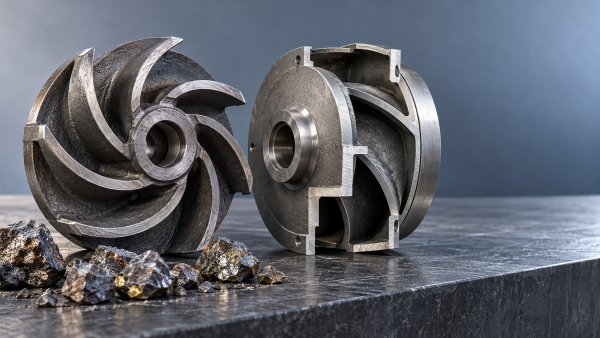
Terminology also deserves attention. A fully open impeller has exposed vanes without front or rear shrouds. A semi-open impeller generally has a back shroud and an open front face. A closed impeller has shrouds on both sides of the vanes. Suppliers sometimes use “open” loosely when discussing semi-open designs, so a sectional drawing is more useful than the name alone.
For coarse slurry, examine the minimum passage through the entire pump. A generous impeller inlet offers limited protection if a narrower vane passage or casing throat creates a restriction farther downstream. Ask what the quoted solids-passage dimension represents and whether it applies to the complete pump assembly.
Particle shape makes this assessment more demanding. A rounded stone and an elongated fragment of similar nominal size do not present the same blockage risk. Flat particles may bridge an opening; angular particles may lodge between surfaces. A quoted spherical passage size helps compare geometry, but it does not fully describe how irregular solids will behave.
The feed description should therefore include the largest credible particles and their shape, as well as the normal size distribution. Occasional oversize material from screen damage or process upsets can determine reliability even when it contributes little to the average solids loading.
When is a closed impeller the better starting point?
A closed impeller deserves serious consideration when the slurry contains hard, abrasive particles, the duty is reasonably well defined, and continuous hydraulic performance matters. Its enclosed channels can control flow effectively and may deliver better hydraulic efficiency than a comparable open design. That advantage remains conditional on the impeller being designed for the slurry and operating within a suitable range.
For a mineral-processing transfer duty, for example, the useful comparison is between slurry pump designs that can both pass the material and meet the required head. A closed impeller intended for relatively clean liquid should not be treated as equivalent to a closed slurry impeller simply because their nominal diameters or connection sizes match.
Shrouds do not remove wear from the equation. Abrasion can damage the inlet, vane leading edges, passage surfaces, and adjacent liners. Leakage through worn running clearances can also reduce performance. The effect depends on the pump’s wear-control arrangement, material selection, speed, and the characteristics of the solids.
Internal passages can be less accessible for direct inspection or cleaning than exposed vanes. If deposits harden during shutdown or lodged material must be removed frequently, maintenance access may become a deciding factor. The actual casing construction and dismantling procedure matter as much as the impeller category.
A closed impeller is therefore a sensible candidate when passage geometry is adequate, the slurry remains reasonably predictable, and energy consumption matters over long running hours. Its case becomes stronger when replaceable wear components and practical clearance adjustment help preserve performance as wear develops.
When does an open or semi-open design make more sense?
An open or semi-open design may suit a duty where exposed wear surfaces simplify inspection, cleaning, or clearance management. In many semi-open arrangements, the gap between the vane edges and the adjacent wear plate directly affects internal leakage. Restoring that gap can recover some performance lost as the surfaces wear.
That maintenance benefit comes with an operating requirement: the clearance must be checked and adjusted correctly. Excessive clearance allows more recirculation and can reduce delivered flow, head, and efficiency. Insufficient clearance can cause rubbing or damage under conditions such as shaft movement, assembly error, or particles entering the gap.
Adjustment provisions vary by pump. Some closed slurry pumps also allow running clearances to be restored, while some open designs require more maintenance effort than their appearance suggests. Compare the actual adjustment mechanism, access requirements, and replacement parts rather than assigning an automatic maintenance advantage to either category.
Open geometry can help with certain troublesome solids, but it is not a general solution for mixed debris. Fibers may wrap around vanes or the shaft region, and flat or elongated pieces may bridge restrictions elsewhere. If the feed contains rags, vegetation, or process scrap alongside coarse mineral particles, the comparison may need to include a recessed or other specialized solids-handling impeller, with its own hydraulic trade-offs.
An open design becomes more attractive when its service access addresses a recurring maintenance problem and the plant can manage the required clearances. It becomes less attractive when abrasive wear opens those clearances quickly and the resulting performance loss forces frequent intervention.
Which slurry conditions can change the answer?
Particle size is only one part of the selection. The following conditions can shift the balance between an open and a closed design, or show that neither candidate has been evaluated adequately.
Solids concentration and changing feed conditions
Concentration affects slurry density, power demand, particle interaction, and hydraulic behavior. State whether the solids concentration is measured by mass or volume; the two values are not interchangeable. Include the normal operating range and credible peaks rather than providing only an average.
As concentration rises, behavior may depart substantially from the clean-water conditions used to produce a standard pump curve. A coarse slurry with little fine material may behave differently from one containing clay or abundant fines, even at a similar overall solids loading. Viscosity, yield behavior, and settling characteristics can influence the selection.
Neither impeller category automatically resolves a difficult suction condition or a slurry that settles during interruptions. A design that operates acceptably on a stable feed may struggle after a shutdown leaves concentrated solids near the inlet.
Abrasiveness and particle shape
Hard, angular solids can erode vane edges, shrouds, liners, and wear plates. Wear depends on particle properties and impact conditions, as well as material selection and local velocity. An impeller label provides little basis for predicting service life without those details.
Compare the proposed operating speed, hydraulic size, and wear materials together. Where space and duty permit, a larger pump operating more slowly may offer a wear advantage over a smaller, faster alternative. That possibility still needs to be checked against efficiency, solids transport, and the pump’s acceptable operating range.
Material selection can also constrain passage geometry or particle tolerance. A wear-resistant material suitable for fine abrasive solids may be vulnerable to damage from sharp, coarse particles. Ask why the proposed impeller and liner materials suit the actual feed.
Operating point and suction conditions
A pump selected far from its preferred operating region may experience recirculation, unfavorable hydraulic loading, vibration, and accelerated wear. Either impeller type can disappoint under those conditions. Review normal operation alongside minimum flow, maximum flow, startup, and process upsets.
Suction conditions deserve equal attention. Inadequate available suction head, entrained air, and unstable sump levels can cause poor performance that resembles an impeller-selection problem. Slurry behavior may require allowances beyond a straightforward comparison of clean-water suction figures.
The discharge pipeline must also keep settling solids moving at the required operating conditions. Choosing an efficient impeller does little good if reduced production flow allows solids to accumulate in the line. Pump and pipeline behavior need to be assessed together.
How should you compare two actual pump proposals?
Compare the proposals at the same slurry duty and across the same operating range. Clean-water efficiency at one favorable point cannot establish which pump will provide the better result in abrasive service.
Give each supplier a consistent duty description: required flow and head, slurry density, concentration range, particle-size distribution, maximum credible particle size, particle shape, temperature, and any relevant corrosive or abrasive characteristics. Include suction conditions, operating hours, starts and stops, and known feed disturbances.
Then ask for clear answers to the questions that distinguish the candidates:
- Where is the smallest solids passage? Establish whether the stated passage applies throughout the pump and how irregular or elongated particles affect the recommendation.
- How has slurry performance been estimated? Ask what corrections or assumptions connect the published water curve to the expected slurry flow, head, efficiency, and absorbed power.
- What happens as clearances wear? Identify the surfaces that control leakage, how adjustment is performed, and when component replacement becomes necessary.
- What requires dismantling? Review access for inspection, blockage removal, and replacement of the components expected to wear first.
- How does the pump handle operating extremes? Check minimum production flow, peak concentration, oversize particles, and restart after settling.
These answers support a more useful cost comparison than purchase price alone. Energy use matters during sustained operation, but so do wear-part consumption, maintenance labor, and production interruption. An accessible impeller may save time during service while requiring service more often. A more efficient closed design may reduce electricity use while creating a longer repair task when internal parts need attention.
Where wear life is uncertain, compare plausible maintenance intervals and performance deterioration rather than relying on a single unsupported service-life estimate. Existing records from a closely comparable slurry duty are useful if the differences in particle properties, speed, and concentration are made explicit.
What should decide the final choice?
For coarse, predominantly mineral slurry with controlled feed conditions, begin by evaluating a purpose-designed closed slurry impeller with adequate passages. Its hydraulic efficiency and enclosed flow channels can make it a strong option for continuous duty. Keep an open or semi-open candidate in the comparison where access, cleaning, or clearance adjustment offers a practical operating advantage.
If blockage is the main concern, locate the restriction and identify the troublesome particle shape before changing impeller type. If rapid wear is the main concern, examine speed, materials, concentration, and operating point. If performance fades between maintenance stops, determine which clearances are opening and whether they can be restored economically.
The final choice should follow a documented explanation of how the proposed pump passes the solids and maintains the required duty as it wears. When a recommendation rests mainly on “open handles solids better” or “closed is more efficient,” the comparison still needs the passage dimensions, slurry performance assumptions, and maintenance details that make those claims relevant to your operation.
Related Information
 Oct 30, 2026
Do Slurry Pumps Handling Flammable Hydrocarbons Need Double Seals?
Does a slurry pump handling flammable hydrocarbons need a double mechanical seal? Explore leakage risks, seal options, and barrier systems to choose safer, more reliable containment.- Oct 30, 2026
How Can You Tell When a Slurry Pump Liner Needs Replacing?
How do I tell when a slurry pump liner needs replacing? Learn key wear signs, thickness limits, and inspection tips to plan replacement, protect your pump, and avoid costly downtime. - Oct 29, 2026
Should You Choose an Open or Closed Impeller for Coarse Slurry?
Should I choose an open or closed impeller for coarse slurry? Compare solids passage, wear, efficiency, and maintenance to find the right slurry pump and reduce costly downtime. - Oct 29, 2026
Why Does a Slurry Pump Bearing Assembly Overheat After Replacement?
Why does my slurry pump bearing assembly overheat after replacement? Discover common lubrication, preload, and alignment issues, plus practical checks to reduce downtime.

{item.title}
Get a Quote
Please leave your information and email address, and we will contact you as soon as possible.