
How Can You Tell When a Slurry Pump Liner Needs Replacing?
A slurry pump may still deliver flow while its liner is approaching the end of its usable life. Waiting for slurry to escape can turn a planned maintenance job into an unplanned shutdown. Replace the liner when it reaches the manufacturer’s minimum allowable thickness, develops unacceptable damage, or cannot safely remain in service until the next inspection. Reduced performance is a reason to investigate, but it does not prove that the liner alone needs replacement.
“How do I tell when a slurry pump liner needs replacing?” is best answered by combining an internal condition inspection with repeatable thickness measurements and operating trends. The practical decision is not simply whether the liner looks worn; it is whether its thinnest or most damaged area remains acceptable for the intended duty.
Which signs mean the liner should not stay in service?
The strongest evidence comes from the liner itself. During an inspection, look for damage that compromises its protective function, fit, or integrity—not just a roughened surface or uniform polishing.
- Thickness at or below the specified discard limit: use the limit for the exact liner design and material, not a general percentage of original thickness.
- Wear-through or exposed backing: exposed metal beneath an elastomer liner, or an opening through a metal liner, requires replacement and inspection of the protected casing.
- Significant cracking, broken sections, or missing material: these can permit rapid deterioration even where the surrounding liner remains thick.
- Elastomer separation or distortion: lifting, blistering, tearing, swelling, or separation from the backing may make a liner unsuitable regardless of its remaining thickness.
- Damaged seating or sealing areas: erosion or deformation that prevents correct installation or sealing cannot be judged by wall thickness alone.
Leakage from a liner joint or casing area warrants prompt investigation under the site’s shutdown procedures. A seal, gasket, assembly issue, or damaged casing can also cause leakage, so do not assume a new liner will solve the problem without identifying the path. Slurry escaping through a breach can erode adjacent components.
The pump is losing performance. Does that confirm liner wear?
No. A worn liner can alter internal flow passages and contribute to losses, but a drop in discharge pressure or flow can also result from impeller wear, excessive clearances, a blocked suction, entrained air, changing slurry properties, or a different system resistance.
Compare operating data under similar conditions. Record pump speed, flow, suction and discharge pressures, slurry density, and any relevant valve positions. Where density changes, pressure alone is not a reliable measure of hydraulic head. Motor current or power can help identify a change, but neither provides a direct measurement of liner thickness.
A pump that sounds normal can still have severe localized wear. Conversely, abnormal noise does not automatically condemn the liner. Use these symptoms to trigger inspection rather than as stand-alone replacement criteria.
How should the liner be inspected and measured?
Start with the manufacturer’s maintenance instructions, drawings, and acceptance criteria. Confirm the installed part number and material: limits for a metal liner may not apply to a rubber or polyurethane alternative, even when both fit the same pump.
- Make the equipment safe. Isolate and lock out electrical and other energy sources, isolate the process, release trapped pressure, drain, and decontaminate as required. Account for hazardous slurry residues and use the specified lifting arrangements.
- Clean the surfaces without hiding damage. Remove deposits sufficiently to expose grooves, cracks, joint faces, and transitions. Avoid aggressive cleaning that cuts an elastomer or changes the surface being measured.
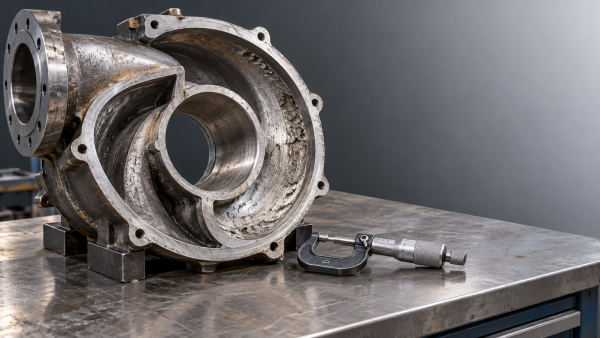
- Inspect the full accessible liner. Give particular attention to flow-direction changes, the cutwater or tongue region where applicable, the discharge transition, joints, and previously identified high-wear areas. The location of maximum wear depends on the design and duty.
- Measure repeatable locations. Use a documented measurement map referenced to fixed features. Add measurements around suspicious areas rather than relying only on a few convenient points.
- Record the minimum and the damage pattern. Keep readings, photographs, operating hours, and relevant process conditions together. Compare with earlier inspections at the same locations.
For accessible metal parts, direct dimensional measurements may be possible after removal. Ultrasonic thickness testing can also be useful where material, geometry, surface condition, and access permit a validated reading. Calibration and interpretation matter, especially on curved, rough, or heavily eroded surfaces.
Do not assume an ultrasonic reading taken through the outer casing represents liner thickness. Interfaces, air gaps, backing materials, and multiple layers can invalidate that interpretation. Elastomer liners generally need a material-appropriate, manufacturer-approved assessment method; visual inspection and accessible dimensional checks are often more useful than an unvalidated ultrasonic number.
How much wear is acceptable?
There is no universal safe remaining thickness or replacement percentage for slurry pump liners. Different designs use different thicknesses to accommodate wear, maintain shape, support attachment features, and protect the casing. A rule such as “replace at half the original thickness” can be unnecessarily conservative for one liner and unsafe for another.
The lowest acceptable reading matters more than the average. A liner may appear substantial across most of its surface while a narrow groove approaches the discard limit. Deep erosion at a joint or fastening feature can also make the part unacceptable before broad wall thinning becomes critical.
Where no documented discard criterion is available, obtain one from the pump manufacturer or have the condition assessed by a suitably qualified engineer. Do not derive a safe limit solely from the thickness of a previously failed liner. That failure may have occurred after damage to the casing had already begun.
Can wear rate help schedule the next replacement?
Yes, provided the measurements are comparable and the operating duty has remained reasonably consistent. At each monitored location, divide the measured thickness loss by the operating time between inspections. Then divide the thickness remaining above the discard limit by that wear rate to estimate the time to the limit.
This is a planning estimate, not a guaranteed remaining life. Use the earliest credible limit among the monitored locations, allow a maintenance margin, and account for measurement uncertainty. When measured loss is close to the method’s uncertainty, the calculated rate may not be meaningful. Wear can also accelerate as the liner profile changes, so do not schedule operation right up to the projected limit.
Why can liner life change between operating campaigns?
A replacement interval established under one duty may be unreliable after a process change. Increased speed, a coarser particle distribution, sharper solids, altered concentration, or a change in mineral hardness can change wear severity. Slurry chemistry and temperature may also affect corrosion or elastomer compatibility.
Operating away from the pump’s recommended range can produce unfavorable flow patterns and localized erosion. Suction restrictions and entrained air can introduce damage mechanisms that resemble ordinary abrasion. Increasing speed to recover lost production may further shorten the inspection interval needed.
The damage pattern helps direct the investigation. Broad thinning may be consistent with sustained abrasive wear; a deep localized groove suggests a concentrated wear mechanism. Cuts and tears in an elastomer warrant checking particle size and foreign material. Swelling, softening, or unusual hardening should prompt a review of chemical and temperature compatibility rather than an automatic like-for-like replacement.
After a significant duty change, inspect sooner until a new condition trend is established. Previous operating hours remain useful history, but they are no longer a dependable replacement schedule by themselves.
Should the liner be replaced now or monitored until the next shutdown?
Continued monitoring is reasonable only when the liner remains within its acceptance criteria, has no disqualifying damage, and has a defensible margin to the next inspection. Monitoring also needs a defined inspection date and clear triggers for an earlier shutdown. “It is not leaking yet” is not a sufficient basis for continued operation.
Replacement at the current shutdown is the stronger choice when projected wear could consume the remaining allowance before the next access opportunity. The decision should reflect uncertainty: sparse measurements, an unknown wear history, or inaccessible high-wear areas reduce confidence in the estimate.
A longer shutdown interval requires more remaining margin than a short, controlled run to a scheduled inspection. Consider the consequences of a breach as well. Where failure could expose personnel to hazardous slurry or damage the casing, a marginal assessment should not be treated as permission to continue.
Does replacing the liner mean replacing the other wet-end parts?
Not automatically. Inspect the impeller, throatbush, frame-plate liner insert or equivalent components, casing, seals, and attachment features according to the pump’s construction. Their acceptance criteria and wear rates may differ from those of the main liner.
A new liner will not correct excessive clearance caused by another worn component. Equally, replacing serviceable parts solely because the pump is open may waste usable life. Base the scope on measured condition, specified clearances, part compatibility, and the cost of reopening the pump before the next planned shutdown.
Before returning the pump to service, verify seating, gasket placement, fastener tightening, and impeller adjustment against the maintenance instructions. Where specified, confirm free rotation and complete the required commissioning checks. Record the replacement liner’s baseline dimensions and initial operating conditions so the next inspection can distinguish normal wear from an installation or process problem.
Related Information
 Oct 30, 2026
Do Slurry Pumps Handling Flammable Hydrocarbons Need Double Seals?
Does a slurry pump handling flammable hydrocarbons need a double mechanical seal? Explore leakage risks, seal options, and barrier systems to choose safer, more reliable containment.- Oct 30, 2026
How Can You Tell When a Slurry Pump Liner Needs Replacing?
How do I tell when a slurry pump liner needs replacing? Learn key wear signs, thickness limits, and inspection tips to plan replacement, protect your pump, and avoid costly downtime. - Oct 29, 2026
Should You Choose an Open or Closed Impeller for Coarse Slurry?
Should I choose an open or closed impeller for coarse slurry? Compare solids passage, wear, efficiency, and maintenance to find the right slurry pump and reduce costly downtime. - Oct 29, 2026
Why Does a Slurry Pump Bearing Assembly Overheat After Replacement?
Why does my slurry pump bearing assembly overheat after replacement? Discover common lubrication, preload, and alignment issues, plus practical checks to reduce downtime.

{item.title}
Get a Quote
Please leave your information and email address, and we will contact you as soon as possible.