
Knife Gate Valve or Ball Valve: Which Is Better for Abrasive Slurry?
Is a knife gate valve better than a ball valve for abrasive slurry? Often, yes—for isolation duties where solids are heavy, space is limited, and straightforward maintenance matters. But a properly specified slurry ball valve may be the better choice when higher pressure, a particular shutoff requirement, or frequent operation calls for a different design. The answer depends less on the valve’s name than on how its gate or ball, seats, seals, and body cope with the actual slurry.
A valve that performs well with clean water can become a persistent maintenance problem once hard particles enter the line. Solids can erode sealing surfaces, collect in cavities, or make the valve difficult to operate. Comparing the two designs therefore starts with the process conditions—not a general claim that one valve is always tougher than the other.
At a Glance: Knife Gate Valve vs. Ball Valve for Slurry
Neither category guarantees a particular pressure rating, leakage rate, or service life. Those details must be checked against the specific manufacturer’s documentation and the intended operating conditions.
Why Slurry Changes the Valve Selection
Slurry is not simply dirty liquid. It is a mixture in which particle hardness, shape, size, concentration, and settling behavior influence what happens inside the valve. Angular mineral particles can act differently from softer organic solids, even when the mixtures look equally dense.
Velocity matters too. Abrasive particles moving through a restricted opening can remove material from edges and sealing surfaces. During closing, solids may become trapped between the moving element and the seat. If the process stops and particles settle, the next valve operation may require more force than expected.
Before comparing models, establish whether the slurry is homogeneous or prone to settling, whether larger particles or debris can appear, and whether the valve will remain open for long periods or cycle frequently. These details help identify the likely wear mechanism rather than merely describing the fluid as “abrasive.”
How a Knife Gate Valve Handles Abrasive Slurry
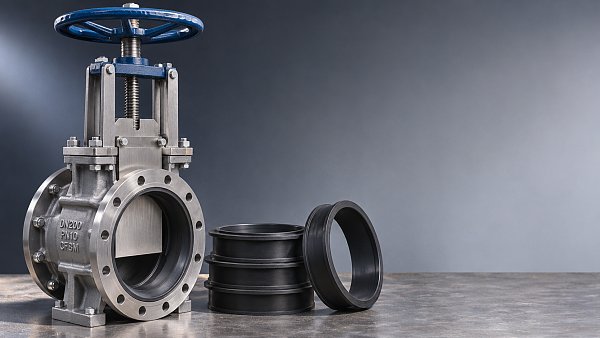
A knife gate valve uses a gate that moves across the flow path. In a slurry-specific design, the gate and surrounding seats or sleeves are arranged to isolate solids-laden flow. When open, many designs present a relatively unobstructed passage, reducing places where material can collect compared with more restrictive valve geometries.
The gate can push through or displace some accumulated solids as it closes. That is useful in duties where sediment might interfere with other closure mechanisms. However, “knife gate” should not be taken to mean that the valve can cut through every particle, rock, or piece of debris. Large or hard solids caught at the seat can damage components or prevent full closure.
Slurry knife gate valves also differ considerably in construction. Some use replaceable elastomer sleeves that protect portions of the body and form the seal. Others use different seat arrangements, including designs intended for particular pressure directions. The sleeve material must be compatible with the slurry’s temperature, chemistry, and abrasive character; an elastomer that seals well in one process may wear or degrade quickly in another.
One practical concern is discharge to the surrounding area. Certain slurry knife gate designs can release a small amount of process media during operation as the gate passes between the sleeves. Where containment is important, ask about enclosed designs and the arrangements needed to manage any discharge.
When a Ball Valve Is a Serious Contender
A ball valve rotates a bored ball between open and closed positions. In a full-port design, the opening can be close to the pipeline bore, providing a relatively direct flow path when fully open. A properly engineered ball and seat arrangement can deliver reliable isolation in abrasive service, including applications with demanding shutoff requirements.
The important qualification is properly engineered. A general-purpose ball valve selected for clean liquid should not automatically be assumed suitable for mineral slurry. Particles can scratch the ball or seats, become trapped in body cavities, or increase operating torque. Damage to either sealing surface may lead to leakage even when the actuator completes its stroke.
Slurry ball valves may use features such as hard-faced sealing surfaces, abrasion-resistant materials, seats designed to manage solids, or cavity-flushing provisions. Metal-seated and soft-seated configurations each have trade-offs: metal seats can suit certain severe services, while soft seats may provide good sealing where the material is compatible with the process. Neither should be chosen without checking abrasion, temperature, pressure, and the required leakage performance.
Ball valves may also be available in pressure classes beyond those of many slurry knife gate designs. That does not make every ball valve a high-pressure slurry valve. The pressure-temperature rating, differential-pressure limits, and solids-handling features must all match the duty.
Wear Resistance Is About More Than Body Material
It is tempting to compare valves by asking which body is made from the harder material. In practice, the first failure may occur at a seat, sleeve, gate edge, ball surface, packing, or localized area of the flow path. The best material in one location cannot compensate for a vulnerable seal elsewhere.
Consider these questions when reviewing a proposed design:
- Where will particles strike? Changes in flow direction, reduced ports, and partly open positions can concentrate erosion.
- What happens during closure? Trapped solids can score a ball and seat or prevent a gate from seating.
- Which parts are intended to wear? Replaceable sleeves or seats may make maintenance more manageable, but access and replacement procedures vary.
- Can solids collect inside the valve? Cavities, dead spaces, and seat pockets deserve attention, particularly with settling slurry.
- Are the materials chemically compatible? Corrosion and abrasion can act together, accelerating damage beyond what either would cause alone.
Ask the supplier to explain the expected wear path for the specific valve, not just provide a material list. A useful discussion identifies which components are exposed, how they are protected, and what symptoms indicate that service is needed.
Shutoff, Pressure, and Operation: Where the Decision Often Turns
Define what “tight shutoff” means
Not every isolation point needs the same leakage performance. A valve used to divert flow may have different requirements from one used to isolate equipment for maintenance. Specify the acceptable leakage criterion, test medium, pressure differential, and flow direction rather than relying on terms such as “bubble tight.”
Both knife gate and ball valves can be supplied with seating arrangements intended for effective shutoff, but actual performance depends on the design and condition of the sealing surfaces. Abrasive wear can change that performance over time. For personnel protection, follow the site’s isolation and lockout procedures; do not assume a single process valve provides safe isolation without a documented assessment.
Check the complete pressure duty
Maximum line pressure is only one part of the picture. The valve must also tolerate the expected differential pressure across the closed element, pressure transients, and the temperature at which it operates. Check the allowable differential for opening and closing as well: a valve that can hold pressure when closed may have different limits for movement under load.
Plan for the required operating force
Solids buildup, seat friction, and differential pressure affect the thrust needed for a knife gate or the torque needed for a ball valve. An actuator sized only for clean-fluid conditions may struggle after slurry has settled or components have worn. Provide the supplier with normal and worst-case operating conditions, along with the expected cycling frequency and available power or air supply.
Neither valve should be assumed suitable for continuous throttling simply because it can stop at an intermediate position. Partly open operation can expose sealing surfaces to concentrated abrasive flow. If modulation is required, select a valve specifically designed and sized for slurry control.
Maintenance and Total Cost: Look Beyond the Purchase
In a difficult slurry line, the least expensive valve to buy is not necessarily the least expensive to own. A maintenance team may value a design with accessible, replaceable wear parts, while another site may prioritize longer intervals between shutdowns or a valve that can be serviced without removing extensive pipework.
Compare the work required to inspect seats and seals, replace wear components, remove the actuator, and return the line to service. Also check spare-part availability and whether replacement requires special tools or trained personnel. A repairable design offers little practical advantage if the necessary parts cannot be obtained within the plant’s maintenance window.
Installation deserves equal attention. Confirm the recommended orientation, support for heavy actuators, clearance for gate travel or ball-valve servicing, and any flushing or drainage connections. Poor installation can make an otherwise appropriate valve troublesome to operate and maintain.
Which Valve Fits Your Slurry Application?
Consider a slurry knife gate valve when the main duty is on-off isolation, the line carries a substantial solids load, and the available pressure rating and leakage performance meet the process requirements. It is especially worth evaluating where a straight-through opening and replaceable sleeves or other wear components suit the maintenance strategy.
Consider a slurry-rated ball valve when the application calls for a ball-valve pressure class, a specified shutoff performance, or a quarter-turn arrangement—and a design is available that addresses the slurry’s abrasive particles and potential cavity buildup. Review the ball coating, seat construction, flushing options, and actuator sizing together rather than treating them as separate choices.
For either option, give potential suppliers a consistent set of data: fluid chemistry, solids concentration, particle size and hardness, temperature, operating and differential pressures, flow conditions, cycling frequency, required leakage performance, and installation constraints. Include abnormal conditions such as settling during shutdown or occasional larger solids.
The better valve is the one that can isolate your slurry at the required pressure, survive the expected wear, and be maintained within the realities of your plant. A knife gate valve is often a strong starting point for abrasive slurry, but a purpose-designed ball valve can be the more appropriate choice when its sealing and pressure capabilities answer the actual duty.
Related Information
 Nov 27, 2026
What Affects Ash Slurry Pump Prices for Power Plants?
Power plant ash slurry pump price depends on materials, flow, head, and operating conditions. Learn how to compare quotes and reduce lifetime costs.- Nov 27, 2026
How to Evaluate Steel Mill Scale Slurry Pump Suppliers
Compare steel mill scale slurry pump suppliers with confidence. Learn how to assess pump selection, wear resistance, maintenance, support, and lifecycle costs. - Nov 26, 2026
How to Read a Slurry Pump Performance Test Report
Learn how to read a slurry pump performance test report, assess flow, head, power and NPSH, and avoid costly acceptance mistakes. - Nov 26, 2026
What Affects the Price of an Abrasive Slurry Knife Gate Valve?
Abrasive slurry knife gate valve price depends on size, materials, wear protection, and actuation. Learn how to compare quotes and reduce long-term costs.

{item.title}
Get a Quote
Please leave your information and email address, and we will contact you as soon as possible.