
How to Evaluate Steel Mill Scale Slurry Pump Suppliers
The best way to compare steel mill scale slurry pump suppliers is to test how well each one translates the same operating data into a defensible pump selection, wear strategy, and support plan. A low purchase price is not a reliable advantage if the pump settles solids in the line, wears out quickly, or requires long shutdowns for replacement parts.
Ask suppliers to quote against a common duty and explain their assumptions. The strongest proposal connects hydraulic performance, particle handling, materials, maintenance access, and lifecycle cost rather than treating each as an isolated feature.
What to Compare Among Steel Mill Scale Slurry Pump Suppliers
Mill scale slurry is not a single standardized fluid. Its solids loading, particle size, temperature, and operating pattern can differ between collection points and change during a production cycle. A supplier should identify which variations affect the selection and which data gaps must be resolved before the pump is ordered.
Use the table to compare complete proposals on the same basis. If one quotation excludes a motor, seal-water system, baseplate, or commissioning, adjust the comparison before deciding which offer is less expensive.
Start With the Slurry and the System, Not the Pump Catalog
A supplier cannot size a scale pump reliably from flow rate and pipe diameter alone. Request a duty sheet that records both normal operation and credible extremes, including startup, flushing, and temporary changes in solids concentration.
- Flow and head: normal, minimum, and peak flow; static elevation; discharge pressure; pipe length, diameter, fittings, and routing.
- Solids: concentration by weight or volume, particle-size distribution, maximum particle size, specific gravity, and particle shape where known.
- Liquid properties: temperature, liquid density, pH, and any chemicals or oil that could affect materials or seals.
- Operating pattern: continuous or intermittent duty, sump level variation, expected starts and stops, and provisions for flushing.
- Site constraints: available suction head, power supply, space, lifting equipment, noise limits, and exposure to heat or water.
Clarify whether solids concentration is expressed by weight or by volume; the figures are not interchangeable without density information. If the slurry varies significantly, provide representative samples or measured ranges rather than relying on a single nominal value. A supplier should state how missing particle or concentration data affects its recommendation.
Settling is an important question. Dense scale particles can accumulate in a sump or pipeline when local velocity is insufficient to keep them moving. Ask how the supplier has assessed deposition risk across the operating range, including at reduced speed, and what flushing or drainage arrangements the system requires.
Check the boundaries of the supplier’s responsibility
A pump supplier may select equipment using customer-provided pipe losses without designing the pipeline. That division is acceptable if it is explicit. Problems arise when neither party owns the assumptions for slurry friction losses, minimum transport velocity, or suction conditions.
For an existing installation, compare the proposed duty with measured pressures, flow, motor load, and maintenance records where available. For a new system, identify who will validate the system curve and update it if the layout changes.
Compare Hydraulic Proposals at Normal and Difficult Duties
Request a performance curve showing the proposed impeller diameter and speed, with the normal duty point and relevant operating limits marked. The submission should also include power demand, efficiency, and net positive suction head required, together with the basis for any slurry corrections applied to water-test data.
The pump curve alone is not enough. The operating point is where the pump and system curves intersect, and slurry behavior can alter the system resistance. Ask suppliers to explain the assumptions behind friction losses and performance corrections rather than comparing catalog curves as though the fluid were clean water.
Pay attention to the normal duty, not only the maximum specified duty. A pump selected far from its preferred operating region can face higher vibration, recirculation, wear, or energy consumption. Conversely, a selection with no credible margin may struggle when solids loading or discharge resistance increases.
Where variable-speed operation is proposed, ask for the anticipated speed range and the resulting flow, head, and motor load. Reduced speed can lower wear in some conditions, but it must still maintain sufficient pipeline transport velocity and meet process requirements. A drive is not a substitute for a correctly sized pump and pipeline.
Examine suction conditions and solids passage
Compare the available net positive suction head with the supplier’s required value using a clearly stated margin and the same operating conditions. Sump level, suction-pipe losses, liquid temperature, and transient operation all matter. Inadequate suction conditions can cause cavitation and unreliable operation, regardless of the quality of the wear materials.
Also request the maximum permissible particle size and the basis for it. A large free-passage dimension is useful, but it does not by itself prove that the pump will handle the full particle distribution without blockage or excessive wear. Screens, sump design, and flushing arrangements remain part of the overall solution.
Weigh Materials Against the Wear Mechanism
Mill scale can cause abrasive wear, but the appropriate material depends on how particles contact the pump surfaces. The impeller, casing, liners, throatbush, and suction-side components may experience different wear patterns. Ask each supplier to identify the vulnerable components and explain why its material combination fits the stated solids and operating conditions.
Request material specifications for the quoted components, not just terms such as “wear resistant” or “heavy duty.” If a supplier offers a wear-life estimate, ask for its operating assumptions, the component being estimated, and whether the estimate is contractual or informational. Wear life cannot be transferred confidently from a different slurry without accounting for the differences.
Compare Shaft Seals, Water Requirements, and Maintenance Access
Seal selection affects reliability as well as plant utilities. Packing, expeller-assisted arrangements, and mechanical seals have different requirements for flush water, leakage control, pressure, and maintenance. The right choice depends on the slurry, suction conditions, available clean water, and restrictions on leakage or dilution.
Request a clear utility schedule covering seal-water quality, pressure, flow, and what happens if the supply fails. If process water dilution is unacceptable, a low-water or alternative arrangement may be attractive, but its operating envelope and maintenance demands still need scrutiny. Confirm whether seal support equipment is included in the quoted price.
Maintenance drawings can expose differences that a performance curve cannot. Establish whether the impeller and liners can be removed without disturbing major pipework, how much clearance is needed, and whether site lifting equipment can handle the heaviest component. For a submerged or vertical arrangement, check the removal height and the procedure for servicing parts below the mounting plate.
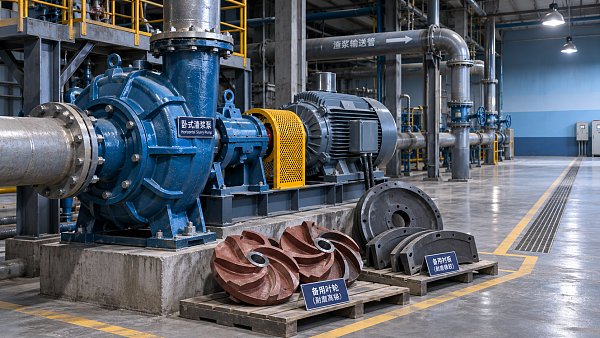
Ask for a recommended spare-parts list split between commissioning, routine service, and longer-term coverage. Identify parts with long manufacturing lead times and confirm whether proposed spares are interchangeable across installed pump sizes or revisions. Stocking a spare is useful only if the part can be identified and fitted when required.
Test Delivery Claims and After-Sales Commitments
A delivery date should be supported by a schedule that identifies drawing approval, casting or fabrication, assembly, testing, and shipment. Clarify which milestones depend on customer information or approval. If a critical material or casting is sourced externally, ask how delays and substitutions will be controlled.
Specify the documents and inspections needed before shipment. Depending on the project, these may include material certificates, dimensional checks, a hydrostatic casing test, performance testing, inspection records, and preservation instructions. Agree on the test basis: a clean-water factory test can verify specified hydraulic characteristics under test conditions, but it does not prove wear life in mill scale slurry.
Support terms deserve the same scrutiny as equipment specifications. Confirm the location of service personnel, response arrangements, language and time-zone coverage, spare-part ordering process, and availability of installation and operating manuals. A local contact is valuable only if responsibilities and escalation routes are clear.
Read warranty exclusions alongside the duty sheet. Wear parts are often treated differently from manufacturing defects, and operation outside the agreed conditions can affect coverage. Define how a failure will be reported and assessed, and avoid treating a broad warranty statement as a guarantee of a particular wear life unless that commitment is explicit.
Build a Comparable Lifecycle Cost
The cheapest installed pump is not necessarily the least expensive to operate. Compare the same scope over a stated evaluation period, using the site’s own operating hours, electricity tariff, maintenance costs, and downtime assumptions.
- Initial cost: pump, motor, drive, baseplate, instrumentation, seal system, freight, installation, and commissioning.
- Energy: estimated absorbed power at the expected operating points, adjusted for operating hours and drive or motor losses where applicable.
- Wear and maintenance: impellers, liners, seals, labor, lifting equipment, and planned service intervals.
- Utilities: seal water, flushing water, and any treatment or handling costs attributable to the pump arrangement.
- Interruption exposure: expected repair time, availability of standby capacity, and the consequences of an unplanned stop.
Use ranges for uncertain wear life and downtime rather than disguising assumptions as known results. For example, in a hypothetical installation with limited access to the pump room, a higher-priced design with removable liners may be preferable if it materially reduces shutdown labor. That conclusion changes if the existing layout still requires major pipe removal or the replacement parts have a long lead time.
Choose Using a Consistent Evidence Standard
Issue the same duty information and scope to shortlisted suppliers, then record deviations in a comparison sheet. Give greater weight to the factors that constrain the installation: reliable solids transport for a long pipeline, maintenance access for a confined pump room, or spare-part availability where shutdown time is especially costly.
A defensible selection is the proposal whose assumptions can be checked, whose operating limits fit the process, and whose support commitments are specific enough to manage. Before placing an order, close unresolved differences in duty, included equipment, testing, delivery, and warranty; those details determine whether the quoted pump will perform as intended after installation.
Related Information
 Nov 27, 2026
What Affects Ash Slurry Pump Prices for Power Plants?
Power plant ash slurry pump price depends on materials, flow, head, and operating conditions. Learn how to compare quotes and reduce lifetime costs.- Nov 27, 2026
How to Evaluate Steel Mill Scale Slurry Pump Suppliers
Compare steel mill scale slurry pump suppliers with confidence. Learn how to assess pump selection, wear resistance, maintenance, support, and lifecycle costs. - Nov 26, 2026
How to Read a Slurry Pump Performance Test Report
Learn how to read a slurry pump performance test report, assess flow, head, power and NPSH, and avoid costly acceptance mistakes. - Nov 26, 2026
What Affects the Price of an Abrasive Slurry Knife Gate Valve?
Abrasive slurry knife gate valve price depends on size, materials, wear protection, and actuation. Learn how to compare quotes and reduce long-term costs.

{item.title}
Get a Quote
Please leave your information and email address, and we will contact you as soon as possible.