
What Affects the Price of an Abrasive Slurry Knife Gate Valve?
The abrasive slurry knife gate valve price depends primarily on valve size, pressure rating, body and gate materials, wear protection, sealing design, and actuation. A larger or more heavily engineered valve costs more upfront, but the lowest-priced option can become more expensive if abrasive solids cause frequent repairs, leakage, or unplanned shutdowns.
The most useful comparison is between valves specified for the same duty. A quotation should be evaluated against slurry properties, required shutoff performance, installation conditions, replacement parts, and the consequences of failure—not against nominal diameter alone.
Abrasive slurry knife gate valve price: what changes between designs?
Slurry knife gate valves share a basic function: a gate moves across the flow path to isolate a line. Their construction can differ substantially, however, especially in how they seal, protect the body from erosion, and deal with solids around the gate.
These categories are not independent. A higher differential pressure, for example, can affect gate thickness, stem strength, actuator sizing, and the force needed to move the gate through settled solids. Comparing only one component misses the cost of the complete assembly.
Size and pressure rating affect more than material quantity
A larger valve requires a larger body, gate, seals, and pipe connection. It can also require more substantial supports and a more powerful operator, so the price difference between two sizes is not necessarily proportional to the difference in diameter.
Pressure rating and shutoff differential pressure are related but distinct selection inputs. The valve must be suitable for the line’s specified pressure and temperature, while its gate and actuator must also be capable of closing and opening under the required differential pressure. Confirm whether the quoted operating torque or thrust applies with solids present and under the intended differential pressure.
Overspecifying pressure without an operating reason can increase purchase and actuation costs. Underspecifying it creates a more serious problem: a valve that fits the pipe but cannot safely contain pressure or perform its intended isolation duty.
Connection and installation dimensions
Flange drilling, face-to-face dimensions, and installation orientation can change the quotation or the cost of fitting a valve. A lower-priced valve that requires pipework modifications, additional supports, or restricted access for maintenance may not be the cheaper installed option.
Ask for a dimensioned drawing and confirm compatibility with the existing piping specification. Include the space needed to withdraw the gate, remove sleeves or seats, and service the actuator.
Materials and wear protection: where the cost is justified
Abrasive slurry can wear the flow passage, gate, sleeves, and sealing surfaces. The rate and location of damage depend on particle hardness and size, solids concentration, flow velocity, turbulence, and operating pattern. Corrosive liquid chemistry can add another degradation mechanism, so abrasion resistance alone is not enough.
A standard body material may be adequate when replaceable liners or sleeves protect it from the slurry and the external environment is compatible. Where chemicals or leakage can attack exposed components, a more corrosion-resistant body or gate may be justified. The right choice depends on which surfaces actually contact the process and which failure mechanism limits service life.
Do not assume that the most expensive material is the best choice. A hard gate paired with an incompatible sleeve, or a corrosion-resistant alloy exposed to severe erosion, may still require frequent maintenance. Request material specifications for the body, gate, sleeves, packing, fasteners, and any other wetted or exposed parts relevant to the installation.
Sealing performance and valve configuration change the quote
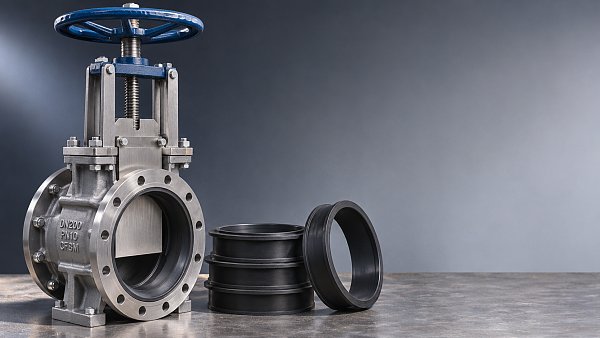
Knife gate valves are not interchangeable simply because they have the same bore. Some slurry designs use elastomer sleeves that seal around the gate and protect the body, while other configurations use different seats and packing arrangements. Their suitability depends on solids behavior, pressure, flow direction, and required leakage performance.
Specify the isolation requirement in measurable terms. Identify the direction of pressure, whether shutoff is required in one or both directions, the test medium, and the applicable acceptance criteria. A bidirectional claim or a reference to a test standard should be accompanied by the actual rating and test scope offered for that valve.
Also clarify what happens to displaced slurry during closure and maintenance. Some designs may discharge process media from the bottom of the valve during operation, depending on configuration. Where containment is required, drainage, guarding, collection, or an alternative design can add to the installed cost.
A knife gate valve selected for isolation should not automatically be assumed suitable for throttling. Partially open operation can expose components to concentrated erosion and may fall outside the manufacturer’s intended duty. If flow control is required, obtain a design explicitly assessed for that service.
Manual and automated operation: compare the complete package
A manual valve can be economical where operation is infrequent, access is safe, and the required effort is practical. As valve size, differential pressure, or solids loading increases, a gearbox or powered actuator may be needed to provide sufficient thrust and acceptable operating time.
Automation adds more than the actuator itself. Depending on the control philosophy, the package can include solenoid valves, limit switches, position indication, local controls, wiring, air preparation, or hydraulic equipment. Site utilities and control-system integration should be included when comparing an automated quotation with a manual one.
- For pneumatic actuation: confirm available air pressure, air quality, failure position, and thrust at the minimum available supply pressure.
- For electric actuation: verify power supply, enclosure protection, control signals, operating duty, and manual override requirements.
- For hydraulic actuation: account for the power unit, hoses or pipework, fluid containment, and maintenance arrangements.
- For any actuator: check opening and closing requirements, gate travel, mounting compatibility, and whether accessories are included.
Actuator sizing should reflect the manufacturer’s valve-specific thrust requirements and the stated operating conditions. An undersized actuator can prevent closure when isolation is needed; an oversized one adds cost and may impose excessive loads unless the assembly and controls are designed for it.
Purchase price versus total ownership cost
Two quotations can be compared over a defined operating period using the same cost categories. The relevant total includes the valve and accessories, installation, planned replacement parts, maintenance labor, lost production during shutdowns, and disposal or handling costs where applicable.
Consider a hypothetical comparison between a lower-priced valve and a protected-sleeve design. If the first valve costs $4,000 and the second costs $6,000, but the first requires two additional $1,500 sleeve replacements during the chosen evaluation period, the replacement parts alone would offset the $2,000 purchase-price saving. Labor and downtime would increase that difference if they also apply.
This is an illustration, not a prediction of service life or market pricing. Use site-specific replacement intervals and consequences, and test the result against shorter and longer service-life assumptions. If both valves are expected to last similarly and failure consequences are low, the simpler design may remain the better value.
For critical isolation, consider the cost and feasibility of maintaining a spare valve or sleeve set. A low component price provides little benefit if a long replacement lead time extends an outage. Conversely, stocking expensive spare assemblies for a noncritical line may tie up funds without a proportionate operational benefit.
How to compare quotations on the same basis
Send each supplier the same duty information and request a breakdown of the complete supply. A slurry description should include liquid chemistry, temperature, solids concentration, particle characteristics, line pressure, maximum differential pressure, and the intended operating frequency. Identify any uncertainty in those inputs, especially where settling or startup conditions could be more demanding than normal operation.
- Match the pressure and isolation duty. Compare pressure-temperature limits, permitted differential pressure, flow direction, and specified leakage acceptance criteria.
- Compare construction in detail. Check body and gate materials, sleeve or seat material, wetted parts, wear protection, and the replacement method for consumables.
- Normalize the operator scope. Establish whether the quoted price includes the actuator, mounting hardware, controls, position feedback, and required accessories.
- Review installed dimensions. Verify flange compatibility, face-to-face length, clearance, support requirements, and any discharge or containment arrangements.
- Examine verification and supply terms. Compare inspection documents, test requirements, spare-parts pricing, delivery scope, lead time, and warranty exclusions.
A useful clarification is whether the quoted valve is suitable for the stated slurry at the specified differential pressure and operating conditions. A catalog rating alone may not resolve questions about solids buildup, closure force, or maintenance access.
Which specification offers the best value?
For a less demanding slurry with manageable shutdown consequences, a standard construction with compatible replaceable wear parts and manual operation can be a defensible choice. For severe abrasion, corrosive chemistry, frequent cycling, or expensive downtime, additional wear protection, specialized materials, automation, and stocked spares may justify their higher upfront cost.
The decision boundary is the duty: pay for features that address a defined operating risk, and avoid paying for ratings or accessories that the application does not require. A comparable, duty-specific quotation makes the abrasive slurry knife gate valve price meaningful—and makes the long-term cost easier to judge.
Related Information
 Nov 27, 2026
What Affects Ash Slurry Pump Prices for Power Plants?
Power plant ash slurry pump price depends on materials, flow, head, and operating conditions. Learn how to compare quotes and reduce lifetime costs.- Nov 27, 2026
How to Evaluate Steel Mill Scale Slurry Pump Suppliers
Compare steel mill scale slurry pump suppliers with confidence. Learn how to assess pump selection, wear resistance, maintenance, support, and lifecycle costs. - Nov 26, 2026
How to Read a Slurry Pump Performance Test Report
Learn how to read a slurry pump performance test report, assess flow, head, power and NPSH, and avoid costly acceptance mistakes. - Nov 26, 2026
What Affects the Price of an Abrasive Slurry Knife Gate Valve?
Abrasive slurry knife gate valve price depends on size, materials, wear protection, and actuation. Learn how to compare quotes and reduce long-term costs.

{item.title}
Get a Quote
Please leave your information and email address, and we will contact you as soon as possible.