
Can a Standard Slurry Pump Run Continuously at 120°C?
Can a Standard Slurry Pump Run Continuously at 120°C?
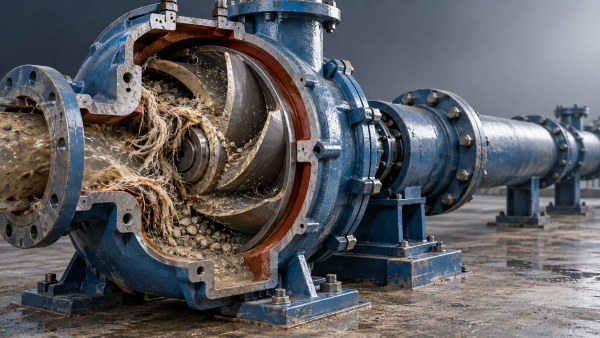
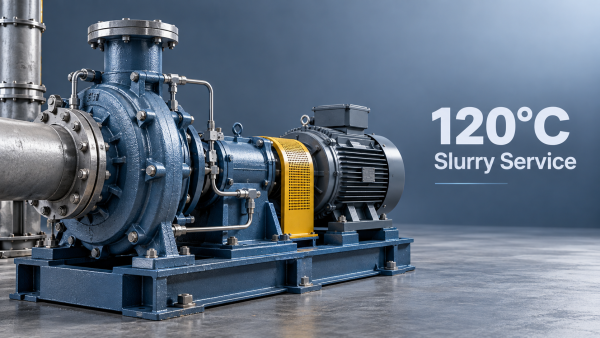
Not without verifying its temperature rating and operating conditions. Some slurry pumps can handle continuous service at 120°C in a suitable configuration; others cannot, even if their metal casings appear capable of tolerating the heat. Seals, liners, bearing lubrication, thermal expansion, and suction conditions can become the limiting factors.
For hot, abrasive slurries, a maximum temperature in a catalog is only a starting point. It may apply to a particular material combination, require auxiliary cooling, or describe a limit that does not cover your pressure and slurry chemistry. The practical question is whether the complete installed pump—not just its casing—is approved for continuous operation at that duty.
What does “standard slurry pump” actually mean?
There is no universal temperature rating for a standard slurry pump. The term might describe a rubber-lined horizontal centrifugal pump, a hard-metal wet end, or simply a manufacturer's regular production model. Those designs can have very different temperature limits.
Even two pumps from the same range may differ because one uses packing and another a mechanical seal, or because their liner and gasket compounds are different. A familiar model number does not establish the suitability of every supplied configuration.
Ask for confirmation against the pump serial number, bill of materials, and operating duty. The useful question is: “Is this exact assembly rated for continuous pumping of this slurry at 120°C, including the specified pressure, speed, and seal-support conditions?” A general statement that the pump range handles hot liquids is not enough.
Which materials are most likely to limit operation?
Elastomer components deserve early attention. A rubber liner selected for abrasion resistance at moderate temperatures may lose strength, swell, harden, or deteriorate in a hot process liquid. Temperature and chemical exposure act together; checking them independently can give a misleading answer.
Do not approve a liner using only a generic material name. Natural rubber, EPDM, and other elastomers cover different formulations, and a compound suitable for hot water may be unsuitable for a process containing oil or particular chemicals. Obtain the temperature and chemical compatibility limits for the actual compound, including any restrictions on continuous service.
A metal-lined slurry pump removes some elastomer-related restrictions, but it does not automatically solve the problem. High-chromium wear alloys are selected largely for abrasion performance; their corrosion resistance still depends on the liquid chemistry. Hot acidic or chloride-bearing service needs a separate materials review.
Small components can set the limit. Casing gaskets, shaft-sleeve seals, O-rings, adhesives, and seal components may have lower allowable temperatures than the main castings. Replacing the liner while leaving an unsuitable gasket in place is not a complete high-temperature conversion.
Will the slurry remain liquid at the pump inlet?
For water-based slurries, this is often the decisive check. Standard steam tables put the saturation pressure of pure water at 120°C at approximately 1.99 bar absolute. Water at that temperature therefore cannot remain in stable liquid form in an ordinary open atmospheric tank.
A process reporting a 120°C aqueous slurry will generally need sufficient pressure to suppress boiling. Dissolved substances can alter vapor pressure, so the actual liquid composition matters. Do not assume that a slurry's high solids content, by itself, prevents flashing.
Consider a pressurized process vessel feeding a pump through a long suction line. The vessel may hold the liquid safely above its vapor pressure, but pressure losses through piping, valves, and strainers can consume that margin before the slurry reaches the impeller. Low vessel level makes the situation worse.
Calculate net positive suction head available, or NPSHA, using absolute vessel pressure, liquid vapor pressure at the actual temperature, static head, and suction losses, with a consistent density basis. Compare it with the manufacturer's NPSH requirement and an appropriate application margin. Where published curves are based on water testing, ask how slurry properties affect their use.
A temperature-rated pump can still fail in a poorly pressurized suction system. Cavitation or flashing can cause unstable flow, noise, vibration, erosion, and seal distress. A tougher impeller does not correct insufficient suction pressure.
Can the existing shaft seal stay in service?
Possibly, but a seal's nominal temperature rating is not a complete approval. Abrasive solids, seal-chamber pressure, local face heating, and the reliability of any flush or barrier system all affect performance.
Packed glands
Packing may be appropriate when its materials and gland-water arrangement suit the duty. Where gland water is required, its pressure must be sufficient relative to the pressure at the stuffing box to establish the intended flow. Excessively tightening the gland to stop leakage can increase frictional heating and damage packing or the sleeve.
At this temperature, leakage is also a personnel hazard. Hot liquid released to atmosphere may flash. Drainage, guarding, and safe access therefore belong in the assessment, not just in the maintenance instructions.
Mechanical seals
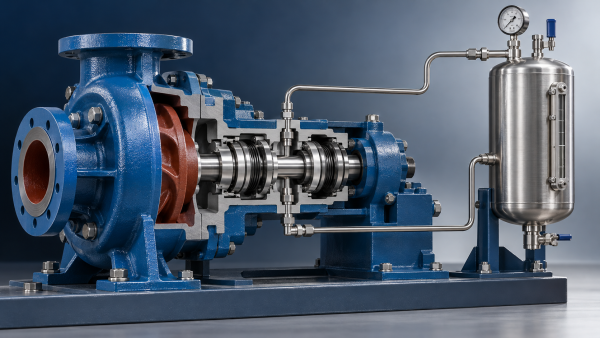
A mechanical seal needs compatible face materials, secondary seals, and a suitable support arrangement. Fluid near the faces can become hotter than the bulk slurry because of friction. If the local pressure margin is insufficient, vapor formation can disrupt the lubricating film.
Depending on the process, the solution may involve flushing, cooling, or a dual seal with a controlled barrier system. These options introduce trade-offs: external liquid can dilute the process, while a support system adds utilities, monitoring, and maintenance. Selection should involve both the pump and seal suppliers.
What changes mechanically during continuous hot operation?
Continuous operation gives heat time to travel from the wet end toward the shaft, bearing housing, and baseplate. The slurry temperature is not the bearing temperature, but it can influence it. Lubricant suitability must be checked against the expected bearing operating temperature, speed, load, and lubrication arrangement.
Fitting a higher-temperature grease is not an automatic remedy. It does not correct excessive heat transfer, an unsuitable bearing arrangement, or overgreasing. Some installations need cooling or a different lubrication configuration; others do not. That decision requires the manufacturer's assessment.
Thermal expansion also affects impeller clearances, coupling alignment, and nozzle loads. A pump aligned cold may move relative to its driver as it reaches operating temperature. Unsupported piping can impose additional loads as the line expands. Use the manufacturer's clearance-setting and alignment procedure rather than applying a generic “hot clearance” adjustment.
Pressure capability needs checking at temperature too. Confirm the allowable pressure of the casing, covers, flanges, and joints at 120°C against the maximum pressure they can experience, including suction pressure and relevant operating or transient conditions.
Does a successful short trial prove continuous-duty suitability?
No. A brief trial may show that the pump produces flow without immediate leakage, but it cannot establish long-term elastomer compatibility, lubricant life, or wear behavior. Bearing and support temperatures may also take time to stabilize.
Commissioning should follow an approved procedure with controlled warm-up and monitoring of suction pressure, flow, vibration, seal performance, and bearing temperature. Set acceptance limits before starting. “It sounds normal” is not an adequate acceptance criterion for a pressurized hot-slurry system.
Include abnormal conditions in the review: loss of flush water, falling vessel level, blocked suction, restart after a trip, and cooling during shutdown. Avoid abrupt temperature changes unless explicitly permitted. A configuration that works only while every utility remains perfect needs suitable alarms, interlocks, or another protective arrangement.
What information is needed before approving 120°C service?
A useful supplier review needs more than temperature and flow. Provide the following information together so that materials, hydraulics, and mechanical limits can be assessed as one duty:
- Normal and maximum temperatures, exposure duration, and expected heating or cooling cycles.
- Liquid chemistry, solids concentration, particle size, density, and relevant viscosity or settling behavior.
- Required flow, differential head, speed, and anticipated operating range.
- Vessel pressure and level range, suction piping losses, and the proposed NPSHA calculation.
- The installed wet-end materials, elastomer compounds, seal arrangement, and lubrication details.
- Available flush, cooling, and barrier-fluid utilities, including their failure conditions.
Request written confirmation of continuous-duty suitability, required modifications, operating limits, and inspection requirements. If the supplier's answer depends on a utility supply or minimum suction pressure, carry that condition into the operating procedure and protection logic.
When is a high-temperature configuration necessary?
A dedicated configuration becomes necessary when the existing assembly cannot meet the duty within its documented limits. That may mean different liners and seals, a revised bearing or cooling arrangement, or a different pump. It may also require changes outside the pump, particularly to suction piping or vessel pressure control.
If the existing pump is explicitly approved for continuous 120°C service and the installed system satisfies its conditions, replacement solely because of temperature may be unnecessary. If approval is missing, do not treat a catalog maximum or a successful short run as permission. Identify the limiting component or system condition first, then decide whether to modify the pump, change the process conditions, or select another configuration.
Related Information
 Oct 31, 2026
Why Does a Non-Clog Slurry Pump Still Get Blocked?
Why does my non-clog slurry pump still block up? Discover how debris, settling, low flow, and wear cause blockages—and find practical fixes to reduce downtime.- Oct 31, 2026
Can a Standard Slurry Pump Run Continuously at 120°C?
Can a standard slurry pump run continuously at 120°C? Discover critical seal, material, and suction requirements—and learn what to verify before approving continuous hot-slurry service. - Oct 30, 2026
Do Slurry Pumps Handling Flammable Hydrocarbons Need Double Seals?
Does a slurry pump handling flammable hydrocarbons need a double mechanical seal? Explore leakage risks, seal options, and barrier systems to choose safer, more reliable containment. - Oct 30, 2026
How Can You Tell When a Slurry Pump Liner Needs Replacing?
How do I tell when a slurry pump liner needs replacing? Learn key wear signs, thickness limits, and inspection tips to plan replacement, protect your pump, and avoid costly downtime.

{item.title}
Get a Quote
Please leave your information and email address, and we will contact you as soon as possible.