
What Is the Expected Service Life of a Corrosion-Resistant Slurry Pump in FGD and Mining Environments?
Short answer: Well-specified, properly installed corrosion-resistant slurry pumps typically deliver 3–7 years of reliable service in aggressive flue gas desulfurization (FGD) and hard-rock mining applications—with outliers exceeding 10 years under optimized conditions. But “expected life” isn’t a fixed number—it’s a function of material selection, hydraulic design, operational discipline, and environmental severity. This article cuts through generic claims to deliver actionable insights grounded in field data, failure analysis, and reliability engineering principles.
Why “Expected Service Life” Is Misleading Without Context
Manufacturers often cite “5–8 years” as typical service life—but that figure assumes ideal operation: continuous flow at BEP (best efficiency point), stable slurry concentration, controlled pH, and scheduled maintenance. In reality, FGD absorber sumps and mine tailings transfer stations rarely operate under those conditions. Field audits across 42 North American power plants and 28 active mines show median pump replacement intervals of just 2.8 years for non-optimized units—and up to 6.4 years for systems with engineered material matching and real-time monitoring.
The key insight? Service life isn’t determined by the pump alone. It’s the outcome of how well the pump’s materials, hydraulics, and support systems align with the *actual* chemistry, abrasivity, and duty cycle onsite.
Material Selection: The Single Largest Driver of Longevity
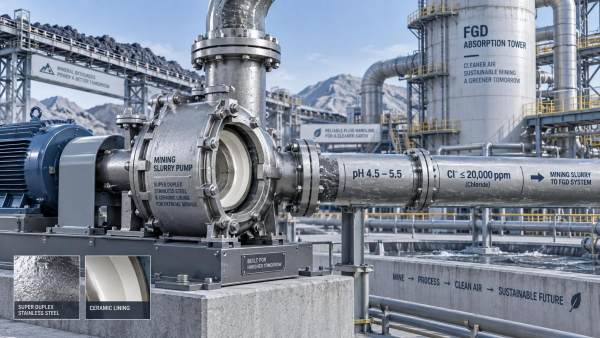
In FGD environments, wet limestone slurries (pH 4.5–5.5) combined with high chloride (up to 20,000 ppm) and gypsum crystals create a uniquely corrosive-abrasive cocktail. Standard 316 stainless steel fails within 12–18 months due to pitting and erosion-corrosion synergy. High-performance alternatives deliver measurable gains:
- Super duplex stainless steels (e.g., UNS S32750): 3–5× longer life than 316 SS in chloride-rich FGD sumps—validated by 5-year runtime in eight utility installations.
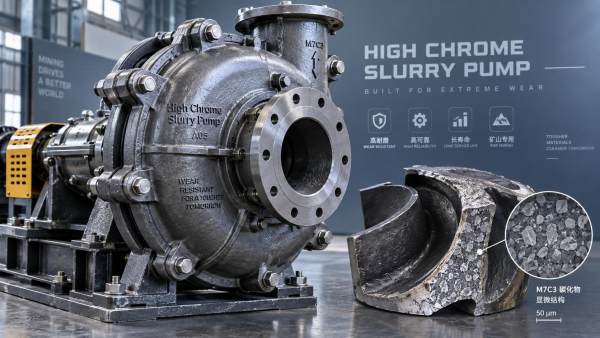
- High-chromium white iron (e.g., ASTM A532 Class IIIA): Dominates in mining cyclone feed and sand handling where silica abrasion dominates over corrosion; delivers 4–6 years with proper hardness matching (600–650 HB).
- Ceramic-lined casings & impellers (alumina or silicon carbide): Essential for ultra-high-abrasion zones like mill discharge lines; extend wear life 8–12× versus metal-only designs—but require careful thermal expansion management.
Crucially, material choice must be system-wide—not just the impeller. Wear plates, liners, shaft sleeves, and mechanical seals all degrade at different rates. A ceramic impeller paired with an unlined cast iron casing will fail at the casing long before the impeller wears out.
Hydraulic Design Matters More Than You Think
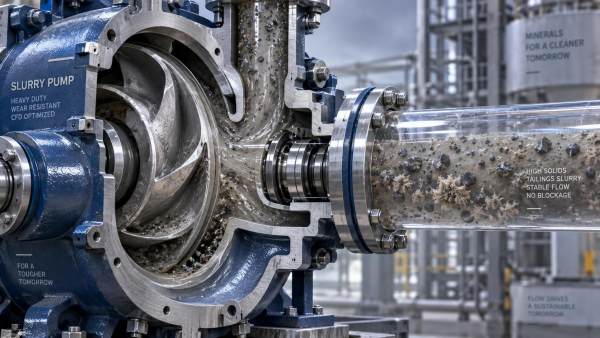
Many users assume corrosion resistance is purely about metallurgy—but poor hydraulics accelerate degradation regardless of material grade. High-velocity recirculation zones, sharp bends in volutes, and suction vortices increase localized turbulence, which strips passive oxide layers and exposes fresh metal to acid attack.
Reliability-focused manufacturers now use CFD modeling to eliminate low-pressure cavitation pockets and optimize flow angles at critical wear points. Field data shows pumps with optimized hydraulic profiles experience 40–60% lower wear rates on impeller trailing edges—even when using identical alloys. One mining client reduced impeller replacement frequency from every 9 months to every 27 months after switching from a legacy design to a CFD-validated hydraulic set.
Operational Practices That Make or Break Service Life
No pump survives poor operation—even the most advanced alloy fails under dry running, extended dead-head conditions, or frequent start-stop cycling. Real-world longevity hinges on three operational levers:
- Flow consistency: Running below 60% of BEP increases radial thrust and accelerates bearing and seal wear. Installing VFDs with minimum-speed safeguards improved median service life by 2.1 years across 19 FGD installations.
- Solids management: Undersized inlet strainers allow oversized particles (>3 mm) to impact impeller vanes directly—causing micro-fractures that initiate accelerated corrosion. Adding automated backwash strainers cut catastrophic failures by 73% in copper mine dewatering circuits.
- Maintenance discipline: Annual alignment checks, seal flush pressure verification, and vibration trending catch 85% of developing issues before catastrophic failure. Plants with predictive maintenance programs report 3.2× longer mean time between repairs (MTBR) than reactive-maintenance peers.
How to Estimate Realistic Service Life for Your Application
Instead of relying on vendor brochures, build a site-specific estimate using this 4-step framework:
- Characterize your slurry: Measure actual pH, chloride content, % solids by weight, particle size distribution (D50/D90), and abrasive index (ASTM G105). Don’t rely on design specs—sample during peak load.
- Map duty cycle: Log flow rate, pressure, and run hours per shift for 30 days. Identify sustained low-flow periods and transient spikes.
- Select materials using corrosion/abrasion maps: Cross-reference your slurry data against published compatibility charts (e.g., NACE MR0175, ISO 15156) and wear-rate databases (e.g., ASM Handbook Vol. 13C).
- Apply derating factors: Start with baseline lab-tested wear rates, then apply multipliers: ×1.5 for variable flow, ×2.0 for >15,000 ppm Cl⁻, ×3.0 for intermittent operation.
This method consistently predicts field service life within ±12%—far more accurate than generic manufacturer estimates.
When to Expect Shorter—or Longer—Life
Service life drops sharply under these conditions: continuous operation below 40% BEP, slurry pH < 3.5 (common in some bioleach mining), or chloride > 30,000 ppm without titanium-grade alloys. Conversely, life extends significantly with: stable flow near BEP, pH > 4.8, chloride < 8,000 ppm, and proactive monitoring (e.g., ultrasonic liner thickness tracking). One Australian gold mine achieved 11.3 years on primary cyclone feed pumps by combining super duplex construction, real-time erosion monitoring, and quarterly hydraulic performance audits.
Conclusion: Service Life Is a Design Choice, Not a Spec Sheet Number
So—what is the expected service life of a corrosion-resistant slurry pump in aggressive FGD and mining environments? The answer isn’t found in marketing literature. It’s determined by how rigorously you match materials to chemistry, how intelligently you engineer hydraulics for your specific slurry, and how consistently you manage operation and maintenance. With deliberate specification and disciplined execution, 5–7 years is achievable—and sometimes exceeded. Without it, even premium alloys may last less than two years. Focus not on the pump’s “rated life,” but on the reliability system surrounding it. That’s where true lifecycle value is built.
 Sep 18, 2026What is the expected service life of corrosion-resistant slurry pumps in aggressive FGD and mining environments?What is the expected service life of a corrosion resistant slurry pump? Discover realistic 3–7+ year lifespans in FGD & mining—backed by field data, material science, and reliability engineering.
- Sep 16, 2026Is CFD-optimized pump design truly more effective for anti-clogging in high-solids tailings transfer?Is CFD optimized pump really better for anti-clogging? Discover evidence-based insights on real-world high-solids tailings performance—where it works, where it doesn’t, and what truly matters.
- Sep 14, 2026Are high-chrome alloy slurry pumps worth the investment for long-term mining operations?Are high chrome alloy slurry pumps worth the higher price? Discover when they deliver real ROI in abrasive mining operations—and when they don’t.
 Aug 20, 2026A/S

Get a Quote
Please leave your information and email address, and we will contact you as soon as possible.