
Is CFD-optimized pump design truly more effective for anti-clogging in high-solids tailings transfer?
Yes—but only when specific hydraulic and operational conditions align. CFD-optimized pump designs can reduce clogging in high-solids tailings transfer, but the improvement is neither automatic nor uniform across applications. The value lies not in whether CFD was used, but in how it was applied: what flow physics were modeled, which particle behaviors were prioritized, and whether the resulting geometry survived abrasive wear long enough to deliver net reliability gains.
Where CFD adds measurable anti-clogging value—and where it doesn’t
CFD’s strongest contribution to anti-clogging performance emerges in three narrow but critical zones:
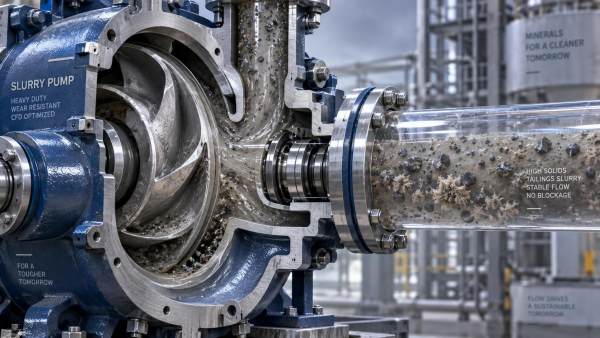
- Impeller inlet and vane leading edges: Conventional impeller designs often create low-velocity pockets just upstream of the vane entry or along suction-side pressure gradients. These zones trap fibrous debris, clay lumps, or oversized solids that then consolidate under shear. CFD allows engineers to map local velocity minima (<1.2 m/s) and turbulence intensity below 5%—conditions known to promote settling in slurries above 45% w/w solids. When used to reshape hub contours or adjust vane wrap angles, CFD can eliminate these pockets without compromising head generation.
- Clearance paths between impeller and volute tongue: In high-solids service, even 2–3 mm of clearance can become a choke point if flow separation occurs nearby. CFD reveals recirculation cells that draw solids into gaps, where they compact and swell (especially with clay-rich tailings). Optimizing the volute cutwater profile—not just its position—reduces this entrainment risk by maintaining axial momentum through the discharge transition.
- Seal chamber and lantern ring flow paths: Clogging here doesn’t stop pumping—but it kills mechanical seals within hours. CFD modeling of secondary flow circuits (e.g., flush water routing, cooling loops) identifies stagnation zones where fines accumulate and dry out. This isn’t about main-flow efficiency; it’s about ensuring continuous, low-velocity purge flow through small-diameter passages—something traditional design rules-of-thumb consistently miss.
Outside these zones, CFD offers diminishing returns for anti-clogging. For example, optimizing diffuser vane angles for peak efficiency at BEP rarely improves solids handling. Likewise, refining surface roughness in CFD post-processing has negligible effect on clog resistance—abrasion erosion dominates surface degradation long before hydrodynamic smoothing matters.
The hidden bottleneck: CFD tells you *where* particles stall—not *why* they stick
This is where many specifications go wrong. Standard CFD setups for pump design typically model particles as passive tracers—tracking trajectory but ignoring adhesion, swelling, or rheological change upon shear cessation. In real tailings, a 10 mm clay-agglomerate behaves nothing like a rigid sphere: it deforms, releases bound water, and adheres to metal surfaces with forces exceeding 5 kPa under low-shear conditions. CFD alone cannot predict this.
Effective anti-clogging design requires coupling CFD with empirical material behavior data—specifically, yield stress vs. shear rate curves for the actual tailings stream, measured at operating temperature and pH. Without this, CFD may show “uniform flow” while field units still clog at the same location—because the simulation assumed Newtonian behavior, not the thixotropic gel-state that forms when flow stops momentarily in a bend or valve.
So the question isn’t “Was CFD used?” but “Was CFD informed by representative slurry rheology—and validated against solids transport tests using the actual feed?” If the answer is no, the optimization is academic—not operational.
Field evidence: Where the gains hold up—and where they erode
Published case studies from mineral processing facilities show consistent patterns:
Notice the pattern: the largest gains occurred where CFD guided geometry changes that addressed localized flow breakdown—not overall efficiency. And crucially, all successful cases involved iterative validation: CFD predictions were checked against physical scale-model testing using surrogate solids (e.g., ground walnut shells for size distribution, hydrated bentonite for rheology), not just mesh convergence studies.
What to check before specifying a CFD-optimized pump
If your site handles high-solids tailings, don’t ask “Does it use CFD?” Ask these four questions instead:
- What specific clogging mechanism does the design target? (e.g., “vane inlet trapping” vs. “seal chamber sedimentation”)—vague claims like “enhanced solids handling” are meaningless without a defined failure mode.
- Was the CFD model calibrated to your slurry’s rheology at operating concentration? Request the Herschel-Bulkley parameters used—or decline the proposal.
- Where was physical validation performed? Not just computational verification, but bench-scale flow loop testing with representative particle size distribution and solids loading.
- How was wear accounted for? A CFD-optimal geometry loses anti-clogging benefit if erosion widens clearances by 0.5 mm within 500 hours. Look for designs that embed wear tolerance—e.g., replaceable vane inserts, not monolithic castings.
CFD-optimized pumps aren’t inherently better. They’re tools—powerful only when applied with domain-specific constraints, grounded in real slurry behavior, and validated where it matters: at the interface between fluid motion and solid accumulation. For high-solids tailings, that interface is narrow, unforgiving, and rarely captured by generic simulation workflows.
 Sep 16, 2026Is CFD-optimized pump design truly more effective for anti-clogging in high-solids tailings transfer?Is CFD optimized pump really better for anti-clogging? Discover evidence-based insights on real-world high-solids tailings performance—where it works, where it doesn’t, and what truly matters.
- Sep 14, 2026Are high-chrome alloy slurry pumps worth the investment for long-term mining operations?Are high chrome alloy slurry pumps worth the higher price? Discover when they deliver real ROI in abrasive mining operations—and when they don’t.
 Aug 20, 2026A/S
- Aug 20, 2026CEM&ODM

Get a Quote
Please leave your information and email address, and we will contact you as soon as possible.