
Yes—high-chrome alloy slurry pumps are frequently worth the higher initial investment for long-term mining operations, but only when specific operational and material conditions align. The value proposition isn’t universal; it hinges on three interdependent factors: slurry abrasivity (measured by particle hardness, shape, and concentration), duty cycle intensity (continuous vs. intermittent operation), and maintenance infrastructure capability (on-site repair capacity, spare parts lead time, and metallurgical expertise).
Where High-Chrome Alloy Delivers Measurable Advantage
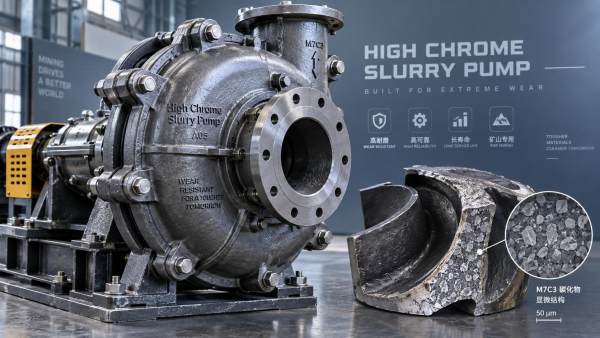
High-chrome white iron alloys—typically containing 22–28% chromium, with carbide volume fractions exceeding 20%—form a microstructure dominated by hard M7C3 eutectic carbides embedded in an austenitic or martensitic matrix. This structure resists cutting wear from sharp silica particles far more effectively than standard ASTM A532 Class I Type A (15% Cr) or ductile iron. In practice, service life extension is not linear across all applications. Field data from hard-rock copper and gold operations show that high-chrome impellers and liners last 3–5× longer than 15% Cr equivalents *only* when handling slurries with >65 HRC quartz content, solids concentrations above 55% w/w, and flow velocities exceeding 4.5 m/s. Below those thresholds, the differential narrows significantly—sometimes to less than 1.5×—and the cost-per-hour advantage diminishes.
The Hidden Cost of “Economy” Materials
Lower-cost alternatives often fail not from catastrophic fracture, but from progressive, asymmetric wear that alters hydraulic geometry. As vanes thin unevenly, internal recirculation increases, efficiency drops by 8–12%, and vibration amplitudes rise—triggering premature bearing failure. Replacing bearings every 3–4 months instead of every 18–24 months adds labor, alignment rework, and unplanned downtime. One underground zinc mine tracked 11.3 hours of unscheduled pump downtime per quarter with standard alloy pumps versus 2.1 hours with high-chrome units—despite identical motor and seal specifications. That difference translates directly into reduced throughput, increased energy consumption per ton moved, and higher labor allocation for reactive maintenance.
Lifecycle Cost Is Not Just About Replacement Intervals
Total cost of ownership includes more than purchase price and spare parts. It encompasses installation labor (high-chrome components are denser—up to 7.9 g/cm³—requiring reinforced mounting and torque verification), machining tolerance sensitivity (±0.1 mm runout tolerances become critical at high rotational speeds), and thermal management during welding repairs. Unlike lower-chrome grades, high-chrome alloys cannot be field-welded without preheat (≥300°C) and post-weld stress relief; attempting repair without both steps introduces microcracks that propagate under cyclic loading. Facilities lacking certified welders trained in high-chrome procedures may inadvertently accelerate failure—even with premium materials.
When the Premium Doesn’t Pay Off
Three scenarios consistently erode ROI: First, low-abrasion, low-solids tailings transfer where pH stability and corrosion resistance matter more than wear resistance—here, duplex stainless steels or rubber-lined pumps often deliver better value. Second, operations with infrequent, short-duration pumping cycles (<4 hrs/day average), where thermal cycling fatigue dominates over abrasive wear, and high-chrome’s brittleness becomes a liability. Third, sites where pump selection prioritizes hydraulic efficiency over longevity—high-chrome geometries sometimes sacrifice peak efficiency (by 2–3%) to maximize wear margin, which compounds energy costs over decades of operation if electricity rates are high and load profiles are stable.
Mechanical Design Must Match Metallurgical Capability
No amount of alloy hardness compensates for poor hydraulic design. High-chrome impellers require precise vane thickness distribution—not uniform thickness—to balance erosion resistance with stress concentration control. Over-thickened vanes crack near the shroud due to restrained thermal contraction; under-thickened tips erode rapidly despite bulk hardness. Similarly, liner clearances must be set within ±0.3 mm of design spec—excessive clearance accelerates recirculation wear behind the impeller eye, while insufficient clearance induces rubbing and localized overheating. These tolerances demand calibrated assembly fixtures and laser alignment—not just torque wrenches.
Material Consistency Matters More Than Grade Labeling
“High-chrome” is not a single specification. Heat treatment history, carbon content (0.9–1.2% typical), and secondary carbide formers like molybdenum or niobium alter real-world performance. Two pumps labeled “27% Cr” can differ by 40% in mean time between failures if one uses air-cooled casting (coarser carbides) and the other employs controlled sand-mold cooling (finer, more uniformly distributed carbides). Reputable foundries provide microstructure reports—not just chemical certs—and verify carbide morphology via SEM imaging. Without that verification, procurement teams risk paying premium prices for suboptimal microstructures.
Operational Discipline Is Non-Negotiable
Even optimal high-chrome components degrade prematurely under cavitation, dry running, or excessive suction lift. Cavitation pits initiate at carbide/matrix interfaces; once started, they propagate faster than in softer alloys because the matrix yields less readily to absorb impact. Dry running—even for 30 seconds—can raise localized temperatures above 600°C, oxidizing carbide surfaces and embrittling adjacent zones. These failure modes aren’t material defects—they’re process deviations. Their recurrence signals gaps in operator training, sensor calibration (e.g., suction pressure transmitters drifting ±5%), or control logic that doesn’t enforce minimum flow safeguards.
In summary, high-chrome alloy slurry pumps justify their higher price when deployed in sustained, high-abrasion duty cycles where wear-driven downtime dominates maintenance strategy—and where supporting practices (alignment discipline, thermal management, microstructure verification, and operational controls) are rigorously maintained. They are not inherently superior in all mining contexts; their value emerges only where material science, mechanical design, and operational execution converge precisely.

Get a Quote
Please leave your information and email address, and we will contact you as soon as possible.