
Selecting a High-Concentration Slurry Pump for Tailings Disposal Lines
Selecting a High-Concentration Slurry Pump for Tailings Disposal Lines
Selecting a high concentration slurry pump for tailings disposal is not a matter of finding a pump that meets a nominal flow rate and head point on a curve. Tailings lines operate with abrasive solids, variable slurry properties, long pipelines, elevation changes, and conditions that can shift during a campaign or over the life of a mine. A pump that appears suitable in a clean-water calculation can lose efficiency quickly, suffer unstable operation, or wear through critical components far earlier than expected once it is placed on a real disposal line.
The right decision begins with the slurry, not the pump model. A technically sound selection connects material characterization, hydraulic duty, mechanical design, maintenance philosophy, and operating control. It also recognizes where uncertainty exists. Tailings are rarely perfectly consistent, especially where feed mineralogy, thickener performance, grind size, or reclaim-water balance changes over time.
Start with the duty conditions that actually matter
Flow rate and total dynamic head remain fundamental, but they are only the visible part of the duty. For a tailings disposal line, the selection package should distinguish normal, minimum, maximum, and upset operating conditions. If the design assumes only one fixed solids concentration, the resulting pump may be poorly matched as the thickener underflow changes or as process water enters the line.
Useful input data normally includes slurry specific gravity, solids concentration by weight and by volume, particle-size distribution, particle shape, maximum particle size, mineral hardness, liquid chemistry, temperature, and viscosity behavior. Coarse, angular particles tend to create a different wear pattern from finely ground but highly dense material. A slurry with a high proportion of fines may also display non-Newtonian behavior, meaning its resistance to flow cannot be treated in the same way as water with suspended solids.
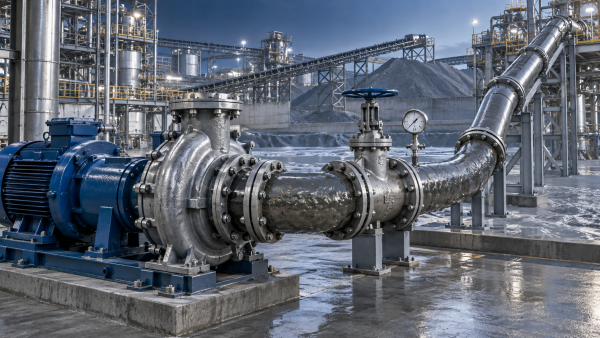
Pipeline information is equally important. Line diameter, length, internal condition, wall thickness, route profile, bends, valves, hose sections, discharge elevation, and downstream pressure restrictions all affect the pump duty. In long lines, friction losses can dominate. In uphill or undulating routes, static head and transient effects may become more significant. The system curve should be developed for the slurry conditions expected in operation, rather than simply correcting a water-based curve with a broad assumption.
A practical question is whether the line can remain above its critical deposition velocity throughout the operating range. If velocity falls too low, particles can settle in low points or along horizontal runs. A settled line is not merely a production interruption; restarting it can impose a substantially different load on the pumping system. Conversely, excessive velocity can accelerate wear in both the pipeline and the wet end. Pump selection therefore has to support a controllable operating window, not only a single best-efficiency point.
High concentration changes the hydraulic problem
At higher solids concentrations, slurry flow becomes less forgiving. Pump head and efficiency commonly differ from clean-water performance, while power demand may increase significantly. The pump must generate enough pressure to overcome pipeline resistance without running so far from its efficient range that recirculation, vibration, shaft deflection, and localized wear become persistent problems.
This is why slurry derating and manufacturer performance data deserve close scrutiny. A vendor should be able to explain the basis for the proposed speed, impeller diameter, predicted absorbed power, and efficiency under the stated slurry duty. When slurry test data is unavailable, assumptions should be identified rather than hidden within a final duty sheet. It is better to document uncertainty early than to discover that the installed motor has insufficient margin or that the pump cannot sustain the required line pressure.
Net positive suction head also requires attention. A tailings pump may be fed from a sump, tank, thickener underflow box, or cyclone-related circuit where liquid level and feed conditions fluctuate. Air entrainment, vortexing, inadequate inlet geometry, or insufficient submergence can reduce suction performance. In severe cases, cavitation and unstable flow damage the impeller and create misleading symptoms that are sometimes blamed on poor wear material.
Choose wet-end geometry for passage and wear, not just peak efficiency
For tailings service, impeller and casing selection involves a trade-off between hydraulic efficiency, solids passage, wear life, and serviceability. A narrow hydraulic passage may produce attractive efficiency under controlled conditions but can be less tolerant of variable particle size, roping, or debris. Wider passages often improve solids handling, although they may alter efficiency and head characteristics. The appropriate geometry depends on the actual particle distribution and the consequences of blockage or lost capacity.
The pump’s operating point matters as much as its physical size. Running close to the best-efficiency region generally reduces hydraulic instability, but a tailings line may need flexibility for changing density or pipeline resistance. A variable-speed drive can provide useful control where process conditions vary, provided the complete operating envelope is checked for minimum flow, motor torque, pipe velocity, and pump limits. Speed control is not a substitute for a correctly sized pump; it simply gives a well-selected system more room to respond.
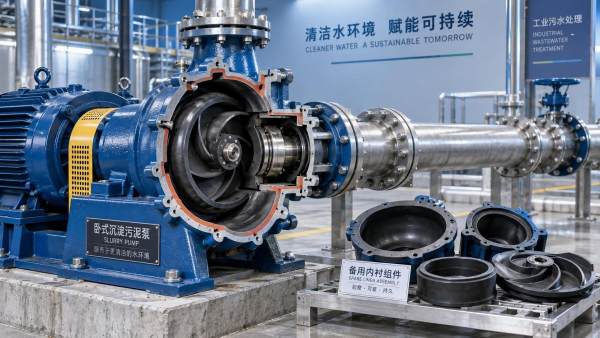
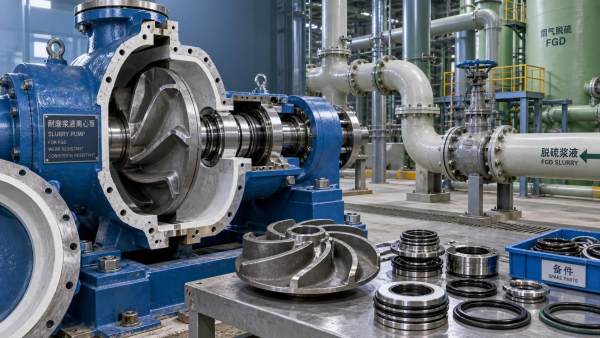
Wear is seldom uniform. The impeller eye, vane leading edges, throatbush, volute tongue, and liner surfaces may experience different mechanisms, including sliding abrasion, impact abrasion, corrosion, and erosion-corrosion. Material selection should reflect the slurry chemistry as well as hardness. High-chrome white iron is widely used for abrasive slurry duties, but it is not automatically the right answer where corrosion is prominent, where particles are unusually coarse, or where an elastomer-lined arrangement better suits the operating environment.
When comparing options such as the DHE Slurry Pump, focus on the information needed to verify the application: available wet-end materials, impeller alternatives, liner arrangement, maximum working pressure, sealing configuration, bearing design, and the performance curve at the intended speed. A brochure-level comparison rarely resolves a tailings duty. The decision should rest on the submitted duty calculation and the assumptions behind it.
Seal selection should follow plant reality
Shaft sealing is often treated as a purchasing detail, yet it has direct consequences for water consumption, housekeeping, reliability, and maintenance exposure. Packed glands are familiar and can be robust in abrasive service, but they require controlled flush water and regular adjustment. Where water availability is limited or leakage needs to be minimized, an expeller-assisted arrangement or mechanical seal may be considered. Neither is universally preferable.
A mechanical seal can perform well when the seal support system, pressure conditions, solids exclusion, and operating discipline are suitable. It can also fail prematurely if dry running, pressure excursions, or contaminated flush conditions are ignored. Expeller seals reduce the dependence on gland water during normal operation, but their effectiveness depends on pump speed and allowable suction conditions. The selection discussion should include startup, shutdown, standby periods, and emergency operation—not only steady-state pumping.
Assess pressure containment and transients as a system
Tailings disposal lines can experience pressure surges during power loss, rapid valve movement, line blockage, pump trip, or restart. These events affect the pump casing, discharge piping, joints, valves, and instrumentation. The maximum working pressure of a pump is important, but it should be reviewed against the highest credible system pressure rather than only the normal discharge pressure.
For longer pipelines or high-head systems, a transient analysis may be warranted. The level of analysis depends on project complexity, pipeline profile, control philosophy, and consequences of a failure. Simple systems may only require sensible allowance and operating procedures. More demanding systems can require coordinated evaluation of pump inertia, non-return valve behavior, surge protection, controlled ramping, and emergency shutdown sequence. Ignoring this interface can leave a mechanically capable pump exposed to conditions outside its design basis.
Look beyond the initial pump duty sheet
A pump should be evaluated as a maintainable asset, not merely a hydraulic component. Ask how wet-end parts are accessed, whether liners can be changed without disturbing pipework, what lifting provisions are needed, and how bearing condition is monitored. For remote operations, spare-part availability and interchangeability can be just as important as nominal efficiency. A low purchase price loses its appeal if a throatbush, impeller, or seal component has a long replenishment time during a critical disposal campaign.
It is also useful to separate consumable wear parts from structural components in the review. Pumps handling abrasive tailings are expected to wear; the aim is not to eliminate wear but to make it predictable, inspectable, and economically manageable. Suppliers should be able to identify recommended inspection points, expected wear-sensitive components, and the operational indicators that signal loss of performance. Rising power draw, declining discharge pressure at constant speed, increased vibration, seal leakage, and reduced line velocity can all deserve investigation before a failure becomes disruptive.
A disciplined approval process reduces avoidable surprises
Before finalizing a high concentration slurry pump for tailings disposal, compare proposals on a common basis. Confirm the stated slurry parameters, required flow range, system head range, operating speed, absorbed power, motor margin, pressure rating, seal plan, materials of construction, and exclusions. If one quotation presents clean-water figures while another provides slurry-corrected duty, the comparison is not yet meaningful.
The most reliable choice is usually the one supported by a transparent duty basis and a practical view of operations. A pump that has enough hydraulic margin, suitable wear materials, a workable sealing arrangement, and service access that matches the plant’s maintenance capability is more valuable than a theoretically efficient unit with little tolerance for changing tailings conditions. Confirm the process envelope, review the pipeline as part of the package, and require open discussion of assumptions before the equipment is released for manufacture.
Related Information
 Oct 04, 2026
When custom slurry pumps make sense for nonstandard process duty
Custom Slurry Pumps reduce wear, blockage, downtime, and lifecycle costs in demanding nonstandard process duties. Learn when tailored pump engineering delivers measurable value.- Oct 03, 2026
Selecting pumps for flue gas desulfurization systems with gypsum slurry
Flue Gas Desulfurization Systems pump selection guide: optimize gypsum slurry handling with wear-resistant materials, reliable sealing, and lower lifecycle costs. - Oct 02, 2026
How abrasive slurry handling reduces premature impeller wear
Abrasive Slurry Handling reduces premature impeller wear through optimized velocity, material selection, suction control, and inspection strategies. Discover practical maintenance tips. - Oct 01, 2026
How mining slurry pumps affect downtime in high-wear circuits
Mining Slurry Pumps can make or break uptime in high-wear circuits. Learn how smarter selection, wear materials, and maintenance reduce failures and lifecycle costs.

Get a Quote
Please leave your information and email address, and we will contact you as soon as possible.